
CAMEL-AI
✓ Editorially verifiedOpen-source Python framework for building multi-agent systems and synthetic data pipelines.
In short
CAMEL-AI is a research-driven Python toolkit for creating multi-agent systems and generating synthetic training data. It is best suited for ML engineers and researchers building simulations or post-training workflows rather than simple production chatbots.
Pick CAMEL-AI if you are a researcher or ML engineer building multi-agent simulations or generating synthetic training data at scale.
Skip it if you just want a managed, hosted agent platform or a low-code way to wire up a single production chatbot.
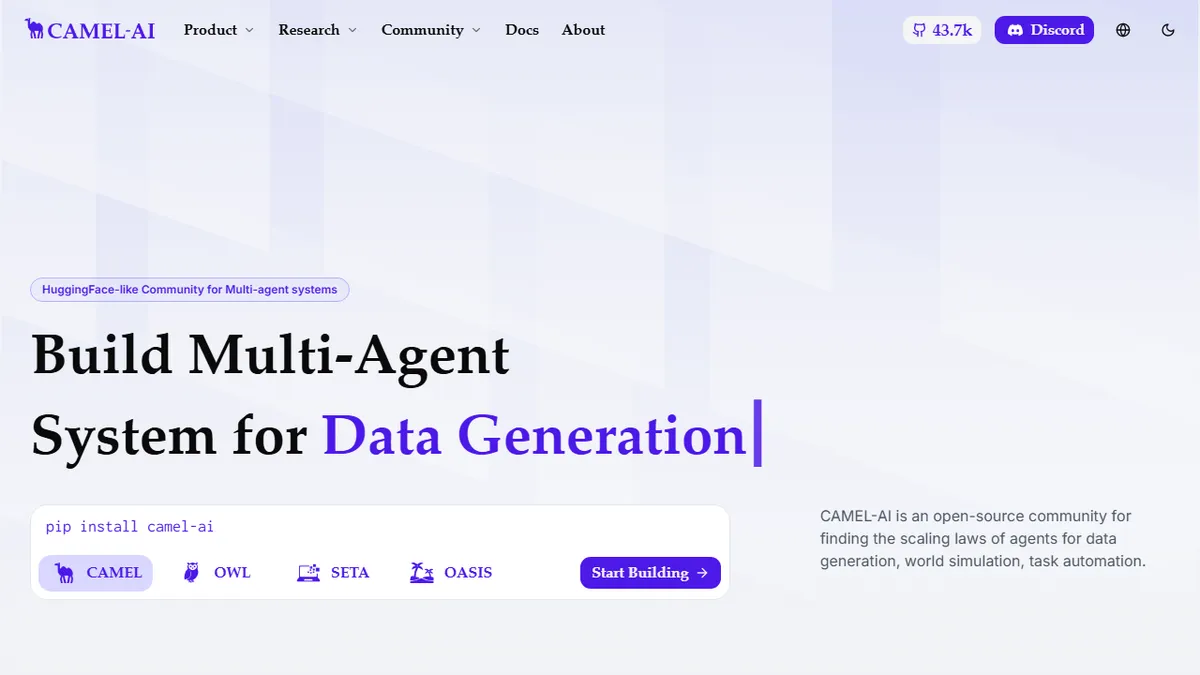
CAMEL-AI is a research-driven, open-source framework for building multi-agent AI systems where roles, hierarchies, and long-horizon tasks are first-class concepts. Originating from the influential CAMEL paper on role-playing agents, the project has grown into a full toolkit covering agent communication, planning, tool use, observability, evaluation, and reinforcement learning hooks. It ships as a Python package (`pip install camel-ai`) and plugs into 40+ model providers including OpenAI, Anthropic, Gemini, and a long tail of open-weights models.
The headline use case is synthetic data generation and agent workforces: CoT generators, self-improving pipelines, and simulated workforces aimed at producing the kind of training data that powers post-training and fine-tuning at scale. That positioning makes it more interesting to researchers and ML engineers than to product developers shipping a chatbot; teams like Databricks and Microsoft have used it for model-training workflows, and contributors include researchers from MIT, Stanford, and CMU.
It is genuinely open source and free to use, with the usual caveat that you pay for whichever underlying LLM APIs you call. Compared to LangGraph, AutoGen, or CrewAI, CAMEL leans harder into the data-generation and simulation angle and ships a deeper research surface (benchmarks, datasets, papers) rather than a polished SDK for production agents.
CAMEL is one of the more academically serious agent frameworks, and it shows: the data-generation and simulation tooling is unusually deep. If your endgame is training or evaluating models, it's a stronger fit than the LangGraph/CrewAI crowd. If you just want a customer-facing agent, look elsewhere.
— The AI Tool Bible editorial team
Pros
- ✅ Genuinely open source with a large active research community
- ✅ Strong focus on synthetic data and multi-agent simulation, not just chat agents
- ✅ Supports 40+ LLM providers out of the box
- ✅ Backed by published research, benchmarks, and reproducible datasets
Cons
- ⚠️ Research-flavored API; less polished than production-focused agent SDKs
- ⚠️ Steeper learning curve for non-ML engineers
- ⚠️ Documentation can lag fast-moving features
Use cases
Frequently asked
- What is the primary use case for CAMEL-AI?
- The headline use case is synthetic data generation and agent workforces, including CoT generators and simulated workforces for producing training data for post-training and fine-tuning.
- How much does CAMEL-AI cost to use?
- CAMEL-AI is free and open-source, but users must pay for the underlying LLM API calls they make through the framework.
- Which LLM providers are supported by CAMEL-AI?
- The framework plugs into over 40 model providers, including OpenAI, Anthropic, Gemini, and various open-weights models.
- Who is CAMEL-AI best suited for?
- It is best for researchers and ML engineers building multi-agent simulations or generating synthetic training data at scale, rather than product developers shipping simple chatbots.
- How does CAMEL-AI compare to other agent frameworks?
- Compared to LangGraph, AutoGen, or CrewAI, CAMEL leans harder into data generation and simulation, offering a deeper research surface with benchmarks and datasets rather than a polished production SDK.
Explore related
Compare with similar tools
All in Agents →LangGraph
FeaturedStateful, graph-based agent orchestration from LangChain.
CrewAI
FeaturedPython framework for multi-agent orchestration.
Ernie Bot
Baidu's Mandarin-first ChatGPT rival, powered by the ERNIE model family
Moveworks
The enterprise AI assistant that searches, answers, and takes action across your business systems
AWS Bedrock
Build and scale generative AI applications with foundation models
Claude Agent SDK
Anthropic's official SDK for building autonomous Claude agents.