
Calmo
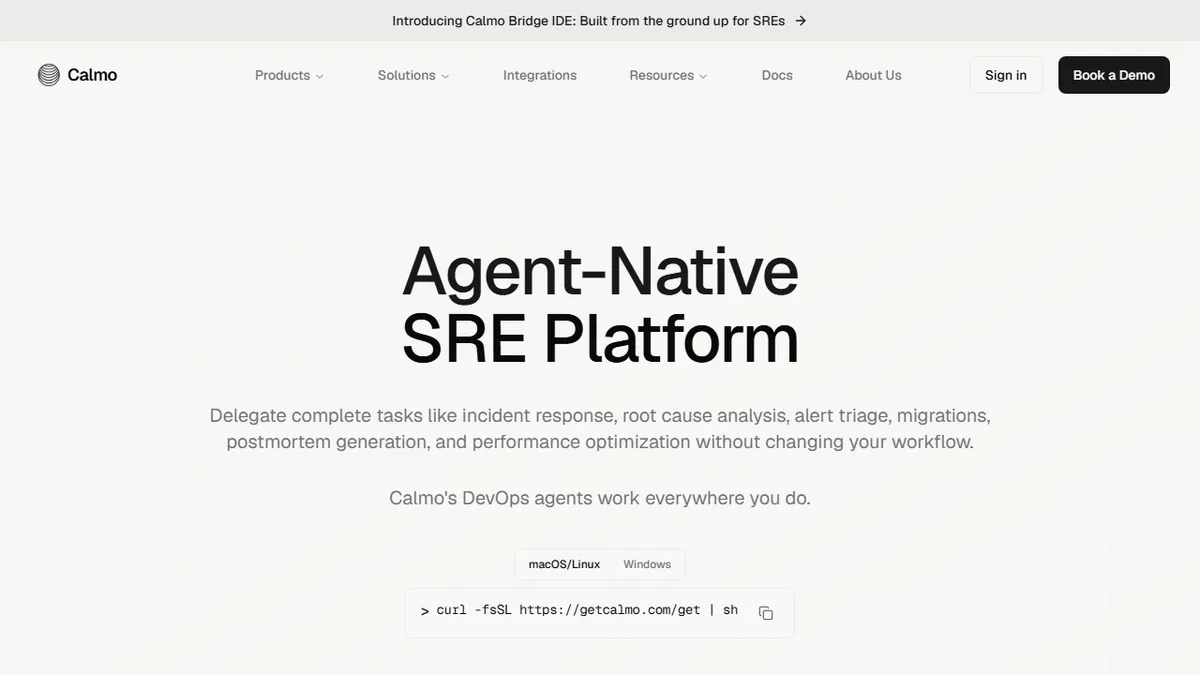
Agent-native SRE platform that runs autonomous incident response, root cause analysis, and postmortems across your existing observability stack.
In short
Calmo is an agent-native SRE platform that automates incident response, root cause analysis, and postmortems by integrating with your existing observability stack.
Pick Calmo if you run a busy on-call rotation with real observability tooling and want an agent that triages incidents and drafts postmortems before a human logs in.
Skip it if you're a solo developer, a small team without proper monitoring, or you need a transparent open-source incident bot you can self-host on day one.
Calmo is an AI agent built for site reliability engineers and on-call teams that takes over the grunt work of incident response. When an alert fires, it autonomously forms hypotheses, then tests them in parallel against your real production telemetry: logs, metrics, deployments, and source code. The output is a triaged alert with a working theory of what broke, not just a Slack ping at 3am. It also handles adjacent SRE chores like postmortem drafting, migration planning, alert triage, and performance investigations.
The pitch is that it slots into the tools you already pay for rather than replacing them. Integrations include PagerDuty, Slack, Datadog, Grafana, SigNoz, GitHub, Kubernetes, and the major clouds (AWS, GCP). Under the hood it is model-agnostic: it can route to Claude, GPT, or Gemini, and customers on stricter deployments can bring their own model. Pricing is not public; a 14-day free trial is offered and serious deals look like a sales conversation. It's aimed at mid-to-large engineering orgs feeling MTTR pain, not solo developers.
The knowledge-management angle is the more interesting bet: every investigation becomes searchable institutional memory, and custom playbooks/SOPs steer how the agent reasons. That makes it more compelling for teams with mature runbooks than for shops still writing their first one.
Calmo is one of the more credible SRE-agent plays we've seen: the parallel-hypothesis framing is the right mental model for incident work, and being model-agnostic with BYO-model is a smart hedge for enterprise buyers. We'd want to see public pricing and an API reference before recommending it beyond a pilot.
— The AI Tool Bible editorial team
Pros
- ✅ Autonomous, parallel hypothesis testing against live production data
- ✅ Model-agnostic with bring-your-own-model option for regulated deployments
- ✅ Plugs into existing stack (PagerDuty, Datadog, Grafana, GitHub, K8s)
- ✅ Turns investigations into reusable institutional knowledge
Cons
- ⚠️ No public pricing; clearly aimed at sales-led enterprise deals
- ⚠️ Value depends on having mature observability and playbooks already in place
- ⚠️ Closed source with no documented public API on the marketing site
Use cases
Frequently asked
- How much does Calmo cost?
- Calmo uses a paid model with pricing available on request. A 14-day free trial is offered, and serious deals typically require a sales conversation. It is not free for long-term use.
- Which tools does Calmo integrate with?
- It integrates with PagerDuty, Slack, Datadog, Grafana, SigNoz, GitHub, Kubernetes, and major clouds like AWS and GCP. It slots into existing observability tools rather than replacing them.
- Is Calmo suitable for solo developers?
- No, it is not recommended for solo developers or small teams without proper monitoring. It is aimed at mid-to-large engineering organizations with busy on-call rotations and mature runbooks.
- Can I use my own AI model?
- Yes, Calmo is model-agnostic. It can route to Claude, GPT, or Gemini, and customers on stricter deployments can bring their own model (BYO) for flexibility.
- What specific SRE tasks does Calmo automate?
- It handles incident response, root cause analysis, alert triage, postmortem drafting, migration planning, and performance investigations. It forms hypotheses and tests them against production telemetry.
Explore related
Compare with similar tools
All in Agents →LangGraph
FeaturedStateful, graph-based agent orchestration from LangChain.
CrewAI
FeaturedPython framework for multi-agent orchestration.
Ernie Bot
Baidu's Mandarin-first ChatGPT rival, powered by the ERNIE model family
Moveworks
The enterprise AI assistant that searches, answers, and takes action across your business systems
AWS Bedrock
Build and scale generative AI applications with foundation models
Claude Agent SDK
Anthropic's official SDK for building autonomous Claude agents.