
Browser Use
✓ Editorially verifiedOpen-source browser automation harness and cloud platform for LLM agents that drive real websites.
In short
Browser Use provides an open-source Python harness and hosted cloud infrastructure for LLM agents to control real browsers. It is best for developers building production web agents that require stealth browsing, proxy rotation, and CAPTCHA solving.
Pick Browser Use if you're building production web agents and need a battle-tested harness plus stealth browser infrastructure you don't have to maintain.
Skip it if your task is plain API scraping or a one-off automation a Playwright script could solve without an LLM in the loop.
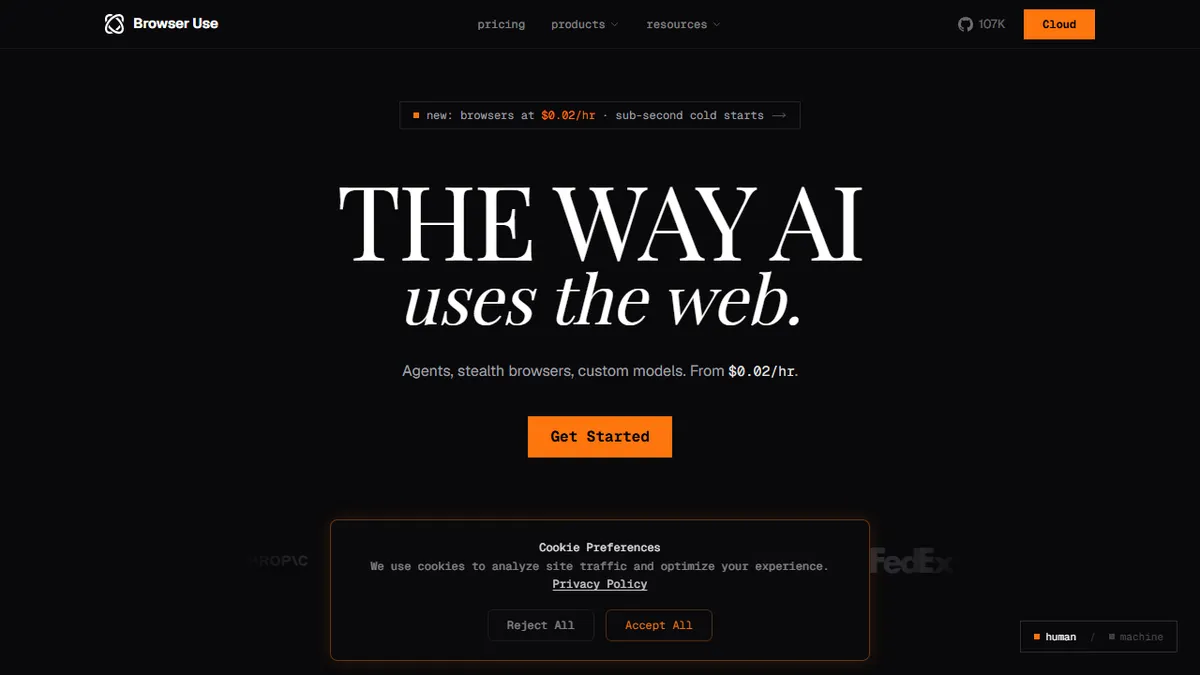
Browser Use is the infrastructure layer for AI agents that need to actually click, type, and read their way around the live web. The core is an open-source Python harness that gives any LLM a thin, self-healing toolset for controlling a real browser, paired with a hosted cloud that adds stealth Chromium instances, residential proxies across 195+ countries, CAPTCHA solving, and a managed API for kicking off agent runs at scale.
It's aimed at developers and AI teams building web agents for scraping, QA, monitoring, lead generation, and form-filling workflows where headless HTTP scraping breaks down. The free open-source library is what put the project on the map (one of the most-starred agent repos on GitHub), while the paid cloud handles the messy parts -- fingerprinting, proxy rotation, session persistence, and a 24/7 hosted 'Browser Use Box' that pairs the harness with Claude. Pricing is usage-based on the cloud side with a free tier for testing, and the company markets enterprise plans to Fortune 500 customers.
It's model-agnostic by design: you bring your own LLM (OpenAI, Anthropic, Gemini, local models via Ollama, etc.), and Browser Use exposes the DOM in a structured, token-efficient form so the agent can reason about pages without drowning in raw HTML. There's also a 'Browser Use 1' custom model trained specifically for web tasks.
The de facto open-source standard for LLM-driven browser agents right now. The harness alone is worth adopting; the cloud is the easiest way to skip the soul-crushing work of running stealth Chromium at scale. Just budget carefully -- token spend plus proxy minutes add up.
— The AI Tool Bible editorial team
Pros
- ✅ Open-source core with a large, active community
- ✅ Model-agnostic: works with OpenAI, Anthropic, Gemini, or local LLMs
- ✅ Hosted stealth browsers and proxies handle anti-bot defenses
- ✅ Structured DOM representation keeps token costs reasonable
- ✅ Backed by serious funding and Fortune 500 adoption
Cons
- ⚠️ Cloud pricing scales fast for high-volume agent runs
- ⚠️ Agents still drift or loop on complex multi-step flows
- ⚠️ Stealth/proxy use lives in a legal grey area for many sites
Use cases
Frequently asked
- Is Browser Use open source?
- Yes, the core is an open-source Python harness that gives LLMs a toolset for controlling a real browser. It is one of the most-starred agent repos on GitHub.
- Which LLMs are supported?
- The tool is model-agnostic, allowing you to bring your own LLM such as OpenAI, Anthropic, Gemini, or local models via Ollama. It also offers a custom 'Browser Use 1' model trained for web tasks.
- What is included in the cloud platform?
- The hosted cloud adds stealth Chromium instances, residential proxies across 195+ countries, CAPTCHA solving, and a managed API for scaling agent runs.
- What are the pricing tiers?
- Pricing is freemium with a free tier for testing. Paid plans include Dev at $29, Business at $299, and Scaleup at $999, with usage-based pricing on the cloud side.
Explore related
Compare with similar tools
All in Agents →LangGraph
FeaturedStateful, graph-based agent orchestration from LangChain.
CrewAI
FeaturedPython framework for multi-agent orchestration.
Ernie Bot
Baidu's Mandarin-first ChatGPT rival, powered by the ERNIE model family
Moveworks
The enterprise AI assistant that searches, answers, and takes action across your business systems
AWS Bedrock
Build and scale generative AI applications with foundation models
Claude Agent SDK
Anthropic's official SDK for building autonomous Claude agents.