
BrainSoup
Windows desktop app for building teams of specialized AI agents that collaborate through chat.
In short
BrainSoup is a Windows-only desktop client that allows users to create teams of specialized AI agents that collaborate via chat. It is best for solo operators and small teams seeking a scriptable, persistent AI workspace that supports both cloud and local models.
Pick BrainSoup if you want a cheap, scriptable Windows desktop home for a team of specialized AI agents that can mix cloud and local LLMs.
Skip it if you need a cross-platform or server-side agent framework, a hosted API, or enterprise-grade governance and audit features.
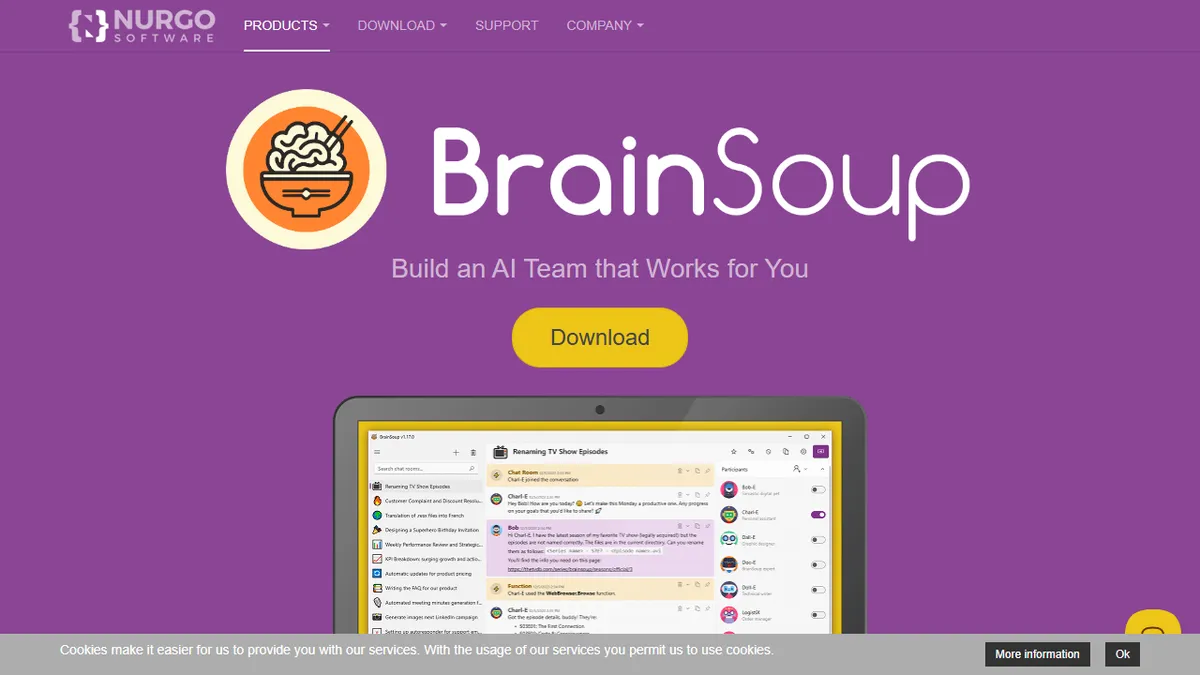
BrainSoup is a Windows desktop client from Nurgo Software that lets you spin up multiple specialized AI agents and have them work together inside natural-language conversations. Each agent has its own persona, memory, and toolset, and can browse the web, send emails, process images and audio, generate or edit media, call APIs, and run scripts. Under the hood it talks to cloud LLMs like OpenAI's ChatGPT and Mistral, and it can also point at local models for users who want to keep data on-device.
What differentiates BrainSoup from a generic ChatGPT wrapper is its multi-agent orchestration and its low-code extensibility: behaviors and tools are defined in plain text files and scripts in any language, with no SDK to learn. It's pitched at solo operators and small teams (developers, marketers, PMs, founders, students) who want a persistent AI workspace on the desktop rather than another browser tab. Pricing starts at $5/month with no commitment, which is unusually cheap for a multi-agent platform.
The app is Windows-only and proprietary, and the public site is light on technical detail (no documented HTTP API, no Mac/Linux build). Buyers should treat it as a personal/SMB productivity tool rather than an enterprise agent platform, but the combination of local-LLM support, scripting hooks, and a $5 entry point makes it a credible pick for tinkerers.
BrainSoup is a refreshingly pragmatic take on multi-agent AI: a Windows app, a $5 subscription, and text-file configuration instead of yet another Python framework. It won't replace LangChain for engineers building production systems, but for power users who want a personal AI ops room on their PC it's one of the more interesting low-friction options we've seen.
— The AI Tool Bible editorial team
Pros
- ✅ Multi-agent collaboration with persistent memory built in
- ✅ Supports both cloud LLMs and local models for privacy
- ✅ Low-code extensibility via plain text files and any scripting language
- ✅ Cheap entry point at $5/month with no commitment
Cons
- ⚠️ Windows desktop only, no Mac or Linux build
- ⚠️ Closed source with limited public technical documentation
- ⚠️ No clearly documented public HTTP API
- ⚠️ Small vendor with modest ecosystem compared to LangChain or AutoGen
Use cases
Frequently asked
- What operating systems does BrainSoup support?
- BrainSoup is a Windows-only desktop application. There are no Mac or Linux builds available.
- How much does BrainSoup cost?
- The service uses a freemium model with pricing starting at $5 per month with no commitment.
- Can BrainSoup use local AI models?
- Yes, BrainSoup can point at local models for users who want to keep data on-device, in addition to using cloud LLMs like OpenAI's ChatGPT and Mistral.
- How are agents and tools configured in BrainSoup?
- Behaviors and tools are defined in plain text files and scripts in any language, offering low-code extensibility without requiring a specific SDK.
- Is BrainSoup suitable for enterprise use?
- It is pitched at solo operators and small teams rather than as an enterprise agent platform, as it lacks enterprise-grade governance and audit features.
Explore related
Compare with similar tools
All in Agents →LangGraph
FeaturedStateful, graph-based agent orchestration from LangChain.
CrewAI
FeaturedPython framework for multi-agent orchestration.
Ernie Bot
Baidu's Mandarin-first ChatGPT rival, powered by the ERNIE model family
Moveworks
The enterprise AI assistant that searches, answers, and takes action across your business systems
AWS Bedrock
Build and scale generative AI applications with foundation models
Claude Agent SDK
Anthropic's official SDK for building autonomous Claude agents.