Axtary
Content authorization and payload-binding for AI agents
Platform, security, and applied-AI teams putting Claude, OpenAI, Cursor, or MCP-based agents in front of code repos, chat, ticketing, and cloud APIs who need per-action human approval that cannot be tampered with post-hoc.
Solo developers running local scripts, teams whose agents only read data, or anyone looking for an agent-building framework — Axtary governs agents, it does not generate content or orchestrate them.
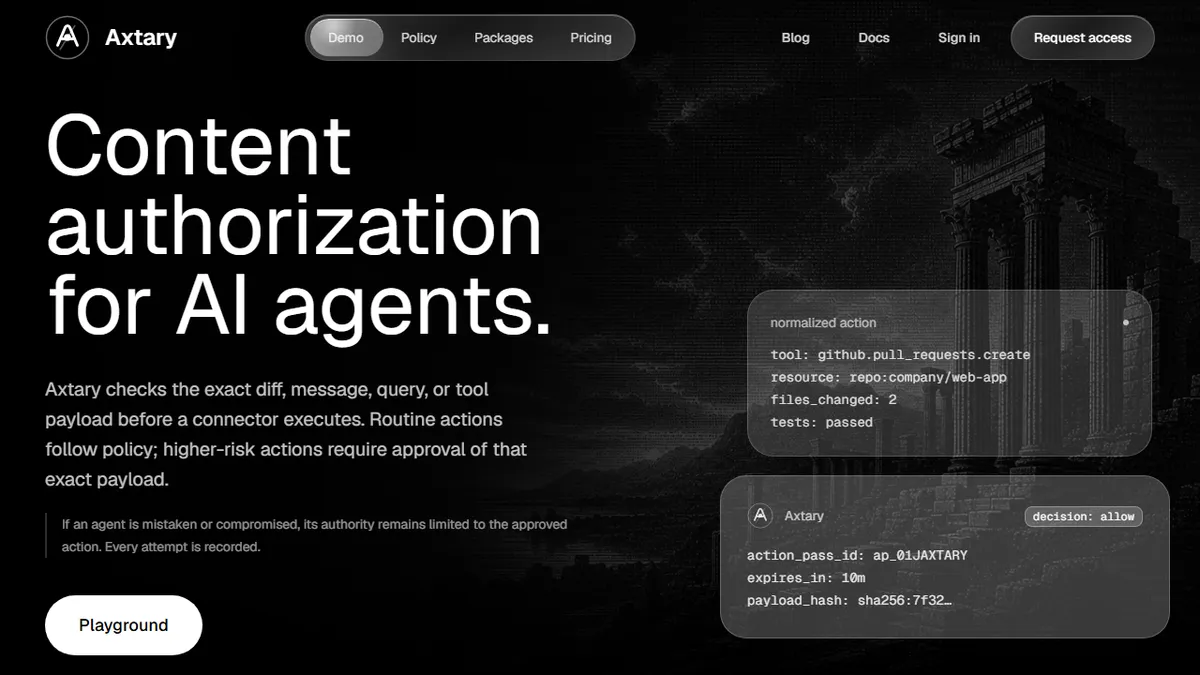
Axtary is a security and governance layer that sits between AI agents and the systems they act on, checking the exact diff, message, query, or tool payload before a connector executes. Rather than trusting a model to only do what a human just approved, Axtary cryptographically hashes each proposed action and binds the approval to that specific payload — if the agent later tries to execute a modified request, the runtime rejects it and logs the mismatch to an audit ledger. The platform ships as npm packages, a CLI, a local proxy, and runtime integrations for Anthropic Claude, OpenAI, and Cursor, plus MCP (Model Context Protocol) server governance. Policies are expressed in Cedar or Rego, so teams can codify who may approve what, on which connectors, at what blast radius. Out-of-the-box connectors cover the systems agents typically touch in real work — GitHub, Slack, Linear, Jira, AWS, Google Cloud — meaning teams can drop Axtary in front of an existing agent stack without rebuilding tool wrappers. Typical users are platform, security, and applied-AI teams deploying agents that write code, post in channels, file tickets, or provision cloud resources, and who need a defensible answer to 'a human approved *what* exactly?' before shipping past a pilot. The free Local tier lets a developer run the full policy-check pipeline in their own environment with no account; the paid Founding Team tier layers on hosted approvals, a team dashboard, and shared evidence for one agreed non-production workflow after a 30-day pilot.
This is the kind of infrastructure that most agent projects skip until an incident forces the conversation. Binding approval to a payload hash is a genuinely stronger primitive than the usual 'the model said yes, so we did it' pattern, and Cedar/Rego is the right choice over another bespoke DSL. The $499 gap to hosted approvals will scare off tinkerers, but for a team about to point an agent at production GitHub or AWS, that is not the expensive number in the equation.
— The AI Tool Bible editorial team
Pros
- ✅ Cryptographic payload binding means approval cannot be reused for a different, silently-modified action
- ✅ Policy layer speaks Cedar and Rego — standard authorization languages security teams already know
- ✅ Connectors for GitHub, Slack, Linear, Jira, AWS, and GCP cover most agent action surfaces out of the box
- ✅ Governs MCP servers, which is where a lot of agent tool sprawl actually lives right now
- ✅ Free Local tier runs entirely in the developer's environment with no account required
- ✅ Explicit 30-day pilot with no billing obligation lowers the risk of evaluating on a real workflow
- ✅ Full audit ledger of attempts and mismatches gives incident responders something concrete to review
Cons
- ⚠️ Adds an approval and verification hop into every agent action, which will slow high-throughput autonomous loops
- ⚠️ $499/month jump from Free to Founding Team is steep for solo builders or hobby projects
- ⚠️ Hosted approvals and dashboard are gated to the paid tier, limiting free-tier utility for teams
- ⚠️ Value depends on writing and maintaining Cedar/Rego policies — teams without that muscle will underuse it
- ⚠️ Younger product with a small published connector catalog compared to general-purpose IAM or SIEM stacks
Use cases
Explore related
Compare with similar tools
All in Agents →LangGraph
FeaturedStateful, graph-based agent orchestration from LangChain.
CrewAI
FeaturedPython framework for multi-agent orchestration.
Ernie Bot
Baidu's Mandarin-first ChatGPT rival, powered by the ERNIE model family
Moveworks
The enterprise AI assistant that searches, answers, and takes action across your business systems
AWS Bedrock
Build and scale generative AI applications with foundation models
Claude Agent SDK
Anthropic's official SDK for building autonomous Claude agents.