
Amazon SageMaker
AWS's end-to-end platform for building, training, and deploying machine learning models and AI agents at enterprise scale.
In short
Amazon SageMaker provides an end-to-end environment for the full machine learning lifecycle, including data management, model training, and deployment. It is best suited for AWS-native enterprises requiring governed infrastructure for ML and emerging agent workflows.
Pick Amazon SageMaker if you are an AWS-native team that needs one governed platform for data, training, deployment, and emerging agent workflows.
Skip it if you want a turnkey agent builder or a lightweight model playground without an AWS commitment.
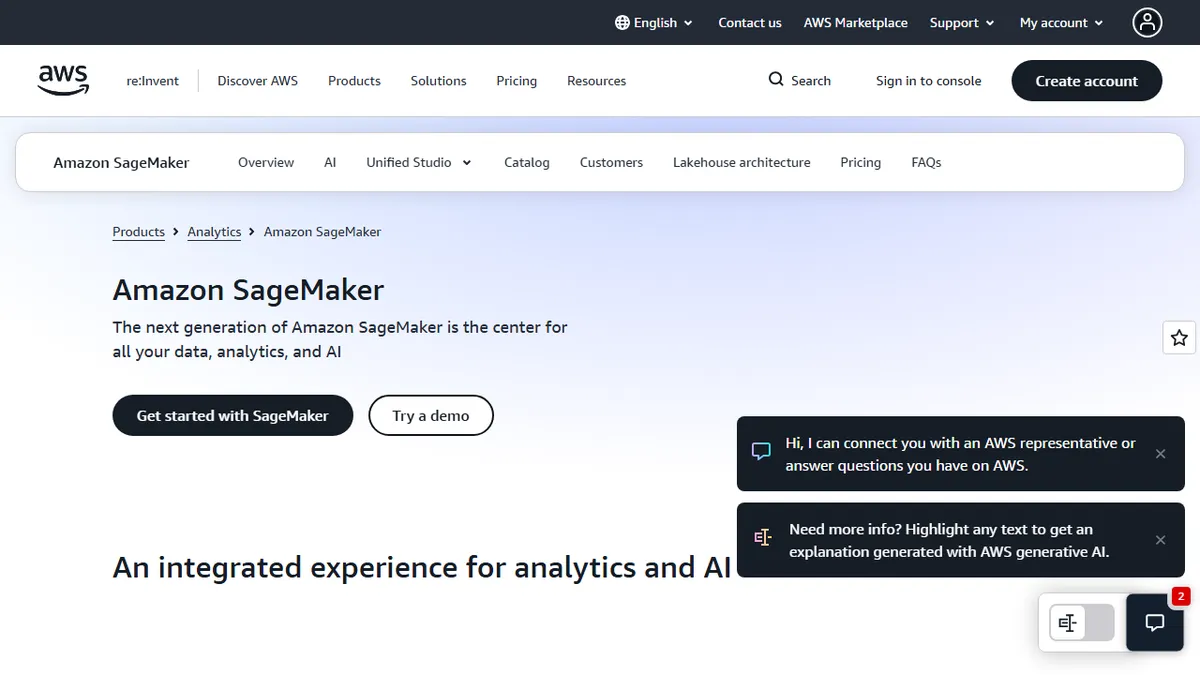
Amazon SageMaker is AWS's flagship managed service for the full machine learning lifecycle, now repositioned as a unified hub spanning data, analytics, and AI. The platform bundles SageMaker AI for model training and deployment, Unified Studio as a single IDE for data and ML work, a governance Catalog built on DataZone, and a lakehouse layer that federates S3, Redshift, and third-party sources. HyperPod handles distributed training for foundation models, JumpStart provides one-click deployment of popular open and proprietary models, and built-in MLOps tooling covers pipelines, monitoring, and governance.
It is squarely aimed at enterprises already living inside AWS who need ML infrastructure that talks natively to IAM, VPCs, S3, and Redshift. Pricing is pure pay-as-you-go across notebook instances, training jobs, inference endpoints, and storage, which gets expensive fast if you leave endpoints running but scales cleanly for batch workloads. The recent push into agentic workflows surfaces in Unified Studio's built-in AI assistant (Amazon Q Developer) and notebook agents, though SageMaker is still more of a platform for building your own agents than a turnkey agent product.
Integrations span the entire AWS catalog plus Hugging Face, MLflow, and major open-source frameworks (PyTorch, TensorFlow, JAX). The main caveat is complexity: SageMaker is a sprawling collection of sub-services with overlapping names, and onboarding rewards teams who already have an AWS-fluent platform engineer on staff.
SageMaker is the obvious default for ML inside AWS, and the Unified Studio rebrand has finally tied its many parts together. It is not the fastest way to ship a single agent, but for enterprises that need governance, scale, and tight cloud integration it remains the safe long-term bet.
— The AI Tool Bible editorial team
Pros
- ✅ Deep native integration with the rest of AWS (S3, IAM, Redshift, VPC)
- ✅ Covers the full ML lifecycle from notebooks to distributed training to inference
- ✅ HyperPod and JumpStart make foundation-model work tractable at scale
- ✅ Enterprise-grade governance, observability, and access control built in
Cons
- ⚠️ Sprawling, overlapping sub-services with a steep learning curve
- ⚠️ Costs can balloon quickly if endpoints or notebooks are left running
- ⚠️ Heavier and less opinionated than newer agent-specific platforms
Use cases
Frequently asked
- Who is Amazon SageMaker designed for?
- It is aimed at enterprises already using AWS that need ML infrastructure integrating natively with services like IAM, VPCs, S3, and Redshift. It is particularly useful for teams with AWS-fluent platform engineers.
- What components are included in the SageMaker platform?
- The platform bundles SageMaker AI for training and deployment, Unified Studio as a single IDE, a governance Catalog built on DataZone, and a lakehouse layer. It also includes HyperPod for distributed training and JumpStart for model deployment.
- How is Amazon SageMaker priced?
- Pricing is pay-as-you-go across notebook instances, training jobs, inference endpoints, and storage. A free tier is available for new AWS accounts, though costs can increase if endpoints remain running.
- Does SageMaker support AI agent development?
- Yes, it supports agentic workflows through Unified Studio's built-in AI assistant and notebook agents. However, it is primarily a platform for building custom agents rather than a turnkey agent product.
- What are the main drawbacks of using SageMaker?
- The platform is complex with sprawling sub-services and a steep learning curve. It is heavier and less opinionated than newer agent-specific platforms, and costs can balloon if resources are not managed carefully.
Explore related
Compare with similar tools
All in Agents →LangGraph
FeaturedStateful, graph-based agent orchestration from LangChain.
CrewAI
FeaturedPython framework for multi-agent orchestration.
Ernie Bot
Baidu's Mandarin-first ChatGPT rival, powered by the ERNIE model family
Moveworks
The enterprise AI assistant that searches, answers, and takes action across your business systems
AWS Bedrock
Build and scale generative AI applications with foundation models
Claude Agent SDK
Anthropic's official SDK for building autonomous Claude agents.