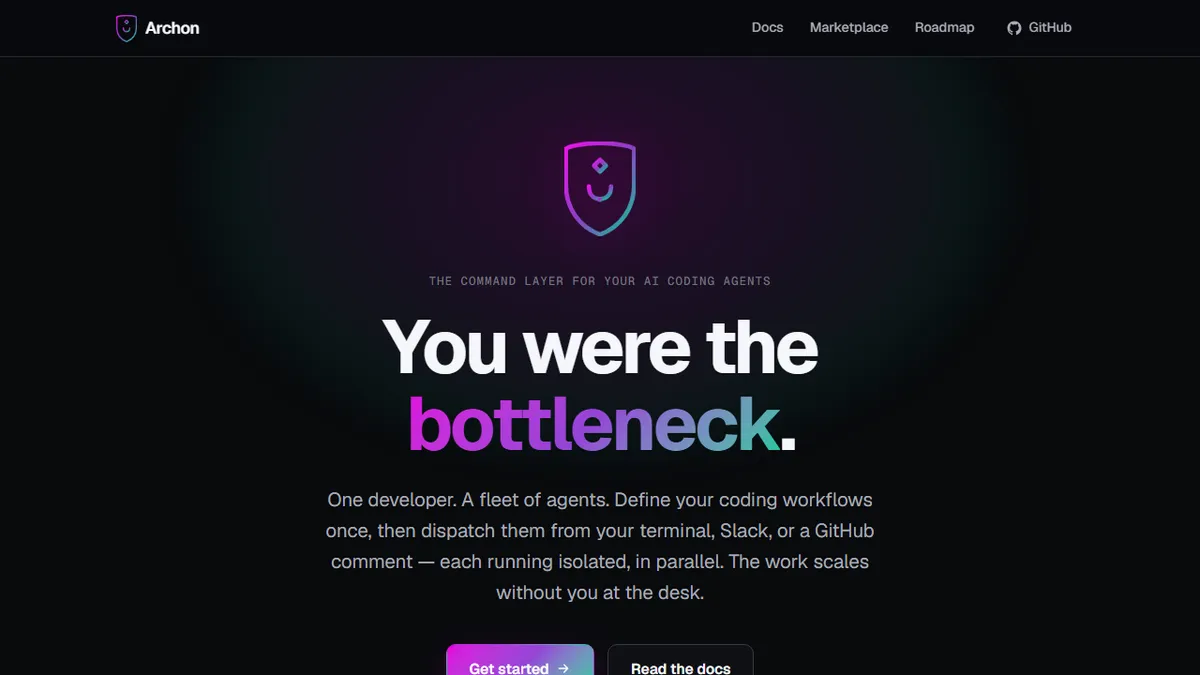

Archon
Open-source orchestration layer for running multiple AI coding agents in parallel git worktrees.
In short
Archon is a free, open-source tool that orchestrates multiple AI coding agents in parallel git worktrees. It lets you run complex YAML-defined workflows across isolated branches to speed up development.
Pick Archon if you want to fan out multiple coding agents across isolated git worktrees and trigger codified workflows from chat or CI.
Skip it if you just want a single in-editor AI assistant or aren't ready to self-host and pay for parallel model calls.
Archon is a self-hosted command layer for dispatching AI coding agents like Claude Code and Codex across isolated git worktrees, so several agents can grind on the same repo concurrently without stepping on each other. Workflows are defined once in YAML as directed acyclic graphs with loops and conditions, then triggered from a terminal, web UI, Slack, Telegram, or a GitHub comment.
It is aimed at engineers who have outgrown single-agent IDE plugins and want to fan out tasks (e.g. five bug-fix attempts, a refactor + tests + docs pipeline) across worktrees and then cherry-pick the best result. Pricing is free and open source; you run it on your own machine, bring your own model API keys, and Archon handles the worktree bookkeeping and dispatch surface.
The per-workflow model selection means you can route cheap planning steps to one model and expensive coding steps to another. Caveat: like most worktree-based orchestrators, it inherits the operational tax of managing many concurrent branches and the API spend that comes with running agents in parallel.
Archon is the right shape for teams that have already accepted agents as part of their dev loop and now need to scale them safely. The git-worktree-per-run design is the unglamorous detail that actually makes parallel agents usable. Just be honest about the API bill before you crank up concurrency.
— The AI Tool Bible editorial team
Pros
- ✅ Each run gets its own git worktree, so parallel agents never collide
- ✅ YAML DAG workflows with loops and conditions, version-controllable
- ✅ Dispatch from terminal, web, Slack, Telegram, or GitHub comments
- ✅ Model-agnostic: mix Claude, Codex, and others per workflow step
- ✅ Free, open source, self-hosted in under a minute
Cons
- ⚠️ Self-hosting and worktree management add operational overhead
- ⚠️ Parallel agent runs multiply API spend quickly
- ⚠️ Requires comfort with YAML and CLI workflows, not a polished IDE plugin
Use cases
Frequently asked
- How much does Archon cost?
- Archon is free and open source. You must self-host it on your own machine and bring your own model API keys, meaning you pay for the underlying model usage rather than a subscription fee.
- Which AI models does Archon support?
- It supports multi-model dispatch, including Claude Code and Codex. You can configure per-workflow model selection to route specific steps, like planning or coding, to different models based on cost or capability.
- How do I trigger workflows in Archon?
- Workflows are defined in YAML and can be triggered from a terminal, web UI, Slack, Telegram, or a GitHub comment. This allows you to initiate codified agent runs from various chat or CI environments.
- Is Archon suitable for single-agent IDE users?
- No, skip it if you just want a single in-editor AI assistant. Archon is designed for engineers who need to fan out multiple agents across isolated git worktrees and are ready to self-host.
- What are the main operational challenges?
- It inherits the operational tax of managing many concurrent branches. Additionally, running agents in parallel increases API spend, so you need to be prepared for the costs associated with multiple simultaneous model calls.
Explore related
Compare with similar tools
All in Agents →LangGraph
FeaturedStateful, graph-based agent orchestration from LangChain.
CrewAI
FeaturedPython framework for multi-agent orchestration.
Ernie Bot
Baidu's Mandarin-first ChatGPT rival, powered by the ERNIE model family
Moveworks
The enterprise AI assistant that searches, answers, and takes action across your business systems
AWS Bedrock
Build and scale generative AI applications with foundation models
Claude Agent SDK
Anthropic's official SDK for building autonomous Claude agents.