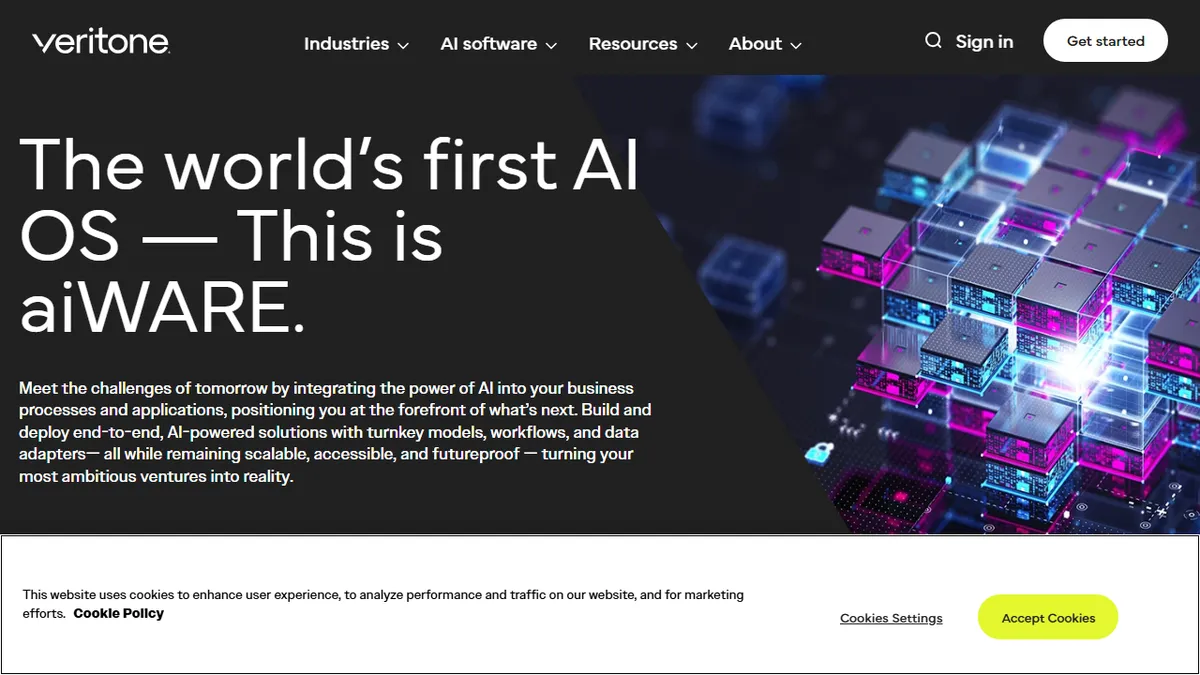

Veritone aiWARE
Enterprise AI operating system that orchestrates hundreds of cognitive engines through low-code workflows.
In short
Veritone aiWARE acts as an enterprise AI operating system that orchestrates over 300 cognitive engines through low-code workflows. It is best for public-sector and large commercial teams needing compliant, multi-model data orchestration.
Pick Veritone aiWARE if you are an enterprise or public-sector team that needs to compose many AI engines under one compliant, auditable platform.
Skip it if you want a single specialized model, transparent pricing, or a self-serve developer experience.
Veritone aiWARE bills itself as an AI operating system for enterprises that need to wire AI into existing data and business processes. It ingests structured and unstructured data from a wide range of sources, runs it through 300+ cognitive engines spanning vision, speech, text, audio, biometrics, and generative AI, and lets teams build automations in Automate Studio, a drag-and-drop low-code builder. An Intelligent Data Lake, GraphQL/REST APIs, and an aiWARE Hub for multi-environment deployment round out the platform.
This is firmly an enterprise play, not a developer side-project. The audience is government, legal, media, and large commercial buyers who need FedRAMP and CJIS compliance, object-level security, and audit logs more than they need a slick consumer UI. Pricing is not published and is handled through sales; expect contract-level commitments rather than self-serve credit-card billing. The trade-off is breadth: instead of one specialized model, you get an orchestration layer that can swap engines and chain them together.
Integration-wise, aiWARE is built to sit on top of whatever AI vendors you already use, with lifecycle management and real-time monitoring across deployments. The caveat is that platforms this broad demand committed implementation effort, and the low-code label hides real architectural decisions about data ingestion, engine selection, and governance.
aiWARE is the kind of platform that makes sense when procurement and compliance matter more than benchmark scores. The cognitive-engine marketplace approach is genuinely useful for media and government workloads, but you are signing up for a sales-led rollout, not a weekend prototype.
— The AI Tool Bible editorial team
Pros
- ✅ Orchestrates hundreds of cognitive engines across vision, speech, text, and generative AI
- ✅ FedRAMP and CJIS compliant with object-level security and audit logs
- ✅ Low-code Automate Studio plus GraphQL and REST APIs for developers
- ✅ Multi-deployment via aiWARE Hub with lifecycle monitoring
Cons
- ⚠️ Enterprise-only pricing with no public tier or self-serve sign-up
- ⚠️ Breadth over depth - not a specialist model for any single task
- ⚠️ Implementation overhead is significant despite the low-code framing
Use cases
Frequently asked
- What types of data and AI engines does Veritone aiWARE support?
- The platform ingests structured and unstructured data and runs it through more than 300 cognitive engines spanning vision, speech, text, audio, biometrics, and generative AI.
- Is Veritone aiWARE suitable for government or regulated industries?
- Yes, it is designed for government, legal, and media buyers, offering FedRAMP and CJIS compliance, object-level security, and audit logs.
- How do users build automations on the platform?
- Teams use Automate Studio, a drag-and-drop low-code builder, to create automations, while developers can utilize GraphQL and REST APIs.
- Is there a free trial or self-serve pricing option?
- No, the platform has enterprise-only pricing handled through sales with no public tier, self-serve sign-up, or free trial.
Explore related
Compare with similar tools
All in Agents →LangGraph
FeaturedStateful, graph-based agent orchestration from LangChain.
CrewAI
FeaturedPython framework for multi-agent orchestration.
Ernie Bot
Baidu's Mandarin-first ChatGPT rival, powered by the ERNIE model family
Moveworks
The enterprise AI assistant that searches, answers, and takes action across your business systems
AWS Bedrock
Build and scale generative AI applications with foundation models
Claude Agent SDK
Anthropic's official SDK for building autonomous Claude agents.