AI-Flow
Visual node-based builder for chaining OpenAI, Anthropic, Replicate and other model APIs into content pipelines.
In short
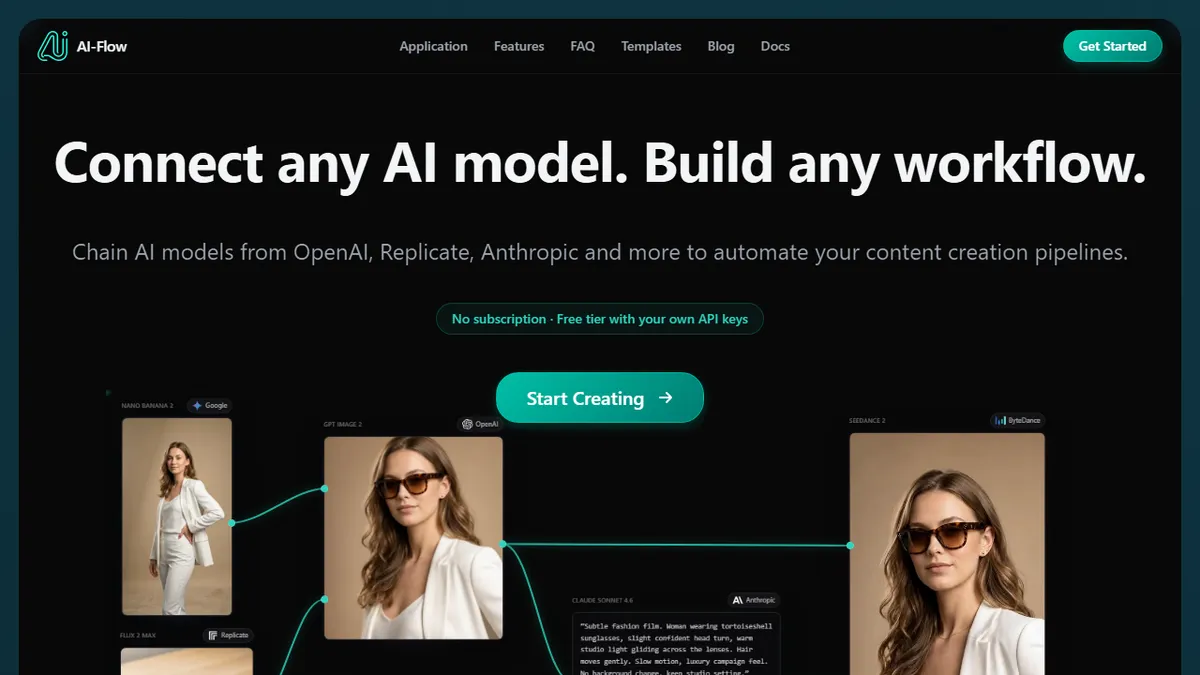
AI-Flow allows users to wire together 30+ AI models from various providers into a single visual graph. It is best for content marketers and developers who need to automate multimodal generation workflows using their own API keys without writing Python code.
Pick AI-Flow if you want a visual canvas to chain image, video, and text models from multiple providers using your own API keys.
Skip it if you need a code-first agent framework, complex tool-use orchestration, or a mature plugin marketplace.
AI-Flow is an open-source workflow builder that lets you wire together 30+ AI models from OpenAI, Anthropic, Google, Replicate, and xAI into a single visual graph. Instead of writing glue code to coordinate GPT, Claude, Gemini, Seedance, and image/video models, you drag nodes onto a canvas, connect outputs to inputs, and ship a reproducible pipeline for tasks like product videos, storyboard-to-cinematic clips, image animation, or mockup generation.
The pitch is BYOK-first: bring your own provider API keys and pay the underlying vendors directly, or buy platform credits if you want a managed experience. The free tier gives 25 welcome credits and 20 free runs per day on BYOK nodes, which is generous enough to prototype a real pipeline before committing. It's aimed at content marketers, creative ops, and developers who want LangChain-style orchestration without a Python codebase, and the templates lean heavily toward visual content production rather than text-only RAG.
The project is open source on GitHub (DahnM20/ai-flow), so self-hosting is on the table if you'd rather avoid the hosted SaaS. Webhook and API integration is built in for triggering flows from other systems, and the hosted version handles storage retention (7 days free, 30 days paid). It sits in the same category as tools like Flowise and n8n's AI nodes, with a stronger bias toward multimodal generation workflows.
A pragmatic visual orchestrator for the multimodal era - especially strong if you're already paying OpenAI, Anthropic, and Replicate directly and just want a canvas to wire them together. The BYOK economics and open-source repo make it a safer bet than closed credit-only competitors, though the templates betray a clear bias toward generative media over text RAG.
— The AI Tool Bible editorial team
Pros
- ✅ Open source with self-host option via GitHub
- ✅ BYOK model avoids platform markup on API costs
- ✅ Visual node canvas covers 30+ models in one graph
- ✅ Generous free tier with no credit card required
- ✅ Webhook/API hooks for triggering flows externally
Cons
- ⚠️ Paid plan pricing not transparent on the landing page
- ⚠️ Templates skew toward media generation, less RAG/text focus
- ⚠️ Smaller ecosystem than n8n or Flowise
Use cases
Frequently asked
- Which AI model providers does AI-Flow support?
- The platform supports over 30 models from providers including OpenAI, Anthropic, Google, Replicate, and xAI. Users can connect these models within a single visual graph.
- How does the pricing and credit system work?
- AI-Flow operates on a freemium model where users can bring their own API keys to pay vendors directly or use platform credits. The free tier includes 25 welcome credits and 20 daily runs on BYOK nodes.
- Is AI-Flow open source and can it be self-hosted?
- Yes, the project is open source on GitHub, allowing users to self-host the application if they prefer to avoid the hosted SaaS version.
- What types of workflows is AI-Flow best suited for?
- It is designed for multimodal generation workflows such as product videos, storyboard-to-cinematic clips, and image animation. It is less focused on text-only RAG or complex tool-use orchestration.
- Can AI-Flow be integrated with other systems?
- Yes, the tool includes built-in webhook and API integration features that allow users to trigger flows from external systems.
Explore related
Compare with similar tools
All in Agents →LangGraph
FeaturedStateful, graph-based agent orchestration from LangChain.
CrewAI
FeaturedPython framework for multi-agent orchestration.
Ernie Bot
Baidu's Mandarin-first ChatGPT rival, powered by the ERNIE model family
Moveworks
The enterprise AI assistant that searches, answers, and takes action across your business systems
AWS Bedrock
Build and scale generative AI applications with foundation models
Claude Agent SDK
Anthropic's official SDK for building autonomous Claude agents.