Nyamuru Manga Name Studio vs Rember
A side-by-side look at pricing, capabilities, pros, cons, and our editorial scores.
Nyamuru Manga Name Studio Writing | 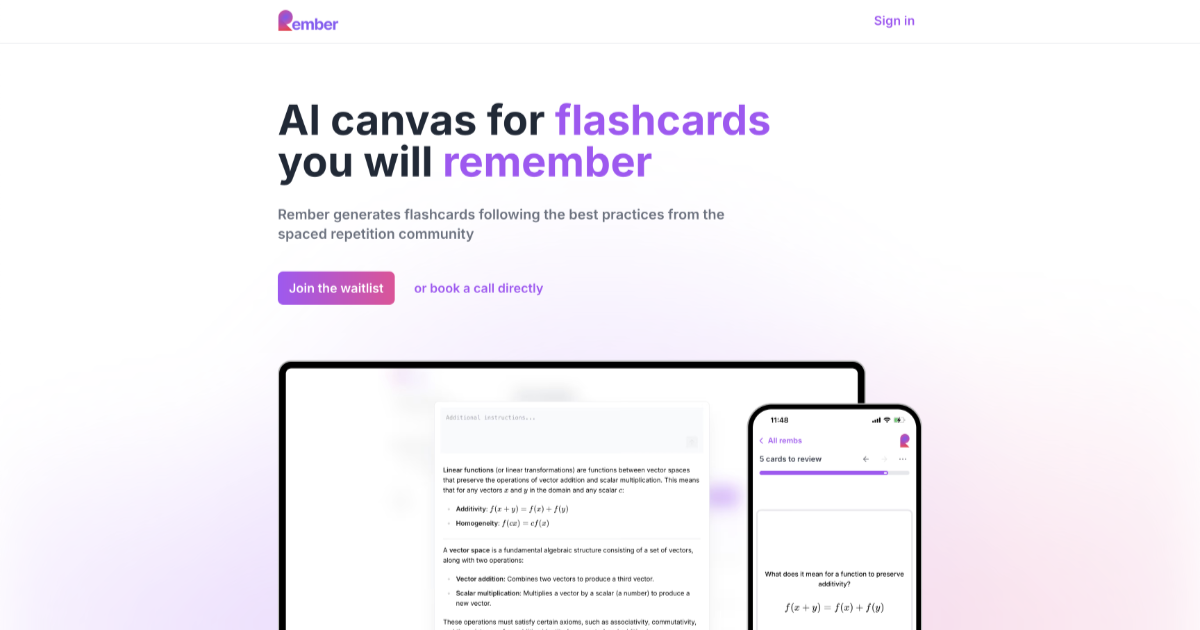 Rember Writing | |
|---|---|---|
| Tagline | Open-source PWA for drafting manga storyboards (ネーム) with LLM-ready prompts and a structured OMNY data format. | AI flashcard generator that turns PDFs, videos, and chats into spaced-repetition decks. |
| Category | Writing | Writing |
| Pricing | Free· Free and open source (MIT License). No paid tiers; users bring their own LLM if they want to use the included AI prompts. | Freemium· Free up to 30 AI notes/mo; Pro $8/mo for 1,000 notes |
| Model | Model-agnostic (BYO LLM — prompts designed for ChatGPT, Claude, Gemini, or local models) | Multi-model |
| Editorial score | — | 7.0 / 10 |
| Use cases | Drafting manga storyboards (ネーム) from a prose scriptConverting light-novel scenes into structured panel layouts via an LLMIterating page compositions using NDM v10 pattern templatesRound-tripping storyboards as OMNY YAML between toolsOffline manga name editing for studios with no-cloud policiesBuilding custom manga-production pipelines on top of an open formatTeaching manga storyboarding with a structured, diffable format | flashcard generationspaced repetitionstudy aidpdf-to-notesvideo-to-notes |
| Pros |
|
|
| Cons |
|
|
| Website | sa-san10.github.io | rember.com |
Pick Nyamuru Manga Name Studio if
- ✅ Fully open source under MIT, including code, prompts, docs, and original assets
- ✅ Runs as a single standalone HTML file with offline PWA support and local-storage auto-save
- ✅ Ships a rigorous structured format (NDM v10 / OMNY YAML) so storyboards are diffable and pipeline-friendly
- ✅ Includes ready-made LLM prompts that convert prose manuscripts into typed manga-name YAML
Pick Rember if
- ✅ Eliminates the worst part of SRS: hand-authoring cards
- ✅ Native MCP hooks into Claude and ChatGPT for inline capture
- ✅ Modern FSRS scheduling, not legacy SM-2
- ✅ Offline PWA with cross-device sync