Forefront vs Ray Tune
A side-by-side look at pricing, capabilities, pros, cons, and our editorial scores.
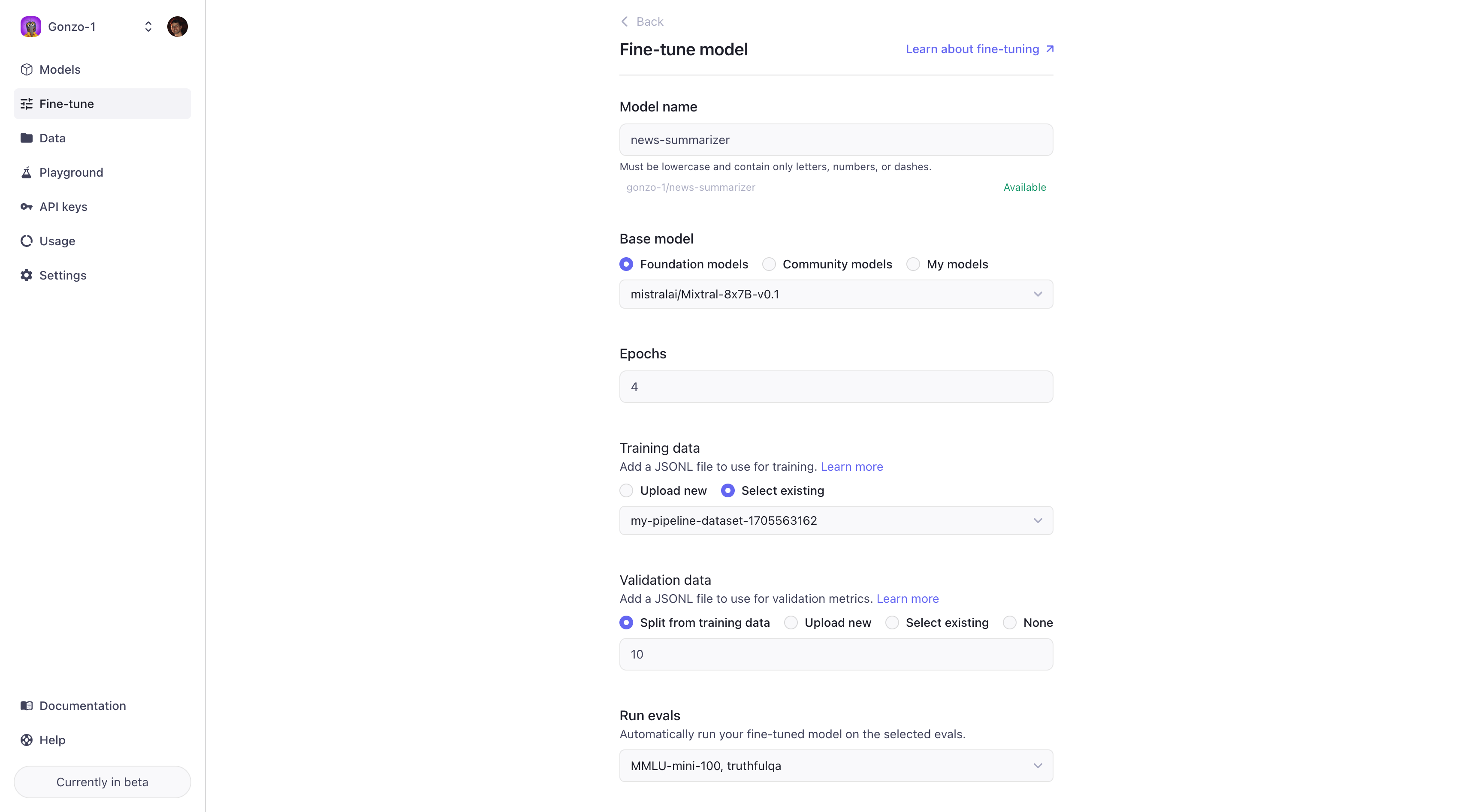 Forefront Fine-tuning | Ray Tune Fine-tuning | |
|---|---|---|
| Tagline | Fine-tune and serve open-source LLMs on your own data without managing GPUs. | Open-source Python library for distributed hyperparameter tuning at any scale. |
| Category | Fine-tuning | Fine-tuning |
| Pricing | Paid· Basic: $20 · Pro: $50 · Enterprise: Contact sales | Free· Open-source (Apache 2.0); managed via Anyscale offers a $100 starting credit |
| Model | Multi-model (Mistral-7B, Mixtral, Phi-2) | — |
| Editorial score | 7.0 / 10 | 8.1 / 10 |
| Use cases | fine-tuningopen-source-llmsmodel-hostinginference-apimodel-evaluation | hyperparameter-tuningdistributed-trainingmodel-selectionpopulation-based-trainingearly-stopping |
| Pros |
|
|
| Cons |
|
|
| Website | forefront.ai | docs.ray.io |
Pick Forefront if
- ✅ End-to-end workflow: data, training, eval, and inference in one platform
- ✅ No GPU provisioning — serverless scaling with per-token pricing
- ✅ Built-in benchmarks (MMLU, TruthfulQA, HumanEval) for fine-tune evaluation
- ✅ Model export lets you take fine-tuned weights to self-hosted infra
Pick Ray Tune if
- ✅ Scales the same code from a laptop to a multi-node GPU cluster
- ✅ Built-in PBT, ASHA, HyperBand plus Optuna/Ax/BOHB integrations
- ✅ Framework-agnostic: PyTorch, TF/Keras, XGBoost, Transformers
- ✅ Fault-tolerant with automatic checkpointing and trial resumption