
UltraRAG
Low-code, YAML-driven RAG pipeline orchestrator with a visual UI for building and demoing retrieval systems.
In short
UltraRAG is a low-code, open-source framework for building retrieval-augmented generation pipelines. It is best for RAG engineers who want a transparent, self-hosted alternative to black-box SaaS tools, offering YAML-based orchestration and a visual interface for debugging and demos.
Pick UltraRAG if you want a transparent, self-hosted RAG orchestrator with a visual UI and YAML-driven loops, not a hosted black box.
Skip it if you need a managed SaaS RAG service with SLAs, or you'd rather build directly on LangChain/LlamaIndex's larger ecosystem.
UltraRAG 3.0 is an open-source retrieval-augmented generation framework from OpenBMB that packages data governance, pipeline orchestration, and live demos into a single tool. Workflows are defined in YAML and support serial, loop, and conditional structures, so you can describe multi-step RAG behaviors (rewrite, retrieve, rerank, generate, critique) without writing glue code. A visual interface sits on top for managing knowledge bases, wiring up the pipeline graph, and demoing the resulting system to stakeholders.
It is aimed at RAG engineers and research teams who want something more transparent than a black-box SaaS but more turnkey than assembling LangChain or LlamaIndex from scratch. The project leans on OpenBMB's own MiniCPM-Embedding-Light and AgentCPM-Report models for the reference stack, but the pipeline approach is model-agnostic. Because it's GitHub-hosted under OpenBMB/UltraRAG, you self-host it; there's no SaaS pricing.
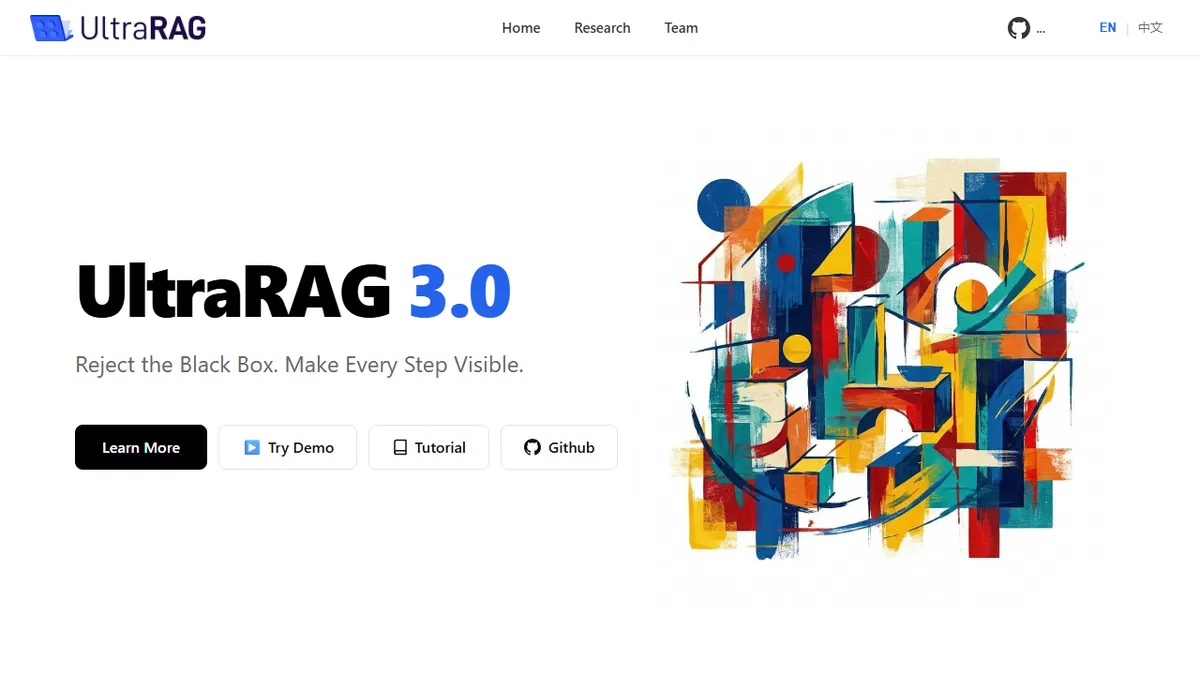
The headline pitch is the slogan "Reject the Black Box. Make Every Step Visible" - every retrieval, rerank, and generation step is inspectable, which is genuinely useful for debugging hallucinations and tuning recall. Best treated as a framework rather than a finished product: expect to bring your own infra, GPU, and integration work.
A serious open-source alternative to closed RAG platforms, with the right instincts: YAML pipelines, visual debugging, and inspectable steps. Best for teams that already have GPUs and want to own the stack - less appropriate if you wanted someone else to run it for you.
— The AI Tool Bible editorial team
Pros
- ✅ Fully open source under OpenBMB - no vendor lock-in
- ✅ YAML pipelines support loops and conditionals, not just linear chains
- ✅ Visual UI for knowledge-base management and demoing
- ✅ Transparent step-by-step inspection of every retrieval and generation call
Cons
- ⚠️ Self-hosted only - you bring the infra and GPU
- ⚠️ Reference stack leans on OpenBMB's own MiniCPM models
- ⚠️ Smaller ecosystem and community than LangChain/LlamaIndex
- ⚠️ Docs are research-flavored; production hardening is on you
Use cases
Frequently asked
- Is UltraRAG a hosted service or do I need to self-host it?
- UltraRAG is an open-source framework that must be self-hosted. There is no SaaS pricing, and users are responsible for providing their own infrastructure and GPU resources.
- How are workflows defined in UltraRAG?
- Workflows are defined using YAML files that support serial, loop, and conditional structures. This allows users to describe multi-step RAG behaviors like rewriting, retrieving, and generating without writing glue code.
- Does UltraRAG support models other than OpenBMB's own?
- Yes, the pipeline approach is model-agnostic. While the reference stack uses MiniCPM-Embedding-Light and AgentCPM-Report, users can bring their own LLMs to the system.
- What is the main advantage of UltraRAG over other RAG tools?
- Its primary advantage is transparency, allowing every retrieval, rerank, and generation step to be inspected. This visibility is useful for debugging hallucinations and tuning recall, unlike black-box SaaS solutions.
Explore related
Compare with similar tools
All in RAG →Pinecone
FeaturedManaged vector database for production-scale similarity search.
LlamaIndex
FeaturedData framework for connecting LLMs to your data.
Elasticsearch Vector Search
Hybrid vector + keyword search in the enterprise-grade Elasticsearch engine
Snowflake Cortex
Generative AI and RAG built into the Snowflake data cloud
DataStax Astra DB
Serverless vector and document database for production RAG and AI agents
MongoDB Atlas Vector Search
Vector search built into the operational database you're already using.