
Superduper
Enterprise AI agent orchestration that brings RAG and agents to your existing data stack without migration.
In short
Superduper deploys AI agents and RAG directly within your existing data infrastructure, eliminating the need for separate vector stores. It is best suited for enterprises seeking agentic automation across departments like HR and Finance without data migration.
Pick Superduper if you're an enterprise wanting agentic RAG over the data warehouse and SaaS tools you already run, without standing up a new vector DB.
Skip it if you're a solo dev or small team that just needs a hosted RAG API and doesn't want to negotiate an enterprise contract or self-host.
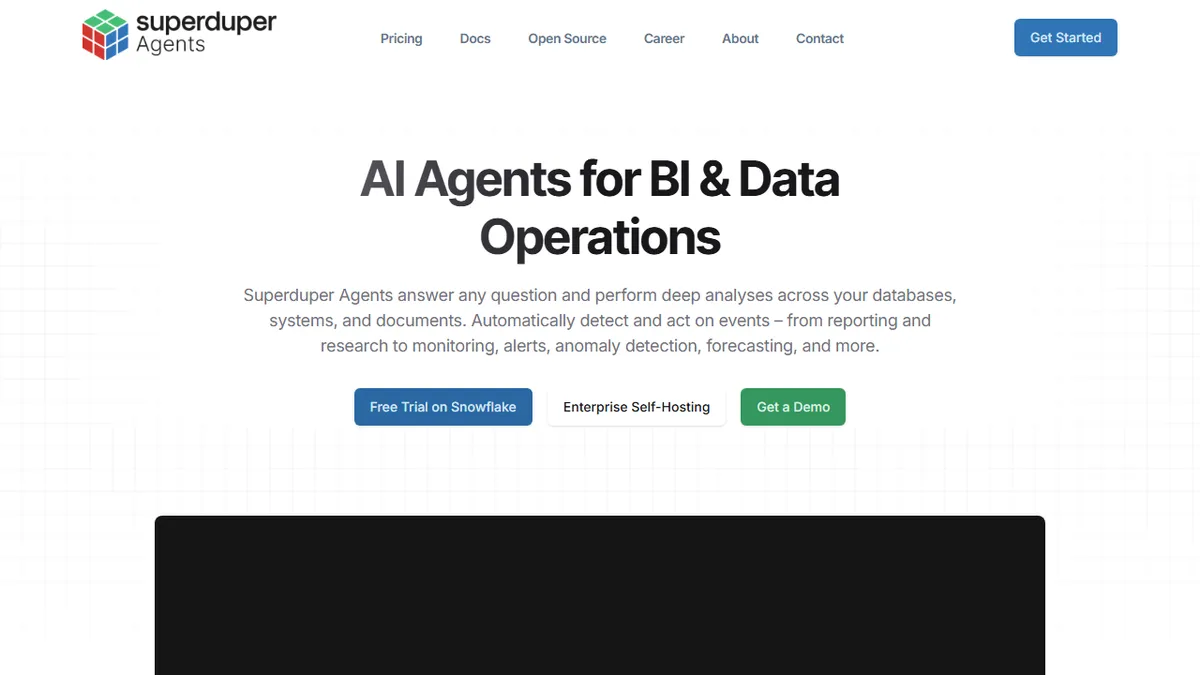
Superduper is an enterprise platform for deploying AI agents and in-database RAG across structured and unstructured data without forcing a migration to a new vector store or warehouse. The core pitch is orchestration: it sits on top of your existing systems, generates vector embeddings in place, and lets agents execute multi-step workflows like reporting, anomaly detection, forecasting, key-value extraction, and object detection across departments.
It is aimed squarely at enterprises that already have data sprawl across Salesforce, Jira, HubSpot, Slack and similar tools (40+ integrations advertised) and want agentic automation for HR, Finance, Legal, Product, and Customer Success teams. There is an open-source core on GitHub and a free trial via the Snowflake Marketplace, but real deployments are self-hosted or enterprise-tier with pricing on request. It is model-agnostic rather than tied to a specific LLM vendor.
The interesting differentiator is the in-database RAG pattern: instead of ETLing your data into a separate vector DB, Superduper turns the database you already use into the retrieval layer for your agents. That is attractive if you're allergic to yet another data copy, less attractive if you want a turnkey hosted SaaS.
Superduper's in-database RAG angle is genuinely useful for enterprises tired of shuffling data into yet another vector store. The open-source repo gives you an escape hatch, but the polished product is clearly aimed at procurement-driven buyers, not weekend hackers. Worth a look if your data already lives in Snowflake or similar.
— The AI Tool Bible editorial team
Pros
- ✅ In-database RAG avoids copying data into a separate vector store
- ✅ Open-source core with enterprise self-hosting path
- ✅ 40+ enterprise integrations (Salesforce, Jira, HubSpot, Slack)
- ✅ Model-agnostic agent orchestration across departments
Cons
- ⚠️ Pricing opaque; real deployments are enterprise-contract
- ⚠️ Marketing is heavy on buzzwords, light on concrete model details
- ⚠️ Self-hosting bias means more ops work than a hosted SaaS
Use cases
Frequently asked
- Does Superduper require migrating data to a new vector database?
- No, Superduper uses an in-database RAG pattern that generates vector embeddings in place. It turns your existing database into the retrieval layer for agents, avoiding the need to ETL data into a separate vector store.
- Which enterprise tools does Superduper integrate with?
- The platform advertises over 40 integrations, including Salesforce, Jira, HubSpot, and Slack. It is designed to handle data sprawl across these SaaS tools for various business departments.
- Is Superduper tied to a specific LLM provider?
- No, Superduper is model-agnostic. It allows for agent orchestration without being tied to a specific LLM vendor, supporting a multi-model approach.
- How is Superduper priced and deployed?
- Superduper offers a free trial on the Snowflake Marketplace and has an open-source core on GitHub. However, real deployments are typically self-hosted or enterprise-tier, with pricing available on request.
- What types of workflows can Superduper agents execute?
- Agents can execute multi-step workflows such as reporting, anomaly detection, forecasting, key-value extraction, and object detection. These capabilities are aimed at automating tasks for HR, Finance, Legal, Product, and Customer Success teams.
Explore related
Compare with similar tools
All in RAG →Pinecone
FeaturedManaged vector database for production-scale similarity search.
LlamaIndex
FeaturedData framework for connecting LLMs to your data.
Elasticsearch Vector Search
Hybrid vector + keyword search in the enterprise-grade Elasticsearch engine
Snowflake Cortex
Generative AI and RAG built into the Snowflake data cloud
DataStax Astra DB
Serverless vector and document database for production RAG and AI agents
MongoDB Atlas Vector Search
Vector search built into the operational database you're already using.