
STORM
Stanford's open-source research agent that turns a topic into a Wikipedia-style article with citations.
In short
STORM is a self-hostable, MIT-licensed Python package that synthesizes web sources into structured, cited long-form articles. It is best for researchers and writers needing auditable, grounded reports rather than polished narrative prose.
Pick STORM if you need a transparent, self-hostable agent that turns a topic into a cited long-form report you can audit and extend.
Skip it if you want a polished narrative essay, a one-click consumer chatbot, or a managed SaaS with SLAs and team features.
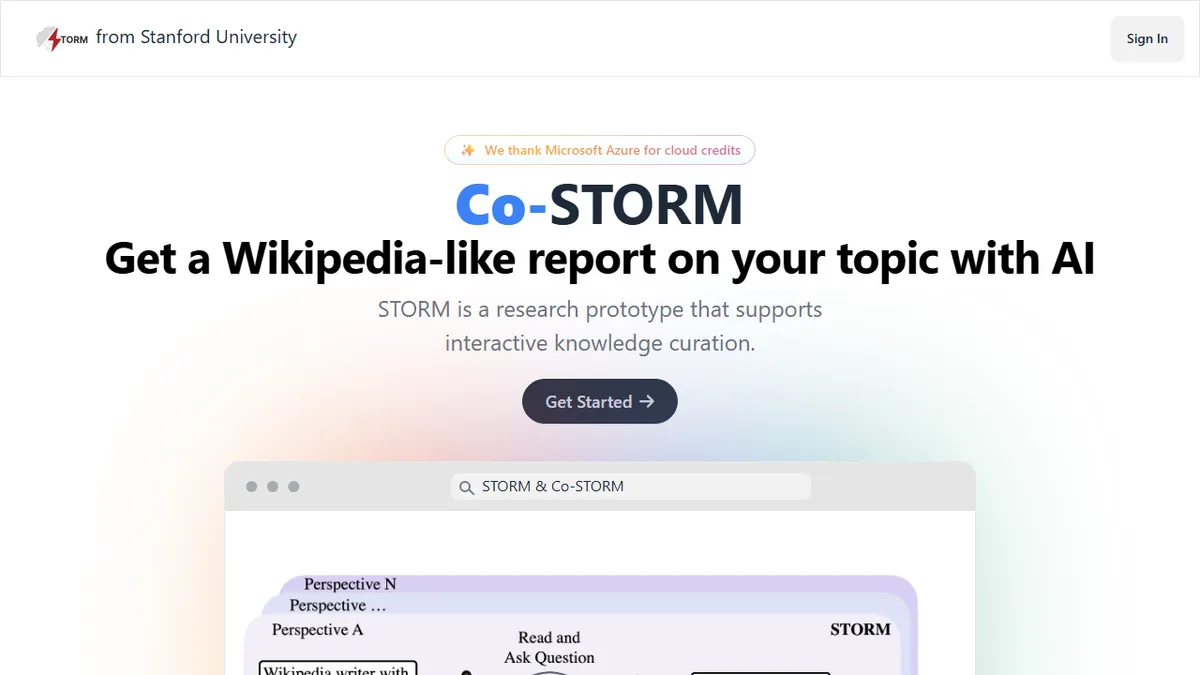
STORM (Synthesis of Topic Outlines through Retrieval and Multi-perspective Question Asking) is a knowledge-curation system from Stanford OVAL that takes a single topic prompt and produces a full long-form report with inline citations. It works in two phases: a pre-writing stage where it searches the web, simulates multi-perspective expert conversations, and builds an outline; and a writing stage where it drafts a structured article grounded in the gathered sources. A free hosted preview lives at storm.genie.stanford.edu, and a Co-STORM variant adds a human-in-the-loop mind map for collaborative research sessions.
It is best understood as a research-grade alternative to consumer 'deep research' features, aimed at writers, analysts, students, and Wikipedia-style contributors who care about traceable sources more than slick prose. The hosted demo is free with terms-of-service signup; the real product is the MIT-licensed Python package (`pip install knowledge-storm`) built on DSPy, which lets you swap in your own LLM provider via LiteLLM and your own retriever (Bing, You.com, Tavily, DuckDuckGo, or a local VectorRM over your documents). Running it seriously means bringing your own API keys and paying for search and model calls.
The trade-off is honest: outputs are encyclopedic and dense rather than narrative, hallucinations and citation drift still occur, and the hosted preview can be slow or queue-limited under load. But as a self-hostable, model-agnostic agent for grounded long-form synthesis, there is little else with comparable academic provenance.
STORM is one of the few 'deep research' systems where you can actually read the code and swap the model. The hosted preview is a fine taste-test, but the real value is the Python package as scaffolding for your own grounded-writing pipelines. Treat its drafts as well-sourced first drafts, not final copy.
— The AI Tool Bible editorial team
Pros
- ✅ Genuinely open source (MIT) and model-agnostic via LiteLLM
- ✅ Produces structured, cited reports rather than freeform prose
- ✅ Co-STORM adds human-in-the-loop collaboration with a mind map
- ✅ Pluggable retrievers including a local VectorRM for private docs
- ✅ Backed by Stanford OVAL with active research publications
Cons
- ⚠️ Hosted demo is gated and can be slow or unavailable
- ⚠️ Output reads like Wikipedia, not like polished editorial writing
- ⚠️ Self-hosting requires Python plus your own LLM and search API keys
- ⚠️ Citations can still drift; outputs need human verification
Use cases
Frequently asked
- Is STORM free to use?
- A hosted demo is available for free with a terms-of-service signup. The open-source Python package is free to install, but self-hosting requires you to pay for your own LLM and search API calls.
- What type of content does STORM produce?
- It produces full long-form reports with inline citations that are encyclopedic and dense in style, similar to Wikipedia articles, rather than polished narrative essays.
- Can I use my own AI models and search engines with STORM?
- Yes, the system is model-agnostic via LiteLLM, allowing you to swap in your own LLM provider. It also supports pluggable retrievers such as Bing, You.com, Tavily, DuckDuckGo, or a local VectorRM.
- Does STORM support collaborative research?
- Yes, a variant called Co-STORM adds a human-in-the-loop mind map to facilitate collaborative research sessions.
Explore related
Compare with similar tools
All in Writing →Claude
FeaturedAnthropic's flagship assistant for long-form writing, analysis, and coding.
GPT-4o
FeaturedOpenAI's multimodal flagship behind ChatGPT.
Gemini Advanced
Google's flagship — strong at math, long context, and Workspace integration.
Llama 3
Meta's open-weights LLM family that put serious frontier-adjacent models in everyone's hands.
Qwen
Alibaba's open-weight foundation model family covering chat, vision, image generation, translation, and safety classification.
Jan
Open-source desktop ChatGPT alternative that runs local LLMs and routes to cloud providers from one app.