
SMMRY
Veteran web-based summarizer that condenses articles, books, and YouTube videos into digestible bullet points.
In short
SMMRY is a veteran web tool that converts long-form content like articles, books, and videos into concise summaries. It is best for users seeking a simple, affordable way to skim reading lists without complex LLM interfaces.
Pick SMMRY if you want a fast, cheap web tool to skim long reads, lectures, or YouTube videos without firing up a full LLM chat session.
Skip it if you need a documented summarization API, model transparency, or interactive follow-up questioning of the source material.
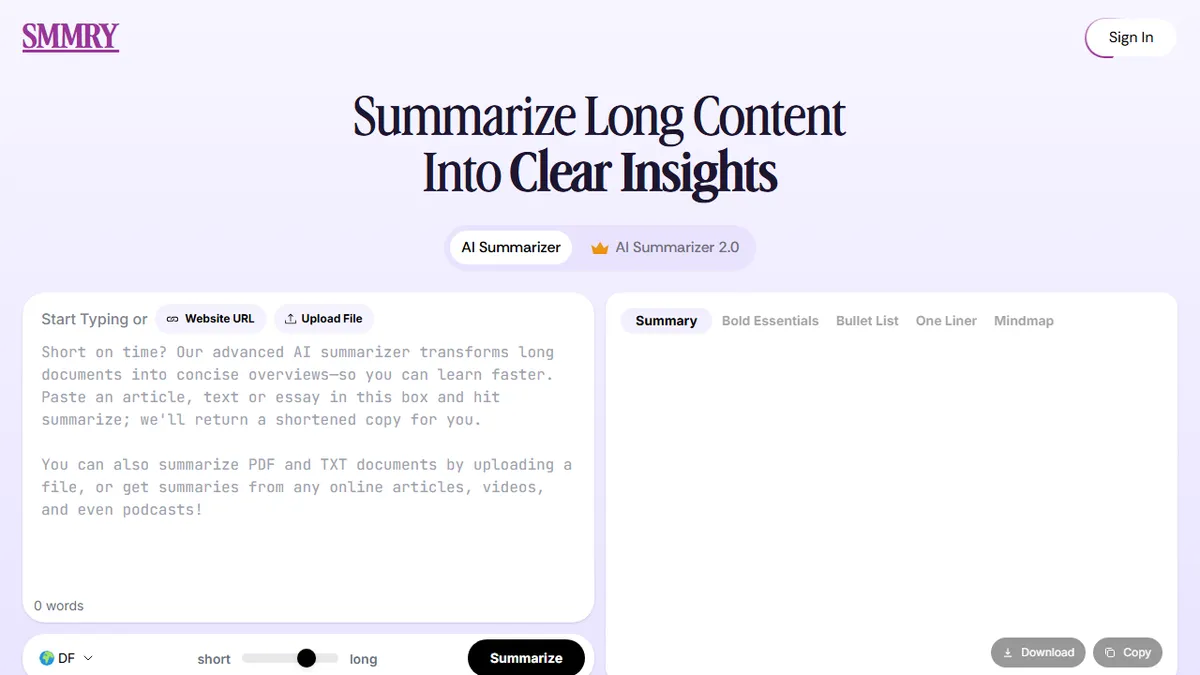
SMMRY is a long-running text summarization service that takes URLs, pasted text, or uploaded documents and returns a condensed version with the key sentences and themes preserved. It started as a classical extractive summarizer (ranking sentences by importance and trimming filler) and has since rebranded around 'AI Summarizer 2.0,' adding support for articles, books, websites, YouTube videos, podcasts, and mind-map generation.
The target audience is students, researchers, and knowledge workers who want a no-fuss way to skim long reading lists rather than developers building summarization into their own apps. Pricing is friendly: a free tier gives 10 summaries, the $7/mo Essential plan covers 20/day with a personal library, and the $13/mo Advanced plan unlocks unlimited summaries plus podcast and mind-map features. An API is referenced in the footer, though the public docs are thinner than what dedicated summarization APIs like Anthropic or OpenAI offer.
SMMRY's appeal is its simplicity and history — it was one of the original summarizer sites on the web and the UI reflects that focus. The trade-off is that it doesn't expose model choice, doesn't offer the customization or chat-style follow-ups of a modern LLM front-end, and won't satisfy anyone who wants control over tone, length, or output format beyond a basic length slider.
SMMRY is the survivor from the pre-ChatGPT summarizer era, repositioned with an AI 2.0 coat of paint. The pricing is reasonable and the multi-format support is genuinely useful, but power users will outgrow it the moment they want format control or to chat with the source.
— The AI Tool Bible editorial team
Pros
- ✅ Dead-simple interface for one-click summarization
- ✅ Handles articles, books, YouTube, and podcasts in one tool
- ✅ Genuinely useful free tier with no signup friction
- ✅ Affordable paid plans compared with full LLM subscriptions
Cons
- ⚠️ Doesn't disclose which AI model powers summaries
- ⚠️ API exists but documentation is sparse
- ⚠️ No fine-grained control over tone or format
- ⚠️ Limited compared with chat-style assistants for follow-ups
Use cases
Frequently asked
- What types of content can SMMRY summarize?
- The tool supports articles, books, websites, YouTube videos, and podcasts. It accepts URLs, pasted text, or uploaded documents to generate condensed versions with key themes preserved.
- How much does SMMRY cost?
- SMMRY offers a free tier with 10 summaries. Paid plans include Essential at $7/month billed yearly for 20 daily summaries and Advanced at $13/month billed yearly for unlimited summaries plus mind-map features.
- Does SMMRY offer an API for developers?
- An API is referenced in the footer, but the public documentation is described as thinner than dedicated summarization APIs. It is not the primary focus for developers building custom applications.
- Can I customize the tone or format of the summary?
- No, SMMRY does not offer fine-grained control over tone or output format beyond a basic length slider. It lacks the customization and chat-style follow-up capabilities of modern LLM front-ends.
Explore related
Compare with similar tools
All in Writing →Claude
FeaturedAnthropic's flagship assistant for long-form writing, analysis, and coding.
GPT-4o
FeaturedOpenAI's multimodal flagship behind ChatGPT.
Gemini Advanced
Google's flagship — strong at math, long context, and Workspace integration.
Llama 3
Meta's open-weights LLM family that put serious frontier-adjacent models in everyone's hands.
Qwen
Alibaba's open-weight foundation model family covering chat, vision, image generation, translation, and safety classification.
Jan
Open-source desktop ChatGPT alternative that runs local LLMs and routes to cloud providers from one app.