
SiteGPT
Custom GPT-powered support chatbots trained on your website content and docs.
In short
SiteGPT is a hosted platform that creates customer-support chatbots trained on your website content, sitemaps, or uploaded files. It is best for support teams seeking a quick, no-code solution with built-in lead capture and human escalation.
Pick SiteGPT if you want a turnkey, multilingual support bot trained on your docs without writing any retrieval code.
Skip it if you need self-hosting, model choice, or fine-grained control over the retrieval pipeline and prompts.
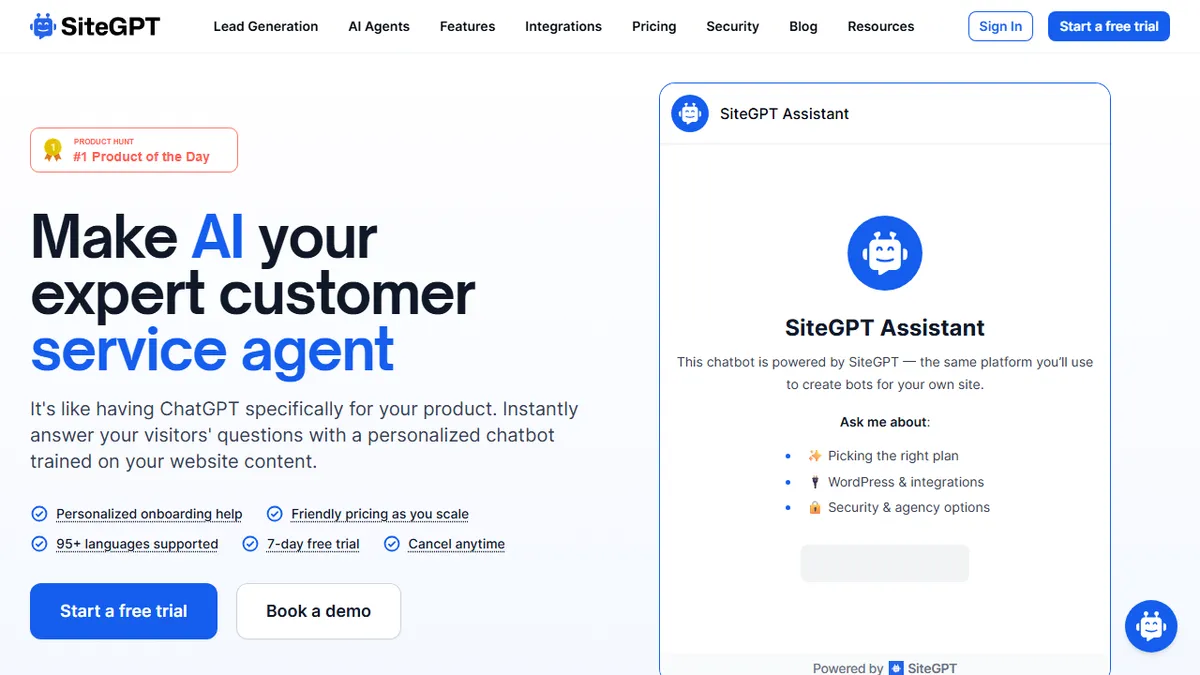
SiteGPT is a hosted platform for building customer-support chatbots trained on your own content — sitemaps, uploaded files, raw text, or help-center URLs. It crawls and embeds the source material, then serves a branded chat widget that handles 24/7 inquiries, captures leads, escalates to a human when stuck, and emails you daily conversation summaries. It supports 95+ languages and can trigger in-app actions via natural-language 'functions'.
It's aimed squarely at SMB and mid-market support teams who want a deploy-this-week alternative to building on raw OpenAI APIs. Pricing starts at $39/mo Starter (1 bot, 4k messages, 1k pages), $79/mo Growth (API access, integrations, 10k messages), $259/mo Scale (40k messages, webhooks), with Enterprise adding HIPAA/BAA and up to 10k bots. A 7-day free trial is offered and annual billing is 40% off.
Integrations cover Crisp, Slack, and Zendesk, with API and webhook access unlocked from Growth and Scale tiers respectively. The product is closed-source SaaS and the underlying model isn't disclosed on the marketing site (testimonials mention GPT-4), so teams with strict model-routing or self-hosting requirements should look elsewhere.
A pragmatic pick in the crowded 'chat with your docs' segment — the auto-refresh, handoff, and Zendesk/Crisp integrations show it's built for real support workflows rather than demos. Pricing is reasonable at the low end but the message caps and locked-down model choice mean serious teams will outgrow it.
— The AI Tool Bible editorial team
Pros
- ✅ Fast setup — point at a sitemap or upload files and ship a trained bot
- ✅ Auto-refresh keeps the index current (monthly/weekly/daily by tier)
- ✅ Solid integration set: Crisp, Slack, Zendesk, plus webhooks and API
- ✅ Human-handoff and lead capture built in, not bolted on
- ✅ Supports 95+ languages out of the box
Cons
- ⚠️ Underlying model not disclosed; no model choice or BYO-key
- ⚠️ Message caps bite quickly on the lower tiers and overage is $39/mo
- ⚠️ Closed-source SaaS — no self-hosting option
- ⚠️ API only on Growth and above; webhooks gated to Scale
Use cases
Frequently asked
- What data sources can SiteGPT use to train the chatbot?
- SiteGPT crawls and embeds source material from sitemaps, uploaded files, raw text, or help-center URLs to build its knowledge base.
- Does SiteGPT support human handoff and lead capture?
- Yes, the platform includes built-in features for capturing leads and escalating inquiries to a human agent when the bot is stuck.
- Which integrations are available?
- SiteGPT integrates with Crisp, Slack, and Zendesk. API access is included on Growth tiers, while webhooks are available on Scale and above.
- Can I self-host SiteGPT or choose my own model?
- No, SiteGPT is a closed-source SaaS product with no self-hosting option. The underlying model is not disclosed, so users cannot select specific models or use their own keys.
Explore related
Compare with similar tools
All in RAG →Pinecone
FeaturedManaged vector database for production-scale similarity search.
LlamaIndex
FeaturedData framework for connecting LLMs to your data.
Elasticsearch Vector Search
Hybrid vector + keyword search in the enterprise-grade Elasticsearch engine
Snowflake Cortex
Generative AI and RAG built into the Snowflake data cloud
DataStax Astra DB
Serverless vector and document database for production RAG and AI agents
MongoDB Atlas Vector Search
Vector search built into the operational database you're already using.