ShyEditor
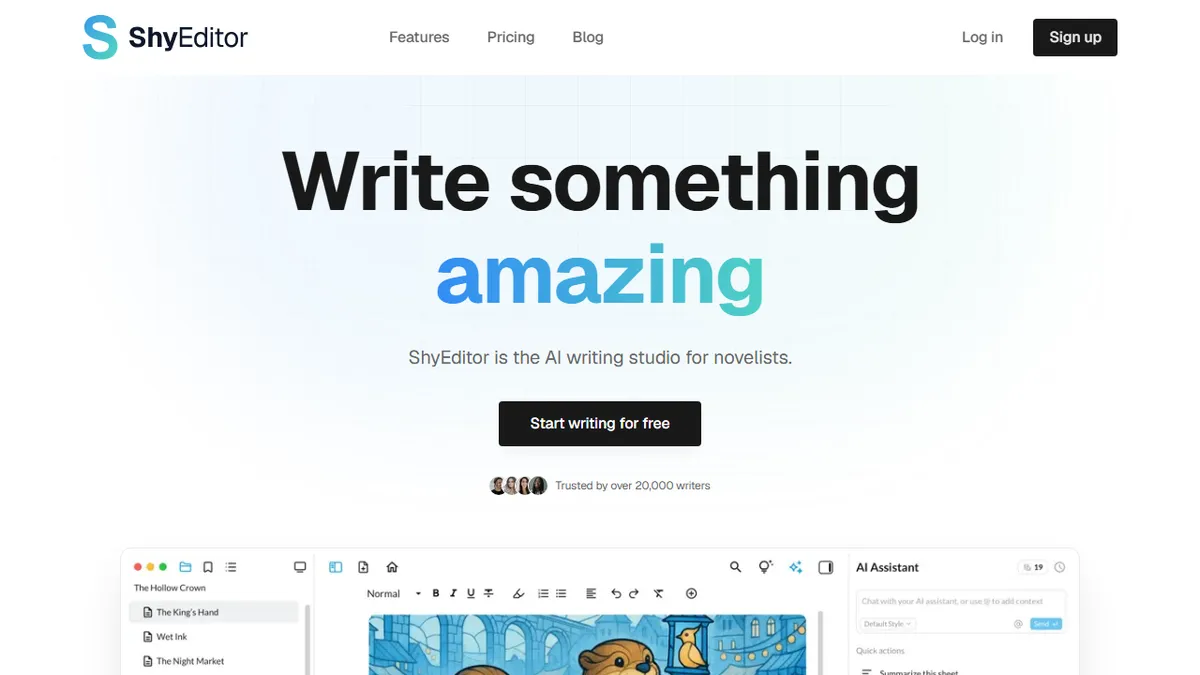
AI-native writing environment that bolts an assistant, citation manager, and knowledge base onto a distraction-free markdown editor.
In short
ShyEditor combines a distraction-free markdown editor with an AI assistant and academic citation management. It is best for students, researchers, and authors who need structured research tools alongside AI writing support in a single browser-based environment.
Pick ShyEditor if you write long-form or academic work and want an AI assistant, citation manager and research notebook in one distraction-free editor.
Skip it if you need API access, a specific named LLM, offline desktop use, or unmetered AI generation.
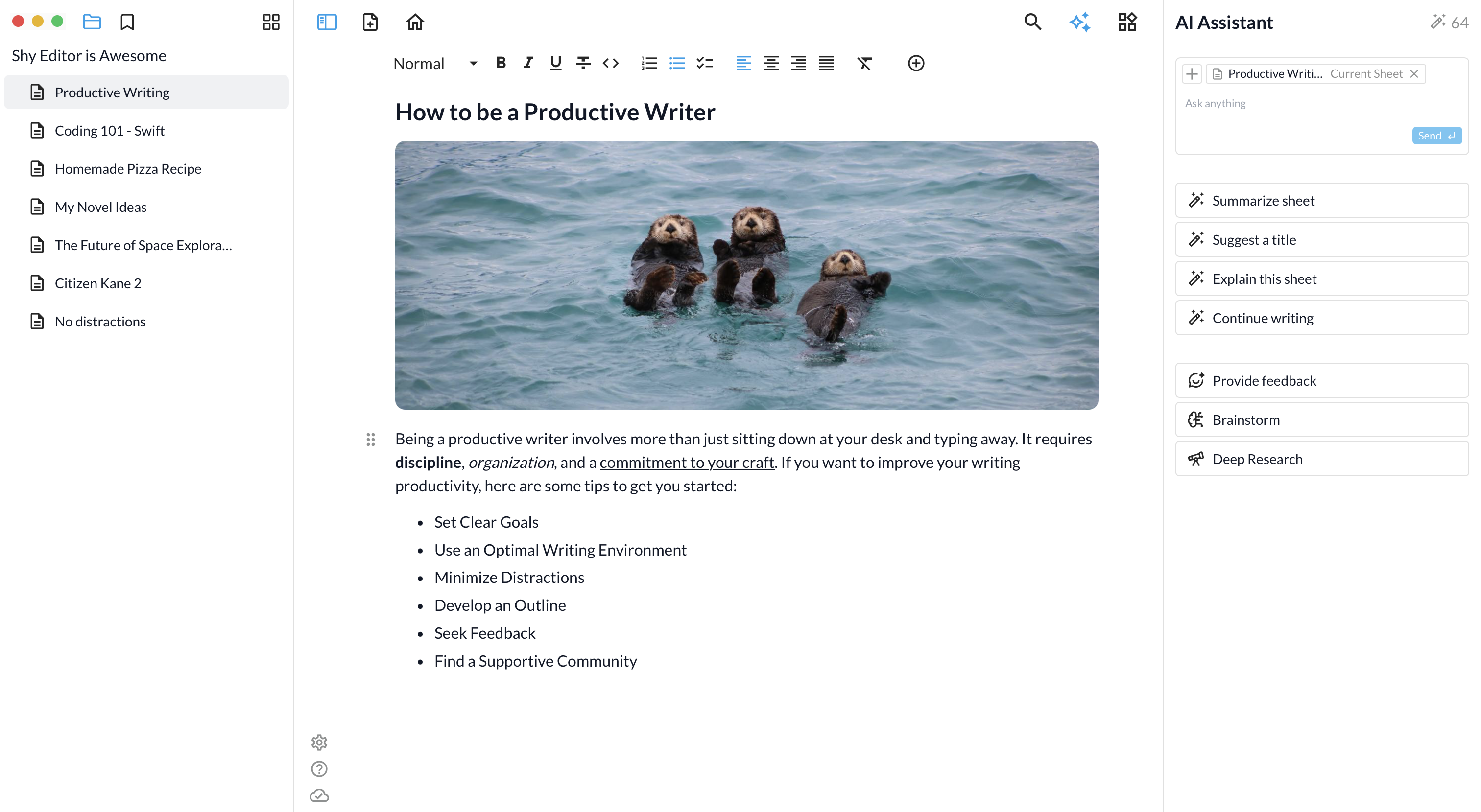
ShyEditor is a browser-based writing app that tries to be the modern word processor for serious long-form work. The headline pitch is an AI assistant for unblocking, refining and giving real-time feedback on prose, paired with a context-aware grammar checker, version history, and a research-oriented knowledge base with entity suggestions. The editor itself is markdown-first with support for tables, images and to-do lists, plus a dozen themes and writing-goal tracking.
What sets it apart from a generic Notion-with-AI clone is the academic plumbing: built-in bibliography and citation management across APA, MLA, Chicago, Harvard and IEEE, automatic source imports, and exports to TXT, PDF, DOCX and Markdown. The free Basic tier gives 20 AI credits a month and 100MB of storage, while Pro at $10/month unlocks 500 credits, 5GB, AI image generation and priority support. That credit-based model means heavy AI users will burn through Pro quickly.
It's aimed squarely at novelists, students, academics, journalists, bloggers and lawyers — anyone who needs both an AI co-writer and structured research/citation tooling in one place. There's no public API or open-source code, and the underlying LLM is not disclosed, so power users who want to swap models or self-host should look elsewhere.
ShyEditor is one of the more thoughtful AI writing apps for academics and authors — the citation stack and knowledge base are real, not afterthoughts. The $10 Pro tier is fair, but the opaque model choice and credit metering keep it from being a Cursor-for-prose. Worth trying on the free tier before committing.
— The AI Tool Bible editorial team
Pros
- ✅ Built-in citation manager covers APA, MLA, Chicago, Harvard and IEEE
- ✅ Markdown editor with version history and knowledge-base entity suggestions
- ✅ Generous free tier and Pro is only $10/month
- ✅ Exports to PDF, DOCX, Markdown and TXT for portability
Cons
- ⚠️ Underlying AI model is not disclosed
- ⚠️ Credit-metered AI usage can be limiting on Pro
- ⚠️ No public API or open-source option
- ⚠️ Browser-only; no offline desktop client mentioned
Use cases
Frequently asked
- What citation styles does ShyEditor support?
- The built-in bibliography and citation manager supports APA, MLA, Chicago, Harvard, and IEEE styles. It also includes automatic source imports and exports to TXT, PDF, DOCX, and Markdown.
- How much does ShyEditor cost?
- ShyEditor offers a free Basic tier with 20 AI credits and 100MB of storage. The Pro plan costs $10 per month and includes 500 credits, 5GB of storage, AI image generation, and priority support.
- Which AI models power ShyEditor?
- The tool uses a multi-model approach that includes GPT-4 and Grok. However, the specific underlying LLM configuration is not fully disclosed, and there is no option to swap models or self-host.
- Is ShyEditor available as a desktop application?
- No, ShyEditor is a browser-based writing app. There is no mention of an offline desktop client, so it requires an internet connection to use.
- Does ShyEditor offer an API for developers?
- No, there is no public API or open-source code available for ShyEditor. It is designed as a standalone browser application for individual writers and researchers.
Explore related
Compare with similar tools
All in Writing →Claude
FeaturedAnthropic's flagship assistant for long-form writing, analysis, and coding.
GPT-4o
FeaturedOpenAI's multimodal flagship behind ChatGPT.
Gemini Advanced
Google's flagship — strong at math, long context, and Workspace integration.
Llama 3
Meta's open-weights LLM family that put serious frontier-adjacent models in everyone's hands.
Qwen
Alibaba's open-weight foundation model family covering chat, vision, image generation, translation, and safety classification.
Jan
Open-source desktop ChatGPT alternative that runs local LLMs and routes to cloud providers from one app.