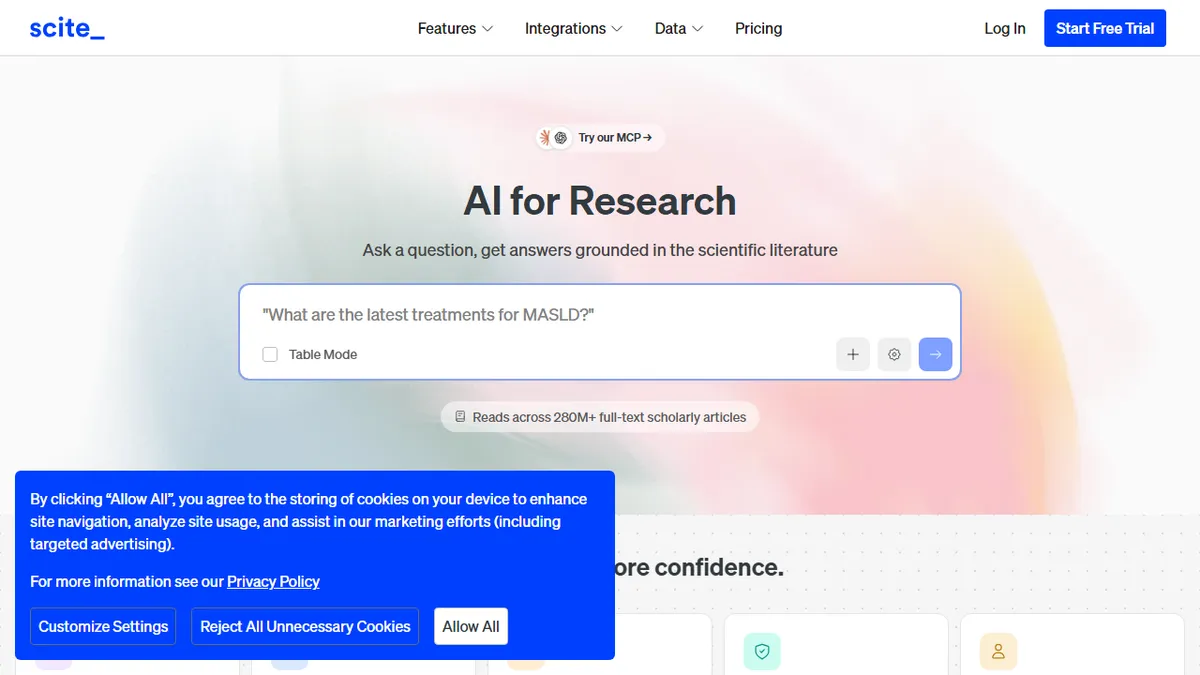

Scite
✓ Editorially verifiedAI research assistant that grades citations as supporting, contrasting, or mentioning across 1.6B citation statements.
In short
Scite provides an AI research assistant that classifies citations in published papers as supporting, contrasting, or mentioning a claim. It is best for academics and clinicians who need to verify if a claim holds up in the literature using a 1.6B-statement index.
Pick Scite if you do serious literature reviews and want to see, at a glance, whether a cited claim is actually supported or contradicted downstream.
Skip it if you need a general-purpose AI assistant or are not working with peer-reviewed scientific literature.
Scite is a research-focused RAG tool built around its Smart Citations dataset: every citation in its 1.6B-statement index is classified as supporting, contrasting, or just mentioning the cited claim, with the surrounding sentence shown in context. Its AI Assistant answers research questions strictly from this corpus of published papers, so you get a literature-grounded reply with inline references to actual studies (and a sense of which of those studies later work has reinforced or pushed back on).
It is aimed squarely at academics, grad students, clinicians, and R&D teams who care less about prose generation and more about whether a claim actually holds up in the literature. Pricing is straightforward: a free tier for basic search, a Personal/Plus plan around $12-$20/user/month for unlimited Smart Citations, dashboards, alerts, and reference checking, and an Organization plan with SSO and analytics for universities and companies. A short free trial is available on the paid tier.
Scite (now part of Research Solutions) integrates with Zotero, exposes an API, and ships an MCP server so the same Smart Citations layer can be called from Claude, ChatGPT, or any MCP-compatible assistant. The main caveat is scope: it only knows the scholarly literature it has indexed, so it is not a general-purpose chatbot or a substitute for full-text access at publishers you do not already subscribe to.
Scite is one of the few research RAG tools that earns the 'evidence-grounded' label, because Smart Citations expose the supporting/contrasting signal most chatbots quietly flatten. At $12-$20/month it is an easy yes for active researchers and a hard sell for casual users. The MCP server makes it genuinely useful inside Claude and ChatGPT workflows.
— The AI Tool Bible editorial team
Pros
- ✅ Smart Citations label every reference as supporting, contrasting, or mentioning with context
- ✅ AI Assistant answers are grounded in published papers, not open-web prose
- ✅ MCP server plus Zotero, ChatGPT, and Claude integrations
- ✅ Dashboards and alerts for tracking papers, authors, and topics over time
- ✅ Public API for teams building on top of the citation graph
Cons
- ⚠️ Useful mostly for scholarly work; not a general writing or coding tool
- ⚠️ Full features gated behind a paid plan after a short trial
- ⚠️ Coverage and full-text depth depend on publisher partnerships
- ⚠️ Classifications are model-generated and occasionally need human sanity-checking
Use cases
Frequently asked
- How does Scite classify citations?
- Scite uses its Smart Citations dataset to label every citation in its 1.6B-statement index as supporting, contrasting, or just mentioning the cited claim, showing the surrounding sentence in context.
- Who is Scite designed for?
- It is aimed at academics, grad students, clinicians, and R&D teams who prioritize verifying whether claims hold up in the literature over general prose generation.
- What integrations does Scite support?
- Scite integrates with Zotero, exposes a public API, and ships an MCP server that allows the Smart Citations layer to be called from Claude, ChatGPT, or any MCP-compatible assistant.
- What are the limitations of Scite?
- Scite only knows the scholarly literature it has indexed, so it is not a general-purpose chatbot or a substitute for full-text access at publishers you do not already subscribe to.
Explore related
Compare with similar tools
All in RAG →Pinecone
FeaturedManaged vector database for production-scale similarity search.
LlamaIndex
FeaturedData framework for connecting LLMs to your data.
Elasticsearch Vector Search
Hybrid vector + keyword search in the enterprise-grade Elasticsearch engine
Snowflake Cortex
Generative AI and RAG built into the Snowflake data cloud
DataStax Astra DB
Serverless vector and document database for production RAG and AI agents
MongoDB Atlas Vector Search
Vector search built into the operational database you're already using.