
Repomix
✓ Editorially verifiedPacks an entire codebase into a single AI-friendly file so LLMs can actually read your repo.
In short
Repomix flattens a repository into one structured file optimized for LLM ingestion. It is best for developers who need to share whole projects with AI assistants for code review or refactoring without building custom pipelines.
Pick Repomix if you regularly hand whole projects to Claude or ChatGPT and want one clean, token-counted bundle instead of copy-pasting files.
Skip it if your workflow is already inside an IDE agent like Cursor or Claude Code that indexes the repo for you.
Repomix is an open-source utility that flattens a whole repository into one structured file (XML, Markdown, JSON, or plain text) optimized for ingestion by ChatGPT, Claude, Gemini, and other LLMs. Instead of pasting files one at a time or wiring up a custom RAG pipeline just to ask 'how does auth work in this project,' you run `npx repomix@latest` and hand the resulting bundle to the model. It respects .gitignore, counts tokens per file, runs Secretlint to strip secrets, and can compress code with Tree-sitter for roughly 70% token reduction.
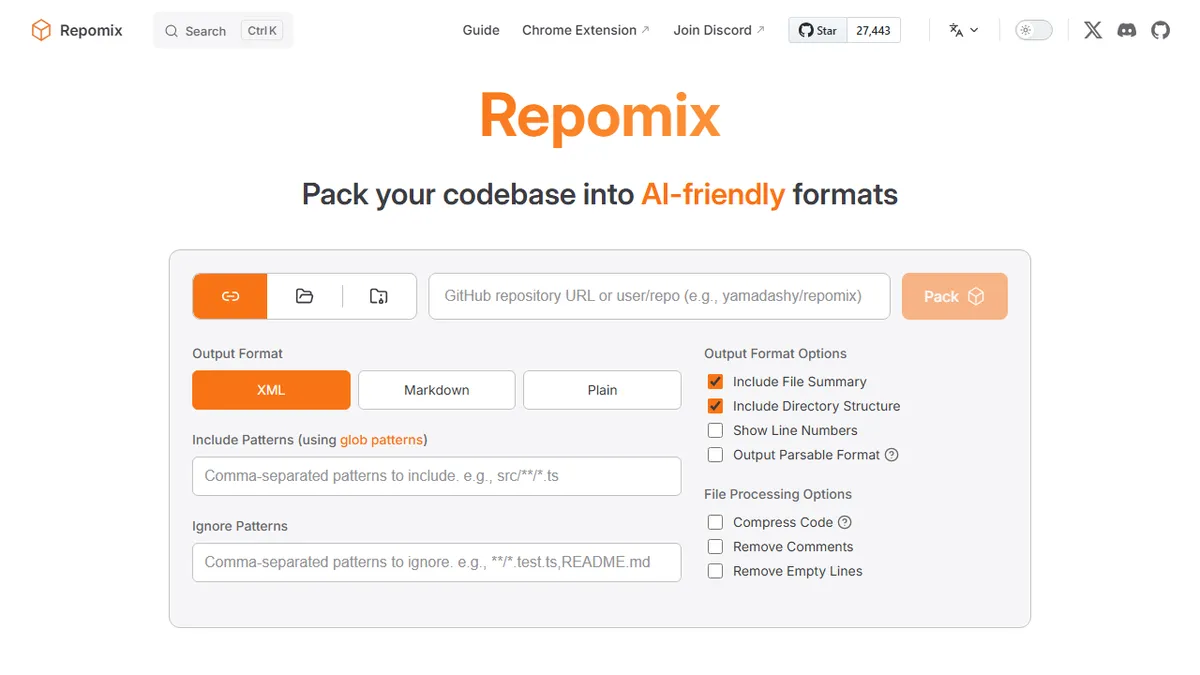
It's aimed squarely at developers who use AI assistants for code review, refactoring, bug hunts, and onboarding into unfamiliar codebases. Pricing is the easiest part of the review: Repomix is MIT-licensed and completely free, distributed as a CLI, Node library, Docker image, and Chrome extension. There's also a hosted web UI at repomix.com for one-off packs of public repos.
It's not an AI product in the strict sense - there's no model behind it - but it sits in the daily loop of anyone pairing with a frontier LLM on a real codebase. The main caveats are the usual ones for context-packing tools: very large monorepos still blow past context windows even after compression, and you need to actually read the security-scan output rather than trusting it blindly before pasting code into a third-party model.
Repomix is one of those small, sharp tools that quietly becomes part of your daily AI workflow. It doesn't try to be clever - it just produces the single artifact every frontier model actually wants. The Tree-sitter compression and Secretlint pass are what elevate it above the dozen weekend-project clones on GitHub.
— The AI Tool Bible editorial team
Pros
- ✅ Free, MIT-licensed, and runs locally with no account required
- ✅ Tree-sitter compression cuts tokens by ~70% on most codebases
- ✅ Secretlint pass strips API keys and secrets before you paste
- ✅ Works as CLI, Node lib, Docker image, Chrome extension, and hosted UI
- ✅ Respects .gitignore and supports remote repo URLs out of the box
Cons
- ⚠️ Not an AI itself - you still need a capable LLM to do the actual work
- ⚠️ Huge monorepos can exceed context windows even after compression
- ⚠️ Hosted web UI is convenient but means uploading code to a third party
Use cases
Frequently asked
- How does Repomix handle sensitive data in code?
- It runs Secretlint to strip secrets and API keys from the output before you paste the code into a third-party model.
- Can Repomix reduce the token count of large codebases?
- Yes, it can compress code using Tree-sitter, which results in roughly 70% token reduction on most codebases.
- What formats does Repomix support for output?
- It generates structured files in XML, Markdown, JSON, or plain text formats.
- Is Repomix suitable for very large monorepos?
- While it helps with compression, very large monorepos may still exceed context windows even after processing.
- How can I access Repomix?
- It is available as a CLI, Node library, Docker image, Chrome extension, and a hosted web UI for public repositories.
Explore related
Compare with similar tools
All in Coding →Cursor
FeaturedAI-first VS Code fork — chat, edit, and agentic coding in one IDE.
GitHub Copilot
FeaturedThe original AI pair programmer, now with chat and agents.
Replit Agent
FeaturedBuild & deploy a full app from a single prompt.
Warp
The agentic development environment, from the terminal up
Cline
Open-source agentic coding assistant that plans, edits, and runs code inside your IDE
Aider
Terminal-based AI pair programmer that writes commits.