
Recommenders
Open-source Python library with classical and deep-learning algorithms for building recommendation systems.
In short
Recommenders is a free, open-source Python library for building recommendation systems. It offers classical and deep-learning algorithms with reproducible notebooks for ML engineers.
Pick Recommenders if you are an ML engineer or researcher prototyping recommendation systems and want a vetted library of canonical algorithms with reproducible notebooks.
Skip it if you want a hosted recommendation API, a no-code personalization service, or a turnkey SaaS — this is a library you build with, not a product you call.
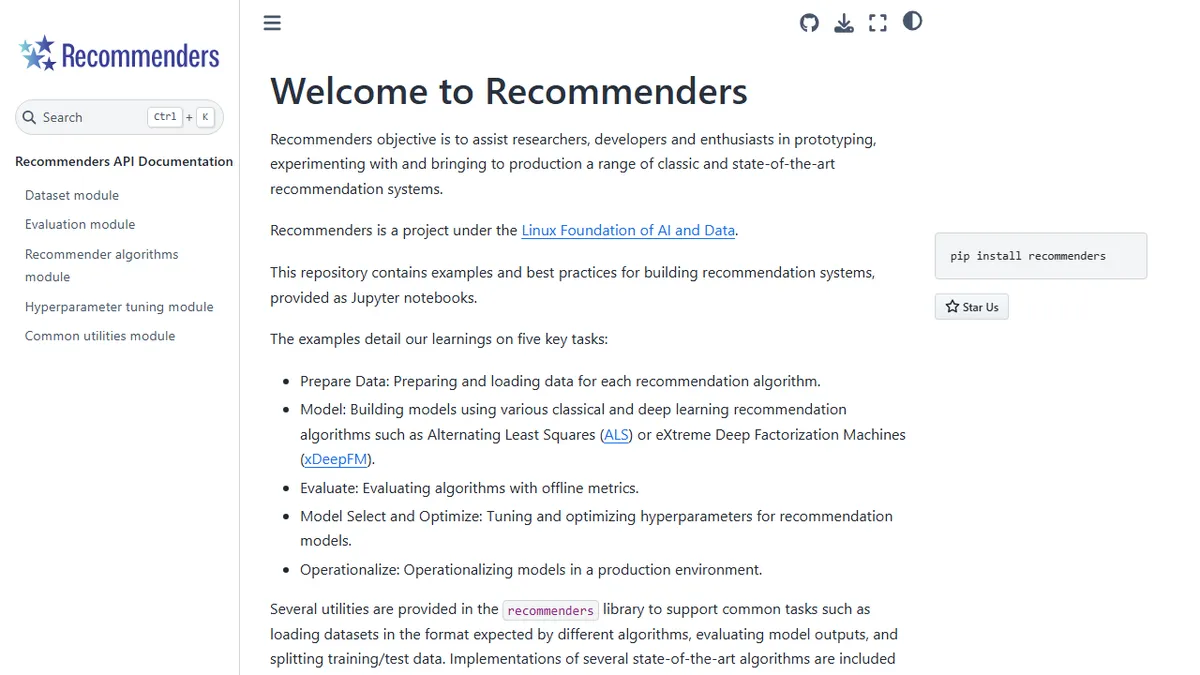
Recommenders is a Linux Foundation of AI and Data project that packages best-practice recipes for building recommender systems as Python utilities and Jupyter notebooks. It covers the full pipeline: data preparation and splitting, model building with classical algorithms like ALS plus deep-learning models such as xDeepFM, offline evaluation metrics, hyperparameter tuning, and production deployment. Install with a single pip command and start from working notebook examples rather than reinventing the wheel.
The library is aimed at ML engineers, researchers, and data scientists who need a reference implementation of state-of-the-art recommendation algorithms without rolling their own from scratch. It's fully open-source under Linux Foundation governance, free to use, and self-hosted — there is no SaaS tier, no API key, and no usage limits. Differentiation comes from breadth (dozens of algorithms in one place), reproducible notebook examples, and the credibility of LF AI and Data stewardship.
Integrations include PySpark for distributed training, GPU-accelerated deep learning frameworks, and standard Python data tooling. The trade-off: this is a developer library, not a turnkey product. You need Python skills, your own infrastructure, and a willingness to read notebooks and source code to ship anything.
A solid, credible reference implementation that saves teams from reinventing standard recommender algorithms. The Linux Foundation backing matters here — this is more durable than the typical GitHub-only ML project. Just remember you're getting a toolkit, not a product, and budget engineering time accordingly.
— The AI Tool Bible editorial team
Pros
- ✅ Comprehensive coverage of classical and deep-learning recommender algorithms in one library
- ✅ Backed by Linux Foundation of AI and Data with active community
- ✅ Jupyter notebook examples make the learning curve manageable
- ✅ Free and fully open-source with no usage limits
- ✅ Covers the entire pipeline from data prep through deployment
Cons
- ⚠️ Developer library only — no hosted product, UI, or managed service
- ⚠️ Requires Python and ML expertise to use effectively
- ⚠️ You bring your own compute and infrastructure
- ⚠️ Documentation is reference-style, not a tutorial path for beginners
Use cases
Frequently asked
- How much does Recommenders cost?
- Recommenders is completely free and open-source under the MIT License. It is a Linux Foundation project with no SaaS tier, API keys, or usage limits. You self-host it using your own infrastructure.
- What algorithms are included in the library?
- The library includes classical algorithms like ALS and deep-learning models such as xDeepFM. It packages best-practice recipes for the full pipeline, including data preparation, model building, evaluation, and deployment.
- Is Recommenders suitable for beginners?
- It is aimed at ML engineers and researchers. You need Python skills, your own infrastructure, and a willingness to read notebooks and source code. It is a developer library, not a turnkey product or no-code service.
- What integrations does Recommenders support?
- Integrations include PySpark for distributed training, GPU-accelerated deep learning frameworks, and standard Python data tooling. You install it with a single pip command and start from working notebook examples.
- Why choose Recommenders over a hosted API?
- Choose Recommenders if you want a vetted library of canonical algorithms with reproducible notebooks for prototyping. Skip it if you want a hosted recommendation API, no-code personalization, or turnkey SaaS, as this is a library you build with.
Explore related
Compare with similar tools
All in Coding →Cursor
FeaturedAI-first VS Code fork — chat, edit, and agentic coding in one IDE.
GitHub Copilot
FeaturedThe original AI pair programmer, now with chat and agents.
Replit Agent
FeaturedBuild & deploy a full app from a single prompt.
Warp
The agentic development environment, from the terminal up
Cline
Open-source agentic coding assistant that plans, edits, and runs code inside your IDE
Aider
Terminal-based AI pair programmer that writes commits.