
Recall
AI-powered personal knowledge base that summarizes, links, and quizzes you on everything you save.
In short
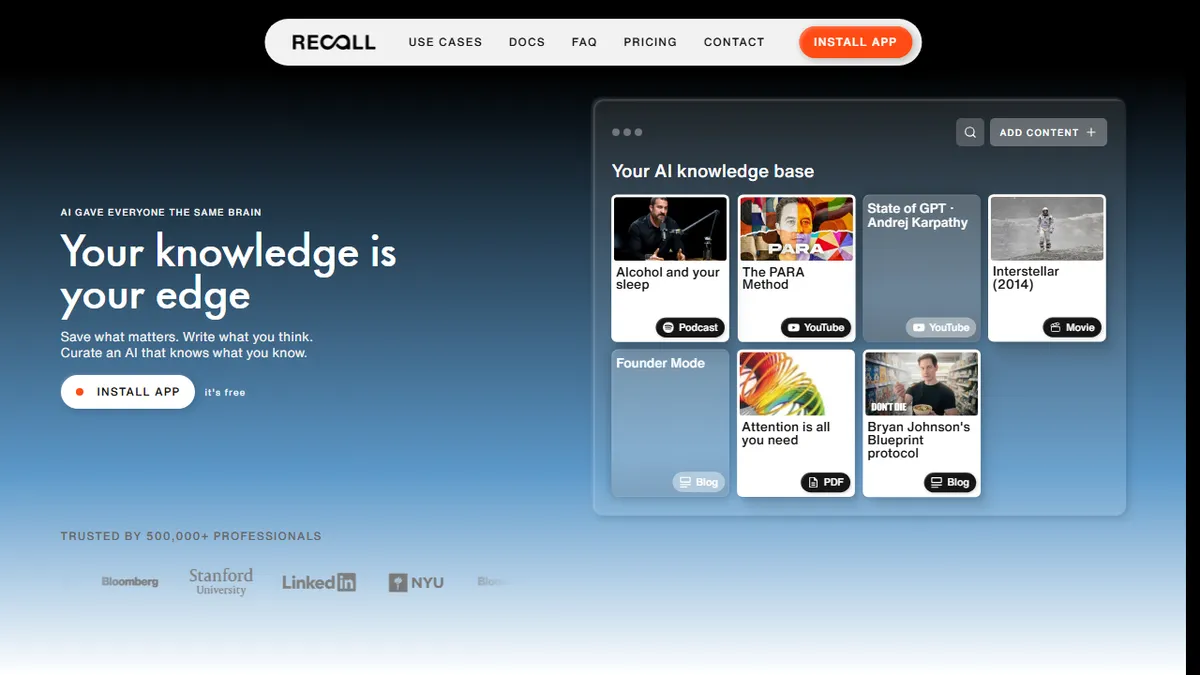
Recall captures long-form content like videos and podcasts to generate summaries and spaced-repetition quizzes. It is best for solo learners who want to retain information from diverse media using a multi-model AI chat interface.
Pick Recall if you consume a firehose of videos, podcasts, and articles and want them summarized, cross-linked, and quizzed back at you automatically.
Skip it if you need a collaborative team wiki, full data ownership, or a developer-first RAG stack you can self-host.
Recall is a personal knowledge management app built around saving long-form content (YouTube videos, podcasts, articles, PDFs, Wikipedia pages, even recipes) and letting an LLM summarize, tag, link, and quiz you on it. A browser extension and mobile apps capture in one click; summaries arrive in seconds in text or cloned-voice audio, and an auto-built knowledge graph surfaces connections between notes you'd never manually cross-link.
Where most read-later apps stop at storage, Recall leans into retention and retrieval: spaced-repetition quizzes are generated from your own saves, and an AI chat layer can answer questions against your library while also reaching out to the open web. You can swap between GPT, Claude, and Gemini mid-conversation, which is unusual for a consumer app at this price point. The free tier is generous enough to evaluate seriously, with a Premium upgrade and a 30-day refund window.
It's aimed at students, researchers, and knowledge workers who consume a lot of video and audio and want it distilled into something searchable and reviewable. API and MCP support are advertised, but the product is closed-source and the API surface is lightly documented compared to dedicated developer tools.
Recall is the rare 'second brain' app that actually pulls its weight on video and audio, not just web clippings. The model-switching chat and built-in spaced repetition push it past Readwise-style competitors for solo learners, though teams and privacy maximalists should look elsewhere.
— The AI Tool Bible editorial team
Pros
- ✅ One-click capture from YouTube, podcasts, PDFs, articles, and more
- ✅ Auto-generated summaries plus spaced-repetition quizzes for real retention
- ✅ Switch between GPT, Claude, and Gemini inside the same chat
- ✅ Auto-built knowledge graph links related saves without manual tagging
Cons
- ⚠️ Closed-source with limited public API documentation
- ⚠️ Quality of summaries depends on the third-party model picked
- ⚠️ Consumer-grade — not a team or enterprise knowledge base
Use cases
Frequently asked
- What types of content can I save to Recall?
- You can save YouTube videos, podcasts, articles, PDFs, Wikipedia pages, and recipes. A browser extension and mobile apps allow for one-click capture of this content.
- How does Recall help with information retention?
- The app generates spaced-repetition quizzes from your saved content and uses an auto-built knowledge graph to link related notes, aiding in retrieval and review.
- Which AI models are supported in the chat feature?
- Recall allows you to switch between GPT, Claude, and Gemini mid-conversation. The AI chat layer can answer questions against your library and reach out to the open web.
- Is Recall suitable for team collaboration?
- No, Recall is a consumer-grade app aimed at students and knowledge workers. It is not designed as a collaborative team wiki or enterprise knowledge base.
- What are the pricing options for Recall?
- Recall offers a free tier, a Plus plan at $10 per month billed yearly, and a Max plan at $38 per month billed yearly. A 30-day refund window is available for Premium upgrades.
Explore related
Compare with similar tools
All in RAG →Pinecone
FeaturedManaged vector database for production-scale similarity search.
LlamaIndex
FeaturedData framework for connecting LLMs to your data.
Elasticsearch Vector Search
Hybrid vector + keyword search in the enterprise-grade Elasticsearch engine
Snowflake Cortex
Generative AI and RAG built into the Snowflake data cloud
DataStax Astra DB
Serverless vector and document database for production RAG and AI agents
MongoDB Atlas Vector Search
Vector search built into the operational database you're already using.