
RAGFlow
✓ Editorially verifiedOpen-source RAG engine with deep document parsing, hybrid search, and visual agent orchestration.
In short
RAGFlow provides a self-hostable RAG stack that ingests complex documents like PDFs and tables using hybrid retrieval. It is best for enterprises requiring grounded answers with citations and visual agent workflows.
Pick RAGFlow if you need a self-hostable, citation-grounded RAG stack that can actually digest gnarly enterprise documents and feed agents.
Skip it if you just want a hosted chat-with-PDF widget or you're allergic to running your own infrastructure.
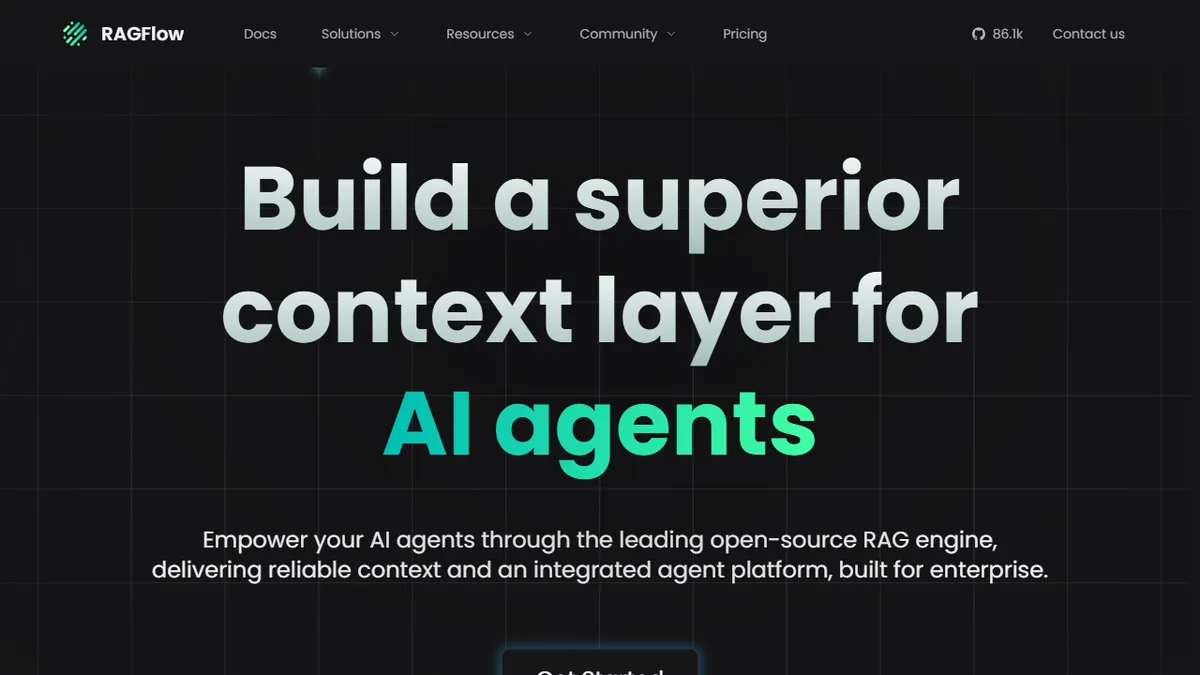
RAGFlow is an open-source retrieval-augmented generation engine built around serious document understanding. It pairs a multi-format ingestion pipeline (PDFs, scans, tables, slides) with hybrid retrieval that mixes dense vectors, BM25, and custom scoring, then exposes the whole stack through a visual workflow builder and Model Context Protocol so agents can call it natively.
The project lives in the open on GitHub and has become one of the more visible RAG frameworks for teams that want grounded answers with citations instead of vibes. The hosted SaaS starts free (5 apps, 500 credits) and scales to Starter at $29/mo, Pro at $129/mo, and an enterprise tier with BYOC and on-prem deployment. The free tier deliberately excludes API access, so anyone wanting programmatic use either pays from Starter up or self-hosts the OSS build.
It ships with industry-specific reference workflows for investment research, legal analysis, and maintenance support, and integrates with arbitrary LLM providers rather than locking you to one model. The trade-off is operational weight: running it well still means thinking about chunking strategy, embedding choice, and infrastructure if you self-host.
RAGFlow is one of the few open-source RAG projects taking document parsing seriously rather than dumping everything through a naive splitter. The hosted pricing is fair, but the real value is the OSS build for teams that want to own the retrieval layer end-to-end. Expect to invest engineering time to get the best out of it.
— The AI Tool Bible editorial team
Pros
- ✅ Strong deep-document parsing for messy PDFs, tables, and scans
- ✅ Hybrid vector + BM25 retrieval with citation-grounded answers
- ✅ Fully open-source with active GitHub repo and self-host option
- ✅ Visual agent builder plus MCP integration for tool-calling clients
- ✅ Model-agnostic; works with most major LLM providers
Cons
- ⚠️ Free tier blocks API access, pushing real use to paid plans
- ⚠️ Self-hosting is non-trivial and resource-hungry
- ⚠️ Documentation and UI lag behind the engine's capabilities
Use cases
Frequently asked
- What types of documents can RAGFlow process?
- It features a multi-format ingestion pipeline capable of handling PDFs, scans, tables, and slides with deep document parsing.
- How does RAGFlow handle retrieval?
- It uses hybrid retrieval that mixes dense vectors, BM25, and custom scoring to provide citation-grounded answers.
- Is RAGFlow open source and self-hostable?
- Yes, the project is open-source on GitHub and offers a self-host option, though running it well requires managing chunking strategy and infrastructure.
- What are the pricing tiers for RAGFlow?
- The hosted SaaS starts with a free tier, followed by Starter at $29/mo, Pro at $129/mo, and an Enterprise tier with custom pricing.
- Does the free tier include API access?
- No, the free tier deliberately excludes API access, requiring users to pay for the Starter plan or self-host the OSS build for programmatic use.
Explore related
Compare with similar tools
All in RAG →Pinecone
FeaturedManaged vector database for production-scale similarity search.
LlamaIndex
FeaturedData framework for connecting LLMs to your data.
Elasticsearch Vector Search
Hybrid vector + keyword search in the enterprise-grade Elasticsearch engine
Snowflake Cortex
Generative AI and RAG built into the Snowflake data cloud
DataStax Astra DB
Serverless vector and document database for production RAG and AI agents
MongoDB Atlas Vector Search
Vector search built into the operational database you're already using.