Qodo (formerly CodiumAI)
✓ Text source-checked Nov 22, 2026Source-checked against the vendor's site · rebuilt from the vendor's own pagesProfile updated Link checked Pricing captured How we rate
In short
Qodo is an AI code review platform that uses multi-model LLMs to analyze pull requests with full codebase context. It enforces standards and governs AI agents for engineering teams.
Engineering teams shipping code at the speed AI writes it.
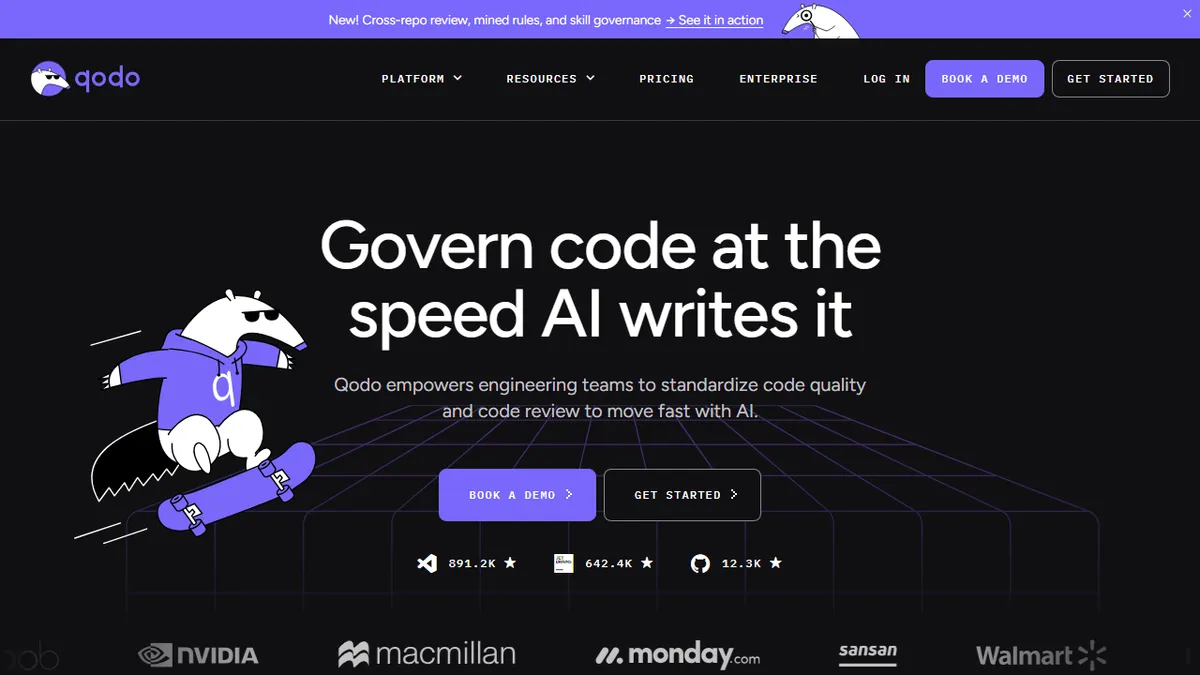
Qodo is an AI code review and governance platform designed for engineering teams shipping code at the speed AI writes it. The vendor says that the platform reviews every pull request using full cross-repo codebase context, enforces coding standards, and governs the AI tools and agents involved in code creation. Qodo operates across two main surfaces: an IDE for real-time code validation while coding, and Git for high-signal pull request reviews.
Specialized review agents utilize full codebase context, user-defined rules, and PR history to identify issues with high precision and recall. The system ranks open pull requests by risk and impact, surfaces review bottlenecks, and enforces triage policies. The vendor says that Qodo converts team standards into rules that coding agents follow and that Qodo enforces on every pull request. The platform can automatically approve pull requests that meet user-defined conditions based on severity, blast radius, and rules.
NVIDIA engineering teams use Qodo’s context engine for deep agentic code search and retrieval. Pax8 uses Qodo to validate code quality and reinforce engineering standards within its software development lifecycle. Slickdeals partners with Qodo to introduce AI into its quality workflows and receive early feedback on code quality.
Qodo supports GitHub, GitLab, Bitbucket, and Azure DevOps, with Gerrit support available on Enterprise plans. The tool integrates with VS Code, various JetBrains IDEs, and Visual Studio. Qodo supports major programming languages including Python, Java, JavaScript, TypeScript, Go, C#, .NET, Swift, Kotlin, Ruby, PHP, and C++.
The vendor says that the platform features zero data retention, meaning code is analyzed and discarded without being stored, logged, or used for model training. Qodo offers on-premises deployment options that run entirely within the user's own infrastructure.
According to Qodo (formerly CodiumAI): Qodo is an AI code review and governance platform designed for engineering teams shipping code at the speed AI writes it. Its pages list this strength: Cross-repo review capabilities reason across dependent repositories to identify breaking changes. They also state this limitation: Single-tenant SaaS deployment is not included in the Pro Team plan.
— The AI Tool Bible editorial team
Pros
- ✅ Cross-repo review capabilities reason across dependent repositories to identify breaking changes.
- ✅ Automated rules enforcement ensures coding agents and human reviewers adhere to team standards.
- ✅ The vendor says that zero data retention policy ensures code is not stored or used for model training.
- ✅ On-premises deployment is available for users requiring internal infrastructure.
- ✅ PR triage features rank pull requests by risk and impact to prioritize review work.
Cons
- ⚠️ Single-tenant SaaS deployment is not included in the Pro Team plan.
- ⚠️ On-premises and air-gapped deployments are not included in the Pro Team plan.
- ⚠️ Bring Your Own Key (BYOK) functionality is not included in the Pro Team plan.
Pricing (captured )
| Tier | Monthly | Key features |
|---|---|---|
| Pro Team | $30 |
|
| Enterprise | — |
|
Prices change; we show the grid as captured on Nov 13, 2026. Check current pricing on the vendor's site →
Facts
- Platforms
- cli, vscode-extension, jetbrains-plugin, api (not source-checked)
- API available
- Yes (not source-checked)
- Free trial
- Yes
- Model used
- Multi-model (Claude, GPT, Gemini, NVIDIA) (not source-checked)
- Hacker News
- 27 stories · top 139 points · last Feb 4, 2026 · checked Nov 19, 2026
- Earliest Wayback capture
- 2024-09-24 (earliest archived capture of the site, not a launch date)
Where this tool sits
Use cases
Frequently asked
- How much does Qodo cost?
- Qodo operates on a freemium model. A free plan is available, while the Pro Team plan costs $30. Enterprise plans offer additional features like Gerrit support and on-premises deployment options.
- Which platforms and IDEs does Qodo integrate with?
- Qodo supports GitHub, GitLab, Bitbucket, and Azure DevOps, with Gerrit on Enterprise plans. It integrates with VS Code, JetBrains IDEs, and Visual Studio, supporting languages like Python, Java, and TypeScript.
- Does Qodo store my code data?
- No. The vendor states that Qodo features zero data retention. Code is analyzed and discarded without being stored, logged, or used for model training. On-premises deployment options are also available for private infrastructure.
- How does Qodo handle AI-generated code?
- Qodo governs AI tools and agents involved in code creation. It converts team standards into rules that coding agents follow and enforces these on every pull request to ensure quality and compliance.
- Can Qodo automatically approve pull requests?
- Yes. The platform can automatically approve pull requests that meet user-defined conditions based on severity, blast radius, and specific rules. It also ranks open pull requests by risk and impact to streamline triage.