
PromptHub
✓ Editorially verifiedGit-style prompt management, testing, and deployment platform for teams running multiple LLMs in production.
In short
PromptHub provides Git-like version control and collaboration tools for teams managing prompts across multiple LLM providers like OpenAI and Anthropic. It is best suited for product and ML teams needing auditable workflows, side-by-side testing, and automated evaluation pipelines in production.
Pick PromptHub if you have a team shipping LLM features and need versioning, multi-model A/B testing, and evals in one place instead of duct-taped spreadsheets.
Skip it if you're a solo developer with a handful of prompts in a single repo — Git plus a notebook will do the same job for free.
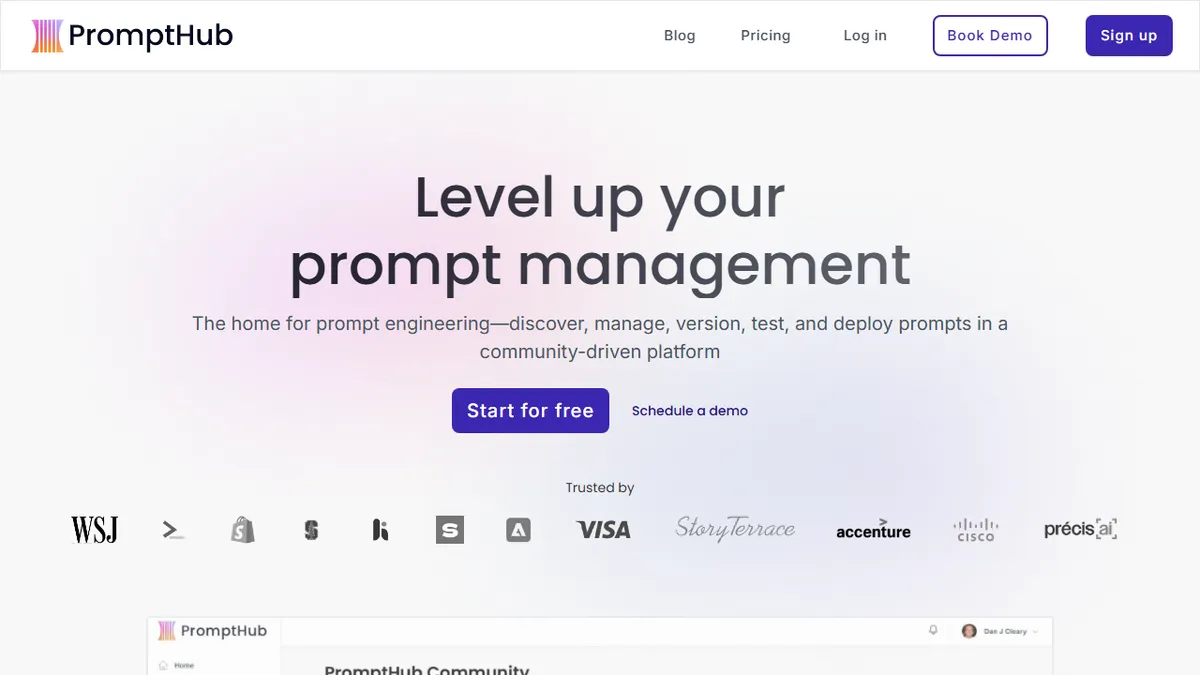
PromptHub is a collaboration platform for prompt engineering, built around Git-like version control for prompts. Teams can author, fork, compare, and deploy prompts across OpenAI, Anthropic, Azure, Google, Meta, AWS Bedrock, and Mistral models, then ship them to production via a simple API, shareable forms, or Zapier. The playground supports side-by-side variation testing, prompt chaining via a no-code builder, and automated evaluation pipelines with guardrails.
It's aimed at product and ML teams who have outgrown pasting prompts into Notion docs and need an auditable workflow with reviewers, versioning, and eval baselines. Customers cited include WSJ, Shopify, Stanford, Adobe, Visa, and Cisco. Pricing isn't on the homepage; there's a free signup tier and a sales demo path, with paid plans handled inside the product.
A public community library adds a discovery layer where users can browse trending prompts, fork them, and build reputation. That community surface plus the multi-provider playground makes PromptHub closer to a 'GitHub for prompts' than a single-vendor prompt IDE.
The 'GitHub for prompts' framing actually holds up here: versioning, forks, and a public library sit alongside genuinely useful evals and a multi-provider playground. The opaque pricing is annoying, but for teams past the prototype stage it's one of the more credible prompt-ops platforms.
— The AI Tool Bible editorial team
Pros
- ✅ Git-style versioning gives prompts proper history, diffs, and rollback
- ✅ Tests the same prompt across providers without rewriting code
- ✅ Built-in evals and guardrails for regression-testing prompt changes
- ✅ Public community library for discovering and forking prompts
- ✅ Ships prompts via API, forms, or Zapier without redeploying app code
Cons
- ⚠️ Pricing isn't published, so budgeting requires a sales conversation
- ⚠️ Yet another SaaS surface to maintain alongside your model provider
- ⚠️ No-code chain builder may not scale to complex agentic workflows
Use cases
Frequently asked
- Which AI models does PromptHub support?
- PromptHub supports OpenAI, Anthropic, Azure, Google, Meta, AWS Bedrock, and Mistral models.
- How can prompts be deployed from PromptHub?
- Prompts can be shipped to production via a simple API, shareable forms, or Zapier without requiring app code redeployment.
- Is PromptHub suitable for solo developers?
- It is not recommended for solo developers with a handful of prompts in a single repo, as Git plus a notebook may suffice. It is designed for teams shipping LLM features who need versioning and evals.
- Does PromptHub offer prompt testing and evaluation?
- Yes, it includes a playground for side-by-side variation testing, prompt chaining via a no-code builder, and automated evaluation pipelines with guardrails.
Explore related
Compare with similar tools
All in Writing →Claude
FeaturedAnthropic's flagship assistant for long-form writing, analysis, and coding.
GPT-4o
FeaturedOpenAI's multimodal flagship behind ChatGPT.
Gemini Advanced
Google's flagship — strong at math, long context, and Workspace integration.
Llama 3
Meta's open-weights LLM family that put serious frontier-adjacent models in everyone's hands.
Qwen
Alibaba's open-weight foundation model family covering chat, vision, image generation, translation, and safety classification.
Jan
Open-source desktop ChatGPT alternative that runs local LLMs and routes to cloud providers from one app.