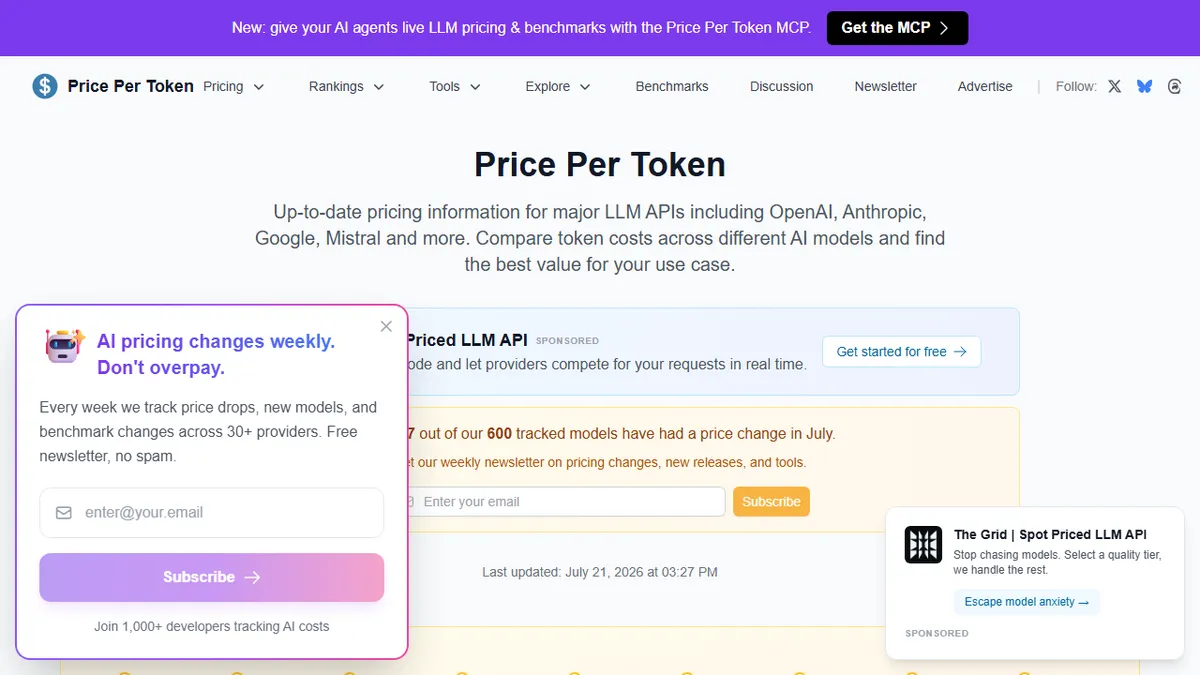
Price Per Token
Daily-updated LLM API pricing comparison across 300+ models, with calculators, leaderboards, and a free MCP server.
In short
Price Per Token tracks per-token input and output costs for over 300 LLM models from major providers. It provides calculators, token counters, and benchmark comparisons to help developers budget API spend. A free MCP server allows coding agents to query live pricing data at runtime.
Pick Price Per Token if you're choosing or budgeting an LLM API and want one place to sanity-check per-token cost against benchmark performance.
Skip it if you need negotiated enterprise pricing, self-hosted inference economics, or audited cost data for finance reporting.
Price Per Token is a reference site for anyone trying to figure out what an LLM API call will actually cost. It tracks per-token input/output pricing for 300+ models from OpenAI, Anthropic, Google, Meta, Mistral, DeepSeek and others, and surfaces that data through a pricing calculator, a token counter, side-by-side model comparisons, and benchmark leaderboards (MMLU-Pro, GPQA, LiveCodeBench, AIME). The dataset is refreshed as providers announce changes, which is the entire reason a tool like this exists.
Where it gets interesting is the Price Per Token MCP server: a free, no-auth MCP endpoint at api.pricepertoken.com/mcp/mcp that lets agents inside Claude Code, Cursor and Windsurf query live pricing and benchmark data at runtime. That turns a static price chart into something an autonomous coding agent can actually consult before picking a model. It's pitched at developers, engineering leads and AI ops folks who need to budget token spend or pick a cost/quality sweet spot, not at end users writing prose.
The site itself is free and ad-supported; there is no paid tier, no signup, and no API key wall. The main caveats are the usual ones for any aggregated pricing dataset: list prices don't reflect committed-use discounts, batch APIs or self-hosted economics, and benchmark scores are only as honest as the labs reporting them.
A genuinely useful utility site rather than a product, and one of the few LLM-pricing trackers that bothers to stay current. The MCP server is the sleeper feature: wiring it into a coding agent so it can pick the cheapest model that clears a benchmark threshold is exactly the kind of thing this data should enable.
— The AI Tool Bible editorial team
Pros
- ✅ Covers 300+ models with daily-updated official pricing
- ✅ Free MCP server lets agents query live prices with no API key
- ✅ Side-by-side comparisons include benchmark scores, not just price
- ✅ Token counter and per-provider calculators handle real cost math
Cons
- ⚠️ List prices ignore committed-use discounts and batch APIs
- ⚠️ Benchmark rankings only as reliable as the labs' self-reports
- ⚠️ No paid tier means no SLAs or historical price exports
Use cases
Frequently asked
- How many models does Price Per Token track?
- The site tracks per-token pricing for more than 300 models from providers including OpenAI, Anthropic, Google, Meta, Mistral, and DeepSeek.
- Is Price Per Token free to use?
- Yes, the site is free and ad-supported with no signup or API key required. There is no paid tier available.
- What is the Price Per Token MCP server?
- It is a free, no-auth MCP endpoint that allows agents in tools like Claude Code, Cursor, and Windsurf to query live pricing and benchmark data at runtime.
- Does the tool include benchmark data?
- Yes, it features benchmark leaderboards for MMLU-Pro, GPQA, LiveCodeBench, and AIME, allowing users to compare model performance alongside cost.
- Does Price Per Token account for enterprise discounts?
- No, the tool displays list prices and does not reflect committed-use discounts, batch APIs, or self-hosted economics.
Explore related
Compare with similar tools
All in Coding →Cursor
FeaturedAI-first VS Code fork — chat, edit, and agentic coding in one IDE.
GitHub Copilot
FeaturedThe original AI pair programmer, now with chat and agents.
Replit Agent
FeaturedBuild & deploy a full app from a single prompt.
Warp
The agentic development environment, from the terminal up
Cline
Open-source agentic coding assistant that plans, edits, and runs code inside your IDE
Aider
Terminal-based AI pair programmer that writes commits.