
Paperspace Gradient
End-to-end MLOps platform with GPU notebooks, training jobs, and model deployment, now folded into DigitalOcean.
In short
Paperspace Gradient is a DigitalOcean MLOps platform offering GPU notebooks, training, and deployment with per-second billing for PyTorch and TensorFlow users.
Pick Paperspace Gradient if you want a simple, GitHub-native MLOps workspace with per-second GPU billing without committing to AWS or GCP.
Skip it if you need a no-code agent builder or hyperscaler-grade enterprise tooling like SageMaker Pipelines and Vertex Feature Store.
Paperspace Gradient is a managed machine-learning platform that bundles three core surfaces: Notebooks for interactive experimentation, Machines for training and fine-tuning on rentable GPUs/IPUs, and Deployments for serving models in production. It supports every major framework (PyTorch, TensorFlow, JAX, Hugging Face) and ties source-controlled experiments to GitHub, so the same repo can move from a Jupyter notebook to a long-running training run to a hosted inference endpoint without leaving the workspace.
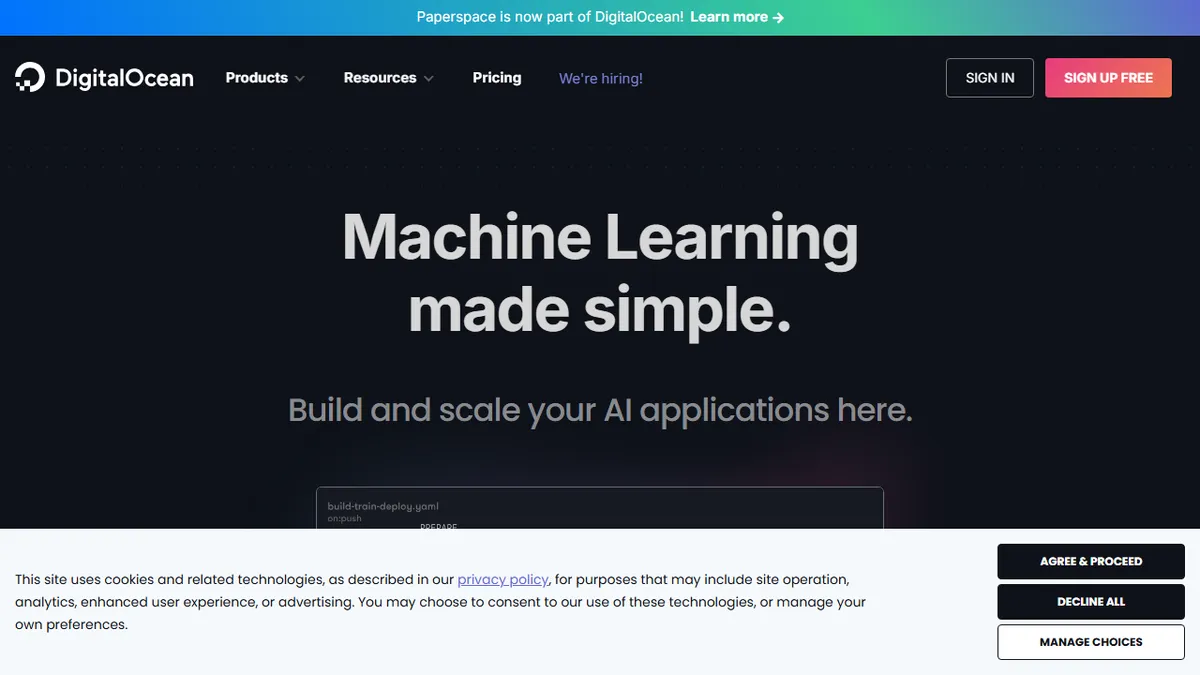
The pitch is mostly aimed at small ML teams and indie practitioners who want pay-as-you-go GPU access without the complexity of raw AWS/GCP. Pricing is per-second on the compute side, with a free notebook tier and paid Pro/Growth subscriptions on top. Since Paperspace was acquired by DigitalOcean, the product is now sold as 'DigitalOcean AI/ML Platform,' and the gradient.paperspace.com URL redirects users into the DigitalOcean product page; the underlying Gradient stack remains operational but new investment appears focused on DO's broader GPU droplet/H100 lineup.
If you came to Gradient expecting agent-building primitives (the directory's 'agents' bucket), note that this is squarely an infrastructure/MLOps tool: it gives you the GPUs and orchestration to train or host models, not a no-code agent runtime. It is best read as a SageMaker-style alternative for teams who prefer DigitalOcean's pricing and DX over the hyperscalers.
Gradient was one of the cleanest small-team MLOps stacks before the DigitalOcean deal, and the bones are still good. The open question is whether DO keeps Gradient as a first-class product or quietly subsumes it into its generic GPU droplet line; in the meantime it remains a fair pick for indie ML work.
— The AI Tool Bible editorial team
Pros
- ✅ Notebooks, training, and deployment in one workspace
- ✅ Per-second GPU billing across a wide range of NVIDIA cards
- ✅ Free notebook tier lowers the barrier to experimentation
- ✅ GitHub-backed projects keep experiments reproducible
- ✅ Now backed by DigitalOcean's infra and support footprint
Cons
- ⚠️ Product roadmap unclear post-DigitalOcean acquisition
- ⚠️ Smaller managed-service surface than SageMaker or Vertex AI
- ⚠️ Free-tier GPUs are frequently capacity-constrained
Use cases
Frequently asked
- How much does Paperspace Gradient cost?
- Paperspace Gradient uses a freemium model. The Free tier is $0, Pro is $8, and Growth is $39. Compute billing is per-second, with specific GPU tiers like T0 at $0 and T1 at $12.
- Which machine learning frameworks are supported?
- The platform supports major frameworks including PyTorch, TensorFlow, JAX, and Hugging Face. It is a bring-your-own-model environment, allowing you to use your existing code and repositories for training and deployment.
- Is Paperspace Gradient suitable for building AI agents?
- No, it is not a no-code agent builder. It is an infrastructure and MLOps tool focused on providing GPUs, orchestration, and deployment for training or hosting models, rather than offering agent-building primitives.
- How does Gradient integrate with GitHub?
- Gradient ties source-controlled experiments directly to GitHub. This allows the same repository to move from a Jupyter notebook to a long-running training run to a hosted inference endpoint without leaving the workspace.
- What happened to Paperspace Gradient after the acquisition?
- Paperspace was acquired by DigitalOcean, and the product is now sold as the 'DigitalOcean AI/ML Platform.' The gradient.paperspace.com URL redirects to DigitalOcean, though the underlying Gradient stack remains operational.
- Who should skip using Paperspace Gradient?
- Skip it if you require a no-code agent builder or hyperscaler-grade enterprise tooling like SageMaker Pipelines and Vertex Feature Store. It is best for teams wanting simple, GitHub-native MLOps without AWS or GCP complexity.
Explore related
Compare with similar tools
All in Fine-tuning →Together AI
FeaturedFine-tune & serve open-weight models (Llama, Mistral, DeepSeek).
Modal
Serverless GPUs and infra for training & serving ML.
Replicate
One-API platform for running and fine-tuning open-source models.
OpenAI Fine-tuning
Fine-tune GPT-4o-mini and friends on your own data.
Llama
Meta's open-weight LLM family covering 1B mobile models up to 405B frontier and natively multimodal 10M-context Llama 4 variants.
RunPod
On-demand GPU cloud and serverless inference platform built specifically for AI workloads.