PaletteBrain
macOS keyboard launcher that pipes selected text in any app to ChatGPT via your own OpenAI key.
In short
PaletteBrain is a macOS utility that lets you send selected text to OpenAI or Azure OpenAI using a single keystroke. It is best for users who want a one-time license alternative to subscription-based AI tools and already possess an API key.
Pick PaletteBrain if you live on macOS, already have an OpenAI key, and want one keystroke to rewrite, translate or summarize selected text inside any app.
Skip it if you're on Windows or Linux, don't want to manage an API key, or need a hosted multi-model assistant with team-shared prompt libraries.
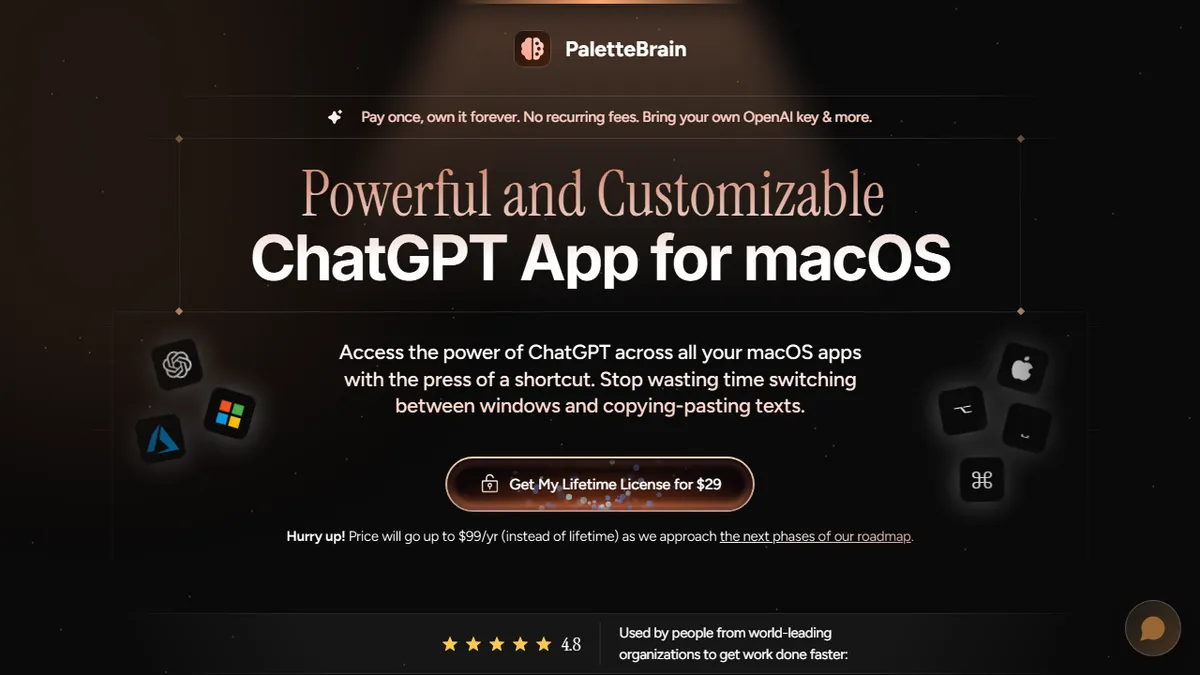
PaletteBrain is a native macOS utility that puts OpenAI models one keystroke away from whatever you're typing in. Select text in Notion, Google Docs, Slack, Gmail or any other app, hit the Space bar shortcut, and a configurable AI command runs against the selection without window-switching. You can define your own commands, bind them to keys, manage conversation history, and route requests through either the OpenAI API directly or Microsoft Azure OpenAI.
The pitch is bring-your-own-key pricing: instead of paying for a ChatGPT Plus subscription, you pay PaletteBrain a one-time fee and OpenAI for tokens consumed, which the vendor claims runs under a dollar a month for most users. Early-supporter licenses are $29 once for Personal (versus $99/year regular) and $99 once for a 5-device Family plan, with custom Team pricing for unlimited devices. It's aimed at founders, writers and knowledge workers who want to consolidate Grammarly, DeepL, Raycast AI and similar tools into one shortcut-driven layer.
Caveats are real: macOS only, no Windows or Linux build, no public API of its own, and you must hold your own OpenAI or Azure key. The roadmap mentions adding Anthropic, Google, Meta, Mistral, Perplexity and xAI models, but at evaluation time it's an OpenAI-first wrapper.
A clean, focused take on the 'AI launcher' category that undercuts Raycast AI and ChatGPT Plus by going one-time-license plus pay-as-you-go tokens. The single-platform, single-provider scope is the honest tradeoff; if that matches your stack, the math is hard to argue with.
— The AI Tool Bible editorial team
Pros
- ✅ One-time license avoids monthly ChatGPT Plus and Raycast Pro fees
- ✅ Works system-wide in any macOS app via Space bar shortcut
- ✅ Fully customizable commands and keybindings
- ✅ Supports both OpenAI and Azure OpenAI endpoints
Cons
- ⚠️ macOS only; no Windows or Linux build
- ⚠️ Requires you to bring and manage your own OpenAI API key
- ⚠️ Locked to OpenAI/Azure today; multi-provider support is roadmap
- ⚠️ No public API to script PaletteBrain itself
Use cases
Frequently asked
- How does PaletteBrain handle pricing and API costs?
- It uses a bring-your-own-key model where you pay a one-time license fee and pay OpenAI directly for token consumption. Early-supporter personal licenses cost $29, while family plans are $99.
- Which operating systems and AI providers are supported?
- PaletteBrain is exclusively for macOS and currently supports OpenAI and Microsoft Azure OpenAI endpoints. Support for other providers like Anthropic and Google is listed on the roadmap but not yet available.
- How do I use PaletteBrain within other applications?
- You select text in any app, such as Notion or Gmail, and press a configurable shortcut, typically the Space bar, to run an AI command without switching windows.
- Does PaletteBrain offer a public API for integration?
- No, PaletteBrain does not have a public API of its own. It is a native utility designed for direct user interaction via keyboard shortcuts rather than programmatic scripting.
Explore related
Compare with similar tools
All in Writing →Claude
FeaturedAnthropic's flagship assistant for long-form writing, analysis, and coding.
GPT-4o
FeaturedOpenAI's multimodal flagship behind ChatGPT.
Gemini Advanced
Google's flagship — strong at math, long context, and Workspace integration.
Llama 3
Meta's open-weights LLM family that put serious frontier-adjacent models in everyone's hands.
Qwen
Alibaba's open-weight foundation model family covering chat, vision, image generation, translation, and safety classification.
Jan
Open-source desktop ChatGPT alternative that runs local LLMs and routes to cloud providers from one app.