PageIndex
Vectorless reasoning-based retrieval for long documents, with traceable, auditable answers.
In short
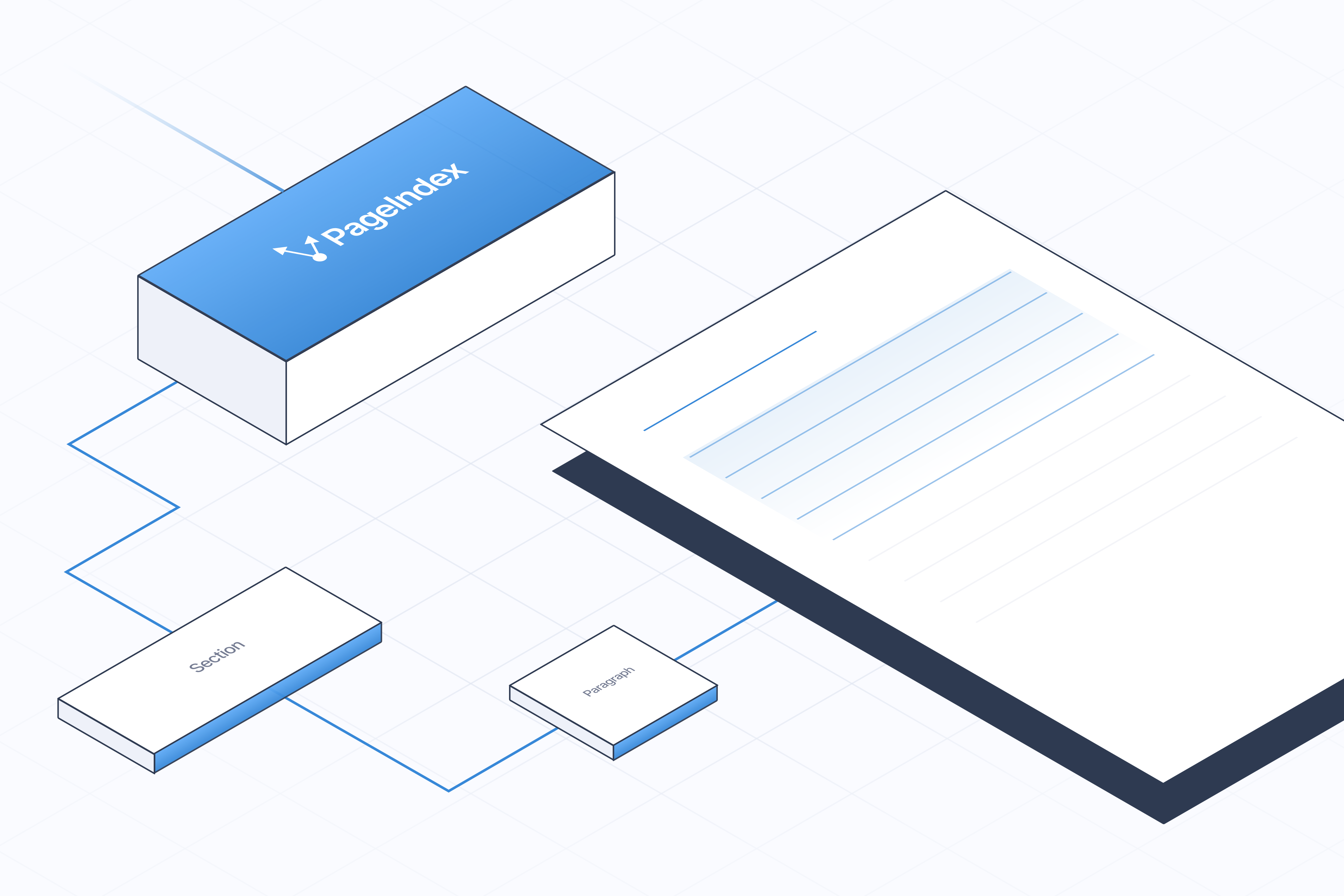
PageIndex uses a reasoning-based retrieval pipeline to navigate long documents without embeddings or chunking. It is best for teams needing auditable, page-cited answers from complex PDFs like legal contracts or financial filings.
Pick PageIndex if you need explainable, citation-grounded answers from long structured PDFs and your team is tired of debugging chunking strategies.
Skip it if you are doing semantic search over short snippets or already happy with a mature vector-DB RAG stack.
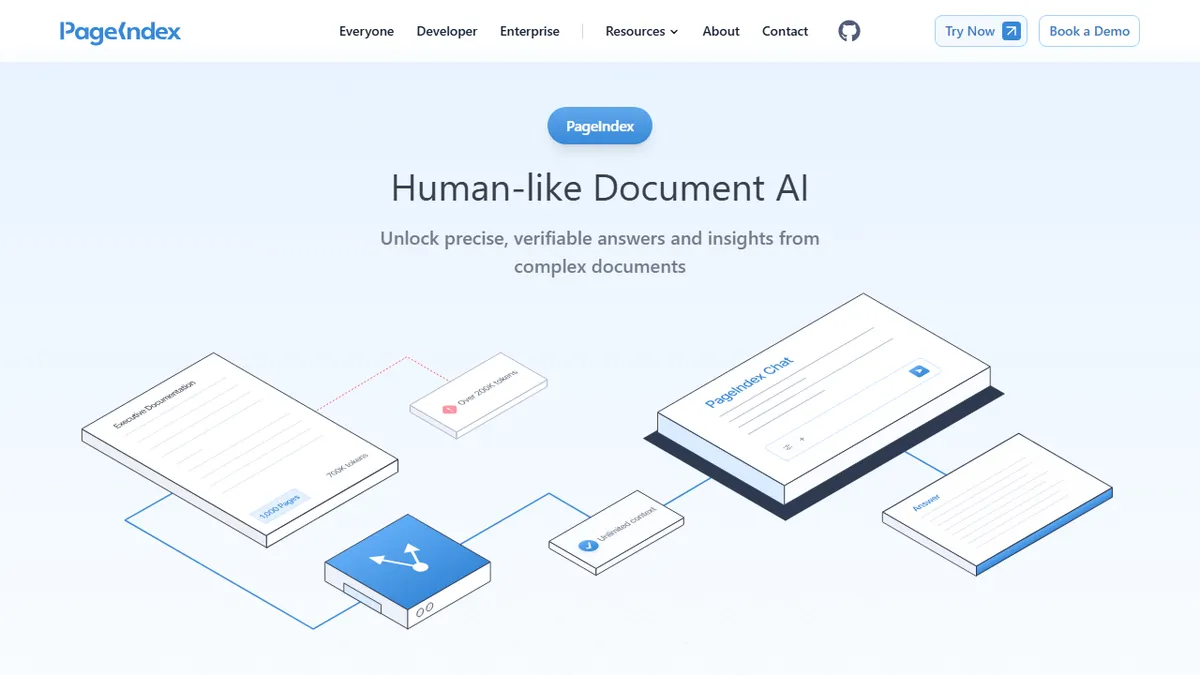
PageIndex is a document intelligence platform that takes a deliberately contrarian approach to RAG: no embeddings, no chunking, no vector database. Instead it uses a reasoning-based retrieval pipeline that navigates documents structurally and returns answers grounded in cited source pages. The product ships as a hosted chat interface, a developer API, and an MCP server, plus an open-source component on GitHub.
The pitch lands hardest for teams working with long, structured PDFs - financial filings, legal contracts, regulatory dossiers, technical manuals - where chunk-and-embed pipelines lose context and hallucinate. PageIndex's selling point is auditability: every answer comes with a traceable path back to the page it came from, which matters for compliance-bound workflows. There is a free Try Now tier; pricing for higher usage and enterprise deployments is not published and goes through a demo booking.
The vectorless approach is the differentiator and the caveat in one. It sidesteps the well-known failure modes of similarity search but it is a newer architecture than mainstream RAG stacks, so prior art and community recipes are thinner. The MCP server and cookbook docs make it reasonable to drop into an existing agent setup without rebuilding a retrieval layer from scratch.
The vectorless angle is more than a marketing tagline - it is a real bet that reasoning over document structure beats nearest-neighbor search for long, audited documents. We would trial it on a regulated-document workflow before committing, mostly because pricing and model details are not yet on the page.
— The AI Tool Bible editorial team
Pros
- ✅ Vectorless retrieval avoids chunking and embedding drift on long documents
- ✅ Every answer carries a traceable path back to source pages
- ✅ Ships as API, MCP server, and hosted chat - flexible integration paths
- ✅ Open-source component on GitHub for inspection and self-build
Cons
- ⚠️ Public pricing is opaque beyond the free tier
- ⚠️ Newer architecture means thinner community recipes than vector RAG
- ⚠️ Underlying model stack not disclosed on the marketing page
Use cases
Frequently asked
- How does PageIndex differ from standard RAG systems?
- PageIndex avoids embeddings, chunking, and vector databases. Instead, it uses a reasoning-based pipeline that navigates documents structurally to return grounded answers.
- What types of documents is PageIndex designed for?
- It is optimized for long, structured PDFs such as financial filings, legal contracts, regulatory dossiers, and technical manuals where context preservation is critical.
- Is PageIndex available as open source?
- Yes, PageIndex includes an open-source component on GitHub, alongside a hosted chat interface, developer API, and MCP server.
- How is PageIndex priced?
- The platform offers a free 'Try Now' tier. Enterprise pricing is not publicly listed and requires booking a demo to request details.
- Can PageIndex be integrated into existing agent setups?
- Yes, it ships with an MCP server and cookbook documentation, allowing it to be dropped into existing agent configurations without rebuilding the retrieval layer.
Explore related
Compare with similar tools
All in RAG →Pinecone
FeaturedManaged vector database for production-scale similarity search.
LlamaIndex
FeaturedData framework for connecting LLMs to your data.
Elasticsearch Vector Search
Hybrid vector + keyword search in the enterprise-grade Elasticsearch engine
Snowflake Cortex
Generative AI and RAG built into the Snowflake data cloud
DataStax Astra DB
Serverless vector and document database for production RAG and AI agents
MongoDB Atlas Vector Search
Vector search built into the operational database you're already using.