
OpenRouter
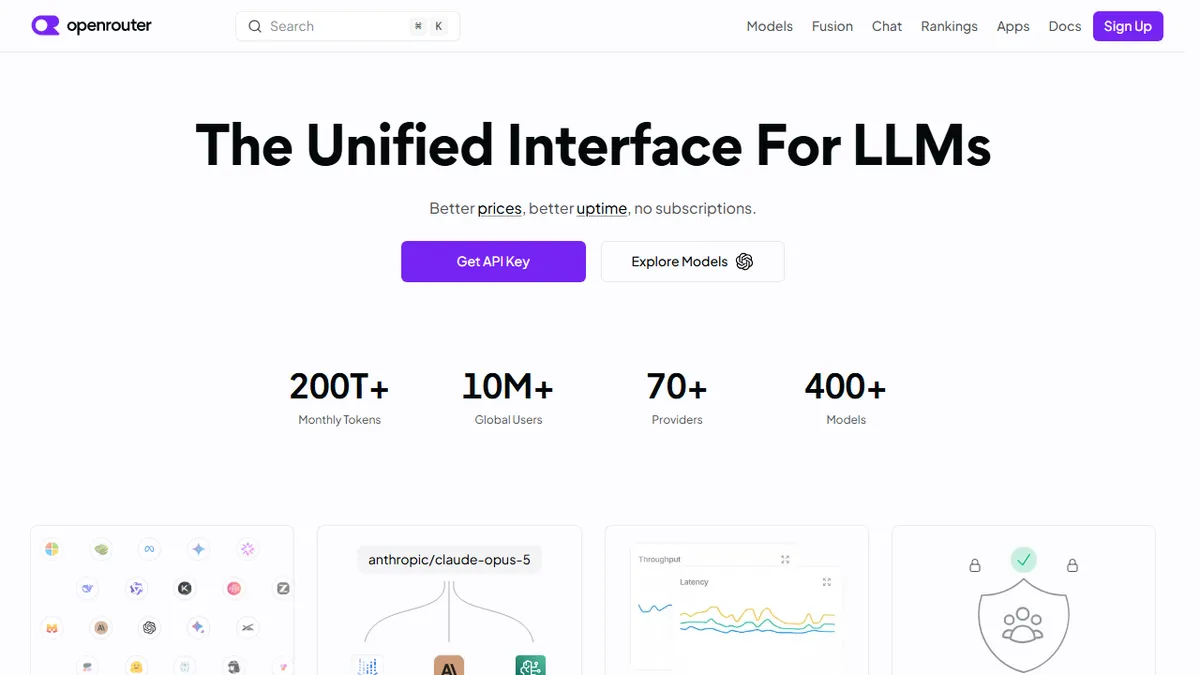
Unified API gateway to 400+ LLMs from 70+ providers, with one OpenAI-compatible endpoint and automatic failover.
In short
OpenRouter provides a single OpenAI-compatible API endpoint for accessing over 400 large language models from 70+ providers. It is best for engineers building LLM apps who need to avoid vendor lock-in, compare models, or implement automatic failover without rewriting client code.
Pick OpenRouter if you are building an LLM app and want to swap, A/B test, or fail over across many models without rewriting client code or signing per-provider contracts.
Skip it if you are committed to a single provider, need provider-specific features at the bleeding edge, or cannot accept an extra hop between your app and the model.
OpenRouter is a model routing and aggregation layer that gives developers a single OpenAI-compatible API for accessing more than 400 large language models from over 70 providers, including Anthropic's Claude family, OpenAI GPT models, Google Gemini, Meta Llama, DeepSeek, Mistral and a long tail of niche and open-weight checkpoints. Calls are routed across distributed infrastructure with automatic failover, so if one upstream provider rate-limits or goes down, requests keep flowing.
The product is squarely aimed at engineers building LLM-powered apps who want to avoid vendor lock-in, comparison-shop on price and latency, or fall back gracefully across providers. Billing is credit-based rather than subscription: you top up (packages start around $10) and pay per-token at near-pass-through provider rates plus a small markup, with no per-model contracts. Custom data policies let you whitelist or blacklist specific providers and route prompts only to ones whose privacy terms you accept.
Because the OpenAI SDK works as a drop-in client, migrating an existing app usually means changing a base URL and an API key. OpenRouter also exposes usage analytics, model rankings, and per-provider performance data, which makes it a useful research tool even if you ultimately call providers directly. The platform itself is proprietary, not open source, and you are still trusting OpenRouter as a middle hop between your app and the upstream model.
OpenRouter has quietly become the default abstraction layer for serious multi-model apps. The pricing is honest, the SDK compatibility is real, and the failover saved more launches than most teams admit. The only real cost is one more vendor in the trust chain, which is usually worth it.
— The AI Tool Bible editorial team
Pros
- ✅ One OpenAI-compatible endpoint for 400+ models across 70+ providers
- ✅ Automatic failover and load balancing between upstream providers
- ✅ Pay-as-you-go credits, no per-provider contracts or commitments
- ✅ Custom data policies to control which providers see your prompts
- ✅ Drop-in migration from OpenAI SDK
Cons
- ⚠️ Adds a middle hop and small markup over direct provider pricing
- ⚠️ Proprietary platform; you trust OpenRouter with traffic and metadata
- ⚠️ Free tier is limited to specific models, not a true free quota
- ⚠️ Some advanced provider-specific features may not surface through the unified API
Use cases
Frequently asked
- How does OpenRouter handle provider outages or rate limits?
- Calls are routed across distributed infrastructure with automatic failover. If one upstream provider rate-limits or goes down, requests keep flowing to other providers.
- What is the pricing model for OpenRouter?
- Billing is credit-based and pay-as-you-go, with packages starting around $10. Users pay per-token at near-pass-through provider rates plus a small markup, with no per-model contracts.
- Is it difficult to migrate an existing OpenAI application to OpenRouter?
- Migration is typically a drop-in process because the OpenAI SDK works as a client. Developers usually only need to change the base URL and API key.
- Can I control which providers receive my data?
- Yes, custom data policies allow you to whitelist or blacklist specific providers to ensure prompts are only routed to those whose privacy terms you accept.
- Does OpenRouter offer a free tier?
- Some free-tier models are available, but the free tier is limited to specific models rather than providing a true free quota for all services.
Explore related
Compare with similar tools
All in Coding →Cursor
FeaturedAI-first VS Code fork — chat, edit, and agentic coding in one IDE.
GitHub Copilot
FeaturedThe original AI pair programmer, now with chat and agents.
Replit Agent
FeaturedBuild & deploy a full app from a single prompt.
Warp
The agentic development environment, from the terminal up
Cline
Open-source agentic coding assistant that plans, edits, and runs code inside your IDE
Aider
Terminal-based AI pair programmer that writes commits.