
OpenDataLoader PDF
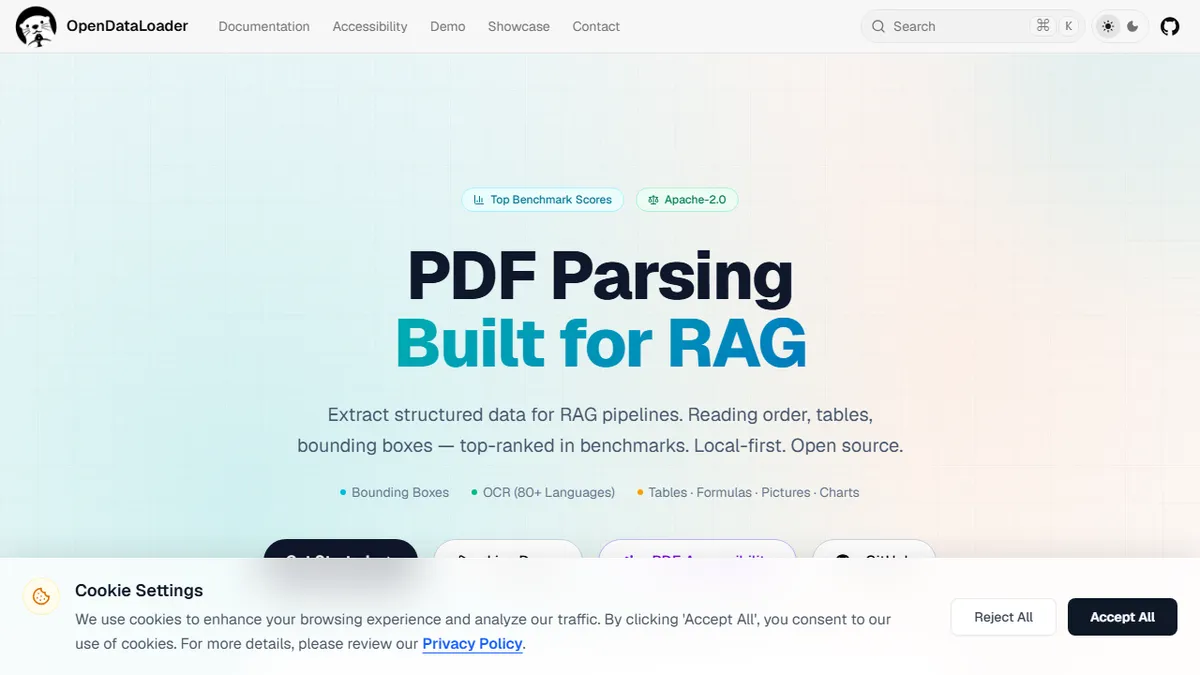
Open-source PDF parser built for RAG pipelines, with reading-order detection, table extraction, and bounding-box citations.
In short
OpenDataLoader PDF is a free, self-hosted Apache 2.0 parser for RAG pipelines. It extracts tables, text, and citations locally with high accuracy.
Pick OpenDataLoader PDF if you are building a RAG or document-AI pipeline and need a self-hosted parser that preserves layout, tables, and citation coordinates.
Skip it if you want a turnkey cloud document chat product or a no-code extraction UI rather than a developer library.
OpenDataLoader PDF is an Apache 2.0-licensed PDF parsing toolkit purpose-built for feeding clean, structured data into RAG pipelines and LLM applications. It uses an XY-Cut++ reading-order algorithm to handle multi-column layouts, extracts tables with merged-cell handling (the project cites 93% accuracy on its benchmarks), and emits structured JSON with element-level bounding boxes so downstream agents can produce source-grounded citations. OCR covers 80+ languages, with optional LLM enhancement, and the pipeline filters hidden text and prompt-injection payloads embedded in documents.
This is squarely a developer tool for teams building retrieval systems who are tired of PDFs being the weakest link. It's local-first (pip install, no API keys, no data leaving the machine), has an official LangChain integration, and ranks at the top of public PDF-parsing benchmarks (0.907 hybrid, 0.831 standard). The core is free; an enterprise tier covers PDF/UA accessibility export and a visual editor. There's no hosted API on the open-source side - you run it yourself.
Good fit for RAG engineers, document-AI startups, and anyone doing compliance-sensitive extraction where cloud parsers are off-limits. Less useful if you just want a one-click cloud document Q&A product.
One of the more thoughtful open-source PDF parsers we've seen for RAG specifically - the bounding-box-per-element design is exactly what citation-grounded agents need, and the prompt-injection filtering is a nice touch. If you're still passing PDFs through generic text extractors, this is worth a benchmark.
— The AI Tool Bible editorial team
Pros
- ✅ Apache 2.0 open source, runs locally with no API keys or cloud dependency
- ✅ Bounding-box coordinates on every element enable source-grounded citations
- ✅ Strong table extraction and multi-column reading-order handling
- ✅ Official LangChain integration drops cleanly into existing RAG stacks
- ✅ Filters hidden text and prompt-injection payloads inside PDFs
Cons
- ⚠️ Not a hosted service - you have to run and scale it yourself
- ⚠️ Some features (PDF/UA export, visual editor) gated behind enterprise tier
- ⚠️ Pure preprocessing tool, not an end-to-end document Q&A product
Use cases
Frequently asked
- How much does OpenDataLoader PDF cost?
- The core tool is free under the Apache 2.0 license. An enterprise tier is available for PDF/UA export and a visual editor, but the open-source version has no hosted API.
- Does OpenDataLoader PDF work with LangChain?
- Yes, it has an official LangChain integration. It is designed as a developer library for building retrieval systems, requiring you to run it locally via pip install.
- Can OpenDataLoader PDF handle complex layouts and tables?
- Yes, it uses an XY-Cut++ algorithm for multi-column layouts and extracts tables with merged-cell handling. The project cites 93% accuracy on its benchmarks for table extraction.
- Is OpenDataLoader PDF suitable for non-technical users?
- No, it is a developer tool for teams building RAG pipelines. It is not a turnkey cloud product or no-code UI, so it is less useful if you want one-click document Q&A.
- Does OpenDataLoader PDF support OCR and security features?
- It supports OCR for 80+ languages with optional LLM enhancement. The pipeline also filters hidden text and prompt-injection payloads, making it suitable for compliance-sensitive extraction.
Explore related
Compare with similar tools
All in RAG →Pinecone
FeaturedManaged vector database for production-scale similarity search.
LlamaIndex
FeaturedData framework for connecting LLMs to your data.
Elasticsearch Vector Search
Hybrid vector + keyword search in the enterprise-grade Elasticsearch engine
Snowflake Cortex
Generative AI and RAG built into the Snowflake data cloud
DataStax Astra DB
Serverless vector and document database for production RAG and AI agents
MongoDB Atlas Vector Search
Vector search built into the operational database you're already using.