
OpenAI Evals
✓ Editorially verifiedOpenAI's open-source framework for benchmarking LLMs against a shared registry of evaluations.
In short
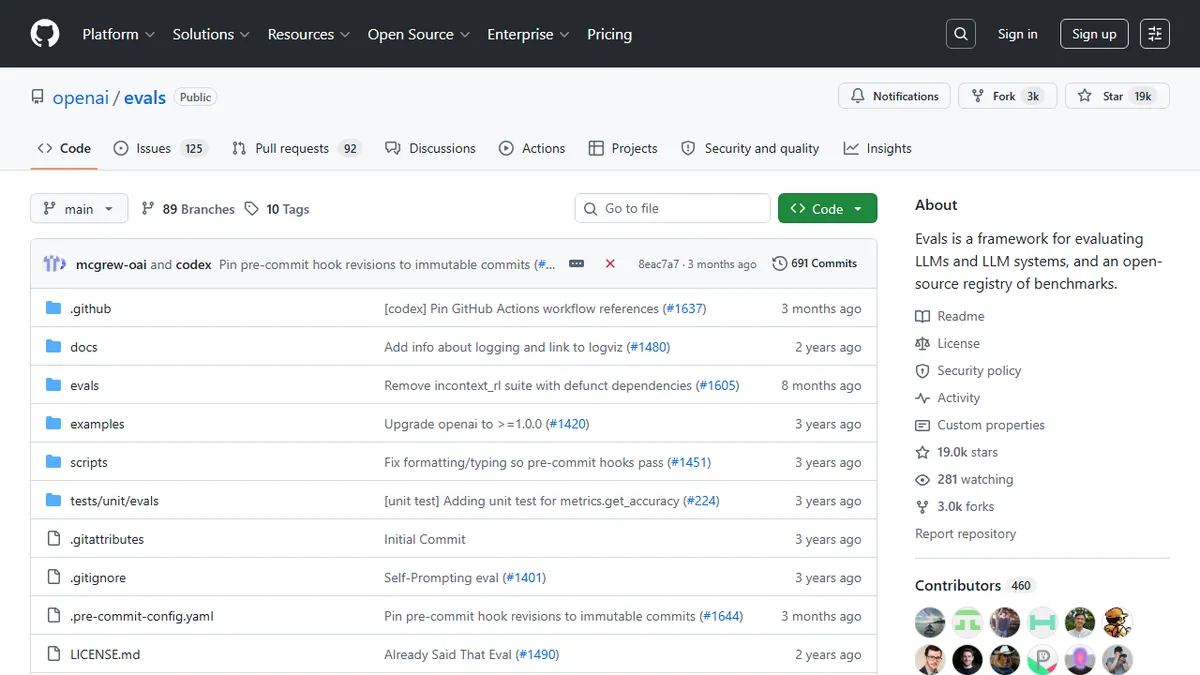
OpenAI Evals is a free, MIT-licensed Python framework for benchmarking LLMs with a large registry of prebuilt tests. It offers reproducible, code-first evaluation for GPT-based systems.
Pick OpenAI Evals if you want a free, code-first, reproducible eval harness for GPT-based systems with a large registry of ready-made benchmarks.
Skip it if you want a polished hosted dashboard, non-OpenAI-first provider support, or a no-code eval workflow for PMs.
OpenAI Evals is a Python framework and public registry for evaluating large language models and LLM-powered systems. It ships with a large catalog of prebuilt evals covering reasoning, factuality, coding, safety, and domain-specific benchmarks, and lets you register your own private evals using YAML plus a small amount of Python. Evals can be basic (exact match, includes, fuzzy match), model-graded (using a stronger model as a judge), or fully custom.
The framework is aimed at ML engineers and applied teams shipping GPT-based products who need reproducible, versioned test suites rather than vibes-based prompt tweaking. It's free and MIT-licensed, but running the evals themselves costs whatever the underlying OpenAI API calls cost, which can add up quickly on large graded suites. It's less polished than commercial eval platforms (Braintrust, Langsmith, Humanloop) but it's the canonical reference implementation and the format many benchmarks are published in.
Integrations include Weights & Biases for run tracking and optional Snowflake logging. Python 3.9+ and Git-LFS are required, and while the registry is OpenAI-flavored, the eval logic itself is portable enough that teams often adapt it to other providers.
OpenAI Evals is the reference eval harness even if you never use it directly, since so many public benchmarks ship in its format. It's the pragmatic starting point for teams who've outgrown ad-hoc prompt testing but aren't ready to pay for Braintrust or Langsmith. Just watch your token spend on model-graded runs.
— The AI Tool Bible editorial team
Pros
- ✅ Large public registry of ready-to-run evals
- ✅ MIT-licensed and fully open source
- ✅ Supports basic, model-graded, and custom evals
- ✅ Canonical format many published benchmarks adopt
- ✅ W&B and Snowflake logging out of the box
Cons
- ⚠️ Registry and defaults are OpenAI-centric
- ⚠️ Model-graded evals can rack up API costs fast
- ⚠️ UX is CLI + YAML, no hosted dashboard
- ⚠️ Less actively iterated than commercial rivals
Use cases
Frequently asked
- How much does OpenAI Evals cost to use?
- The framework is free and MIT-licensed. However, you pay OpenAI API costs for the actual eval runs, which can add up quickly on large graded suites.
- Is OpenAI Evals suitable for non-technical product managers?
- No, skip it if you want a no-code eval workflow. It is a code-first Python framework aimed at ML engineers and applied teams, not a polished hosted dashboard for PMs.
- What integrations does OpenAI Evals support?
- It includes integrations with Weights & Biases for run tracking and optional Snowflake logging. Python 3.9+ and Git-LFS are required for setup.
- Can I use OpenAI Evals with models other than GPT?
- While the registry is OpenAI-flavored, the eval logic is portable enough that teams often adapt it to other providers. It is extensible beyond just OpenAI GPT models.
- What types of evaluations are available in the registry?
- The registry includes prebuilt evals for reasoning, factuality, coding, and safety. You can also register private evals using YAML and Python, supporting basic, model-graded, or custom types.
Explore related
Compare with similar tools
All in Evaluation →Braintrust
FeaturedEval, monitor, and improve AI products end-to-end.
LangSmith
LangChain's eval + observability platform.
Weights & Biases
The ML experiment tracker, now with LLM eval features.
Helicone
Open-source LLM observability — one-line proxy install.
Arize AI
Enterprise observability and evaluation platform for LLM agents and generative AI applications.
Giskard
Continuous AI red teaming platform that stress-tests LLM agents for vulnerabilities before they hit production.