ONNX
Open standard for representing and exchanging machine learning models across frameworks and runtimes.
In short
ONNX is a free, open standard for exchanging ML models across frameworks. It enables portability to various runtimes and hardware without rewriting code.
Pick ONNX if you need to move a trained model out of its source framework and into a different runtime, hardware target, or edge device.
Skip it if you're staying inside a single framework end-to-end or want a managed inference platform rather than a file format.
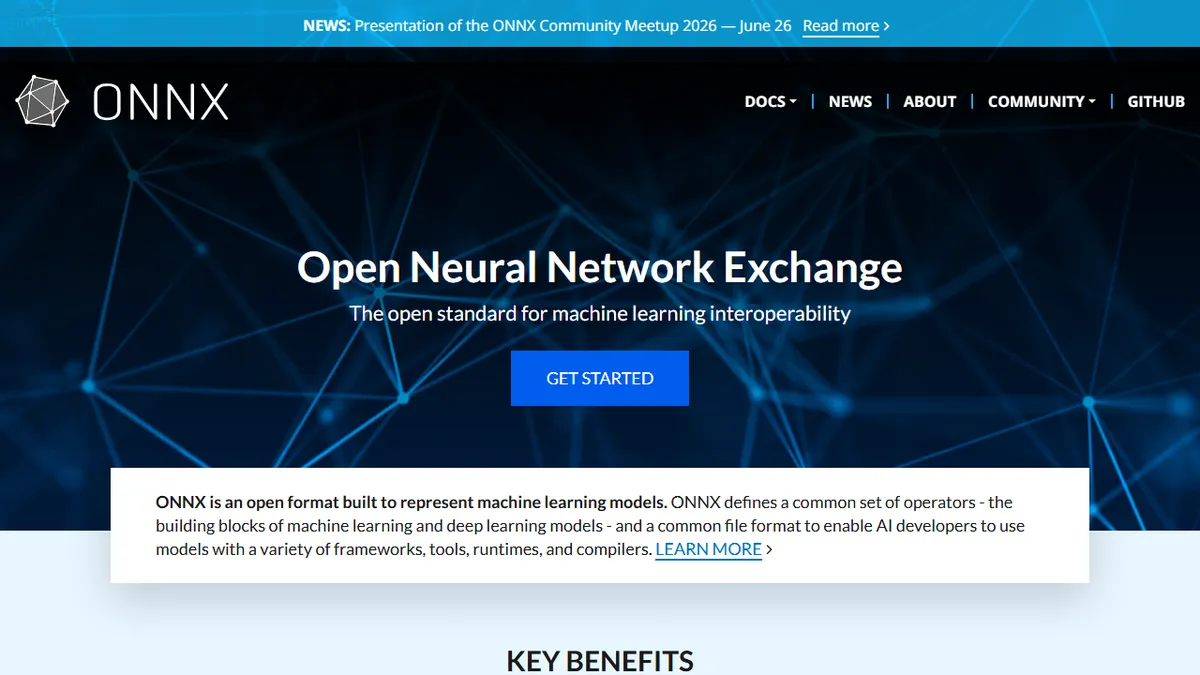
ONNX (Open Neural Network Exchange) is an open format for representing machine learning models, defining a shared set of operators and a common file structure that any compliant framework, runtime, or compiler can read. In practice it lets you train a model in PyTorch, export it to ONNX, then run it through ONNX Runtime, TensorRT, OpenVINO, CoreML, or a browser-side engine without rewriting the model.
It's not a SaaS product and there's no pricing - ONNX is a Linux Foundation AI graduate project maintained by a multi-vendor community (Microsoft, Meta, NVIDIA, Intel, AMD, and others). The audience is ML engineers and platform teams who need framework portability, hardware acceleration across CPUs/GPUs/NPUs, or edge deployment where the training stack isn't available at inference time. The actual runtime work happens in adjacent projects like ONNX Runtime; ONNX itself owns the spec, the opset, and the reference tooling.
The ecosystem is broad: exporters in PyTorch and TensorFlow/Keras, runtimes from most major hardware vendors, optimization tools (onnx-simplifier, onnx-optimizer), and quantization paths for INT8/FP16 deployment. Caveats are real - opset version mismatches and unsupported ops still cause export failures, and dynamic-graph or custom-op models can need manual surgery before they cleanly serialize.
ONNX is plumbing, not a product, but it's the plumbing the entire model-deployment industry has standardized on. If you're shipping inference anywhere outside the training framework, you'll touch it eventually. Expect to spend time on opset compatibility - that's the cost of portability.
— The AI Tool Bible editorial team
Pros
- ✅ Vendor-neutral standard backed by Linux Foundation and every major hardware maker
- ✅ Export once, deploy to CPUs, GPUs, NPUs, mobile, and browsers via compatible runtimes
- ✅ Mature tooling for quantization, graph optimization, and opset conversion
- ✅ Massive ecosystem of pretrained models available in ONNX format
Cons
- ⚠️ Opset version drift between exporters and runtimes still breaks models
- ⚠️ Dynamic shapes and custom ops often need manual export workarounds
- ⚠️ It's a spec, not a turnkey product - you still pick a runtime separately
Use cases
Frequently asked
- How much does ONNX cost?
- ONNX is completely free and open source under the Apache-2.0 license. It is a Linux Foundation AI project maintained by a multi-vendor community, so there are no subscription fees or pricing tiers.
- What are the main alternatives to ONNX?
- If you stay within a single framework end-to-end, you might skip ONNX. Alternatively, if you prefer a managed inference platform rather than a file format for model exchange, other solutions may be more suitable.
- Which frameworks and runtimes does ONNX integrate with?
- ONNX integrates with PyTorch and TensorFlow/Keras for exporting. It supports runtimes like ONNX Runtime, TensorRT, OpenVINO, CoreML, and browser-side engines, allowing execution on CPUs, GPUs, and NPUs from major hardware vendors.
- Is ONNX difficult to learn for ML engineers?
- It is designed for ML engineers and platform teams. While the spec is standard, caveats exist: opset version mismatches or unsupported operations can cause export failures, potentially requiring manual adjustments for dynamic-graph or custom-op models.
- Can ONNX be used for edge deployment?
- Yes, ONNX is ideal for edge deployment where the training stack isn't available at inference time. It supports hardware acceleration and includes quantization paths for INT8/FP16 deployment to optimize performance on edge devices.
Explore related
Compare with similar tools
All in Fine-tuning →Together AI
FeaturedFine-tune & serve open-weight models (Llama, Mistral, DeepSeek).
Modal
Serverless GPUs and infra for training & serving ML.
Replicate
One-API platform for running and fine-tuning open-source models.
OpenAI Fine-tuning
Fine-tune GPT-4o-mini and friends on your own data.
Llama
Meta's open-weight LLM family covering 1B mobile models up to 405B frontier and natively multimodal 10M-context Llama 4 variants.
RunPod
On-demand GPU cloud and serverless inference platform built specifically for AI workloads.