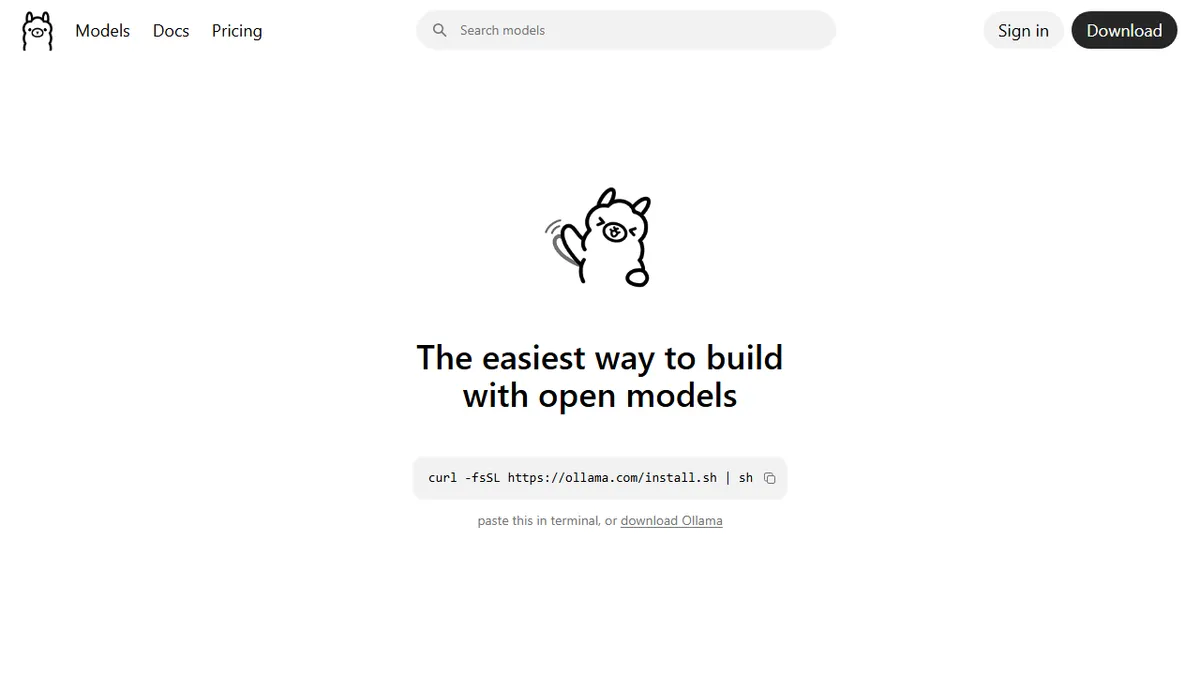

Ollama
The de facto runtime for running open-weights LLMs locally, now with a paid cloud tier for bigger models.
In short
Ollama simplifies downloading and serving open-weights LLMs locally on Mac, Linux, and Windows. It exposes an OpenAI-compatible API for seamless integration with existing tools. A paid cloud tier is available for larger models that exceed local hardware limits.
Pick Ollama if you want one command to run open-weights LLMs on your own hardware with a clean API that any client can hit.
Skip it if you need high-throughput production inference at scale or specifically want frontier closed models like GPT-5 or Claude.
Ollama is the simplest way to download, run, and serve open-weights large language models on your own machine. A single CLI pulls quantized GGUF builds of Llama, Qwen, Gemma, DeepSeek, Mistral, Phi and dozens of others, then exposes them over a local OpenAI-compatible HTTP API so any client (Open WebUI, Continue, LangChain, Claude Code, custom apps) can talk to them without code changes. Mac, Linux and Windows are all first-class.
The tool is open source (MIT) and free for local use, which is how most people meet it. Ollama now also sells a hosted tier for models too big for a laptop: Pro at $20/mo runs up to 3 cloud models concurrently, Max at $100/mo bumps that to 10, with US/EU/Singapore regions and a 'your data is never trained on' promise. The hybrid story (develop locally, burst to cloud with the same API) is the differentiator versus pure-local llama.cpp or pure-cloud Together/Fireworks.
The ecosystem is huge: every desktop LLM client, IDE plugin, and agent framework worth mentioning has an Ollama adapter, and the model library is curated and quantization-tagged so 'ollama run qwen2.5:14b' Just Works. Limitations: it's a wrapper over llama.cpp under the hood, so cutting-edge inference engines (vLLM, SGLang) are faster for serving, and the cloud tier is newer and less battle-tested than Together/Groq.
Ollama is the package manager for local LLMs and has basically won that category. The new paid cloud tier is a smart hedge for users whose laptops can't fit a 70B model, though serious production teams will still reach for vLLM or a hosted inference API. For everyone else, it's the obvious default.
— The AI Tool Bible editorial team
Pros
- ✅ Easiest path to running open-weights LLMs locally on Mac/Linux/Windows
- ✅ OpenAI-compatible API means existing tooling works out of the box
- ✅ Huge curated model library with sensible quantization defaults
- ✅ Same API for local and cloud lets you scale without rewriting code
- ✅ Open source (MIT) with a massive integration ecosystem
Cons
- ⚠️ Underlying llama.cpp engine is slower than vLLM/SGLang for production serving
- ⚠️ Cloud tier is newer than competitors like Together or Fireworks
- ⚠️ Configuration of GPU offload and context length can be finicky
Use cases
Frequently asked
- What models can I run with Ollama?
- Ollama supports a curated library of open-weights models including Llama, Qwen, Gemma, DeepSeek, Mistral, and Phi. It handles quantized GGUF builds with sensible defaults for easy execution.
- How does Ollama integrate with existing development tools?
- It exposes a local OpenAI-compatible HTTP API, allowing clients like Open WebUI, Continue, LangChain, and custom apps to connect without code changes. The same API works for both local and cloud tiers.
- Is Ollama free to use?
- Local use is free and open source under the MIT license. Paid cloud tiers are available for Pro at $20/mo and Max at $100/mo, which allow running larger models concurrently in US, EU, or Singapore regions.
- What are the limitations of using Ollama?
- It uses llama.cpp under the hood, which may be slower than vLLM or SGLang for high-throughput production serving. The cloud tier is newer and less battle-tested than some competitors, and GPU offload configuration can be finicky.
Explore related
Compare with similar tools
All in Coding →Cursor
FeaturedAI-first VS Code fork — chat, edit, and agentic coding in one IDE.
GitHub Copilot
FeaturedThe original AI pair programmer, now with chat and agents.
Replit Agent
FeaturedBuild & deploy a full app from a single prompt.
Warp
The agentic development environment, from the terminal up
Cline
Open-source agentic coding assistant that plans, edits, and runs code inside your IDE
Aider
Terminal-based AI pair programmer that writes commits.