ModelFuzz
Open-source red-teaming and execution-layer defense for AI agents against prompt injection.
In short
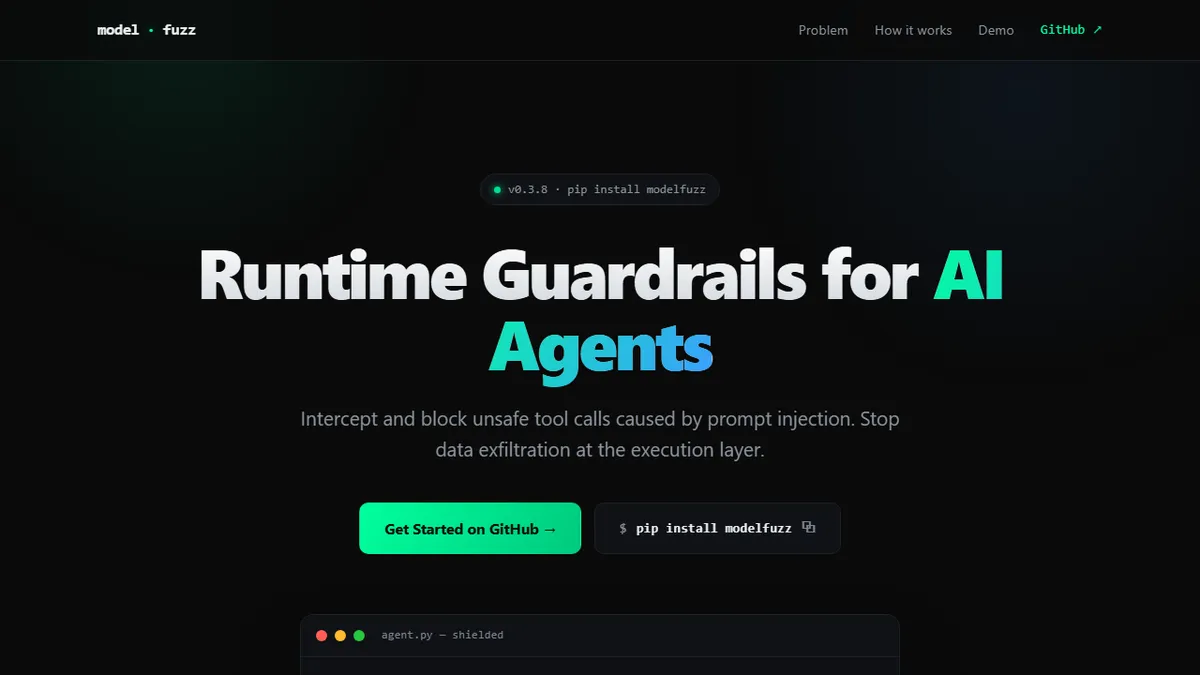
ModelFuzz hardens LLM agents by inspecting tool call arguments at the execution layer to block unsafe actions. It includes a red-teaming scanner for OpenAI-compatible endpoints and a Python decorator for runtime policy enforcement.
Python engineering teams shipping agentic LLM products who need real, execution-layer guardrails on tool calls plus a repeatable adversarial scan they can run in CI against any OpenAI-compatible endpoint.
Non-Python stacks, teams that only need chat-style content moderation with no tool use, or buyers who want a fully managed enterprise security platform with SLAs today rather than a waitlist.
ModelFuzz is an open-source security toolkit that hardens LLM-powered agents against prompt injection and unsafe tool use. Instead of relying on prompt-level filtering, which attackers can talk around, it works at the execution layer: it inspects the arguments an agent is about to hand to a function or external API and blocks the call when it violates a configured policy.
The project ships two complementary halves. The offense side is a red-teaming scanner that hits any OpenAI-compatible endpoint with a library of adversarial prompts and reports which ones successfully jailbreak the model, exfiltrate data, or coerce the agent into unintended tool calls. The defense side is a lightweight Python decorator you wrap around your tool functions; before each invocation it validates arguments against pluggable policy engines such as URLAllowList, blocks anything unsafe, and writes a detailed audit log.
Typical workflows include: pointing the scanner at a staging agent to discover indirect-injection paths coming through poisoned emails, retrieved documents, or web pages; wrapping browsing, shell, filesystem, or HTTP-request tools with policies that constrain domains, file paths, or payload shapes; running the scanner in CI so new tools or model swaps don't silently regress agent safety; and pairing it with observability stacks to alert on blocked calls.
It is aimed at engineering teams shipping agentic products (RAG chatbots with tool use, browsing agents, coding copilots, internal automation) who need something more concrete than model system-prompt hardening. Being MIT-licensed and pip-installable, it drops into existing Python agent stacks without pulling in a vendor. A hosted dashboard for centralized policy management, longitudinal audit logs, and continuous scans is on the roadmap behind a waitlist.
I like that ModelFuzz treats agent safety as an execution problem, not a prompt-engineering problem. The decorator model is the right shape: cheap to adopt, hard for a jailbroken model to bypass, and honest about what it blocked. It is still early, and the built-in policy set is thin, but as a free, self-hostable red-team-plus-runtime layer it is one of the more pragmatic offerings in the agent-security space.
— The AI Tool Bible editorial team
Pros
- ✅ Execution-layer enforcement blocks unsafe tool calls even when the model is jailbroken.
- ✅ Combines red-team scanning and runtime defense in a single project, so findings map directly to policies.
- ✅ MIT-licensed and pip-installable; no lock-in and no data leaves your environment.
- ✅ OpenAI-compatible scanner works against any endpoint you can point at, including local models like Qwen 2.5.
- ✅ Simple Python decorator API integrates with existing agent code without a framework rewrite.
- ✅ Detailed audit logs of blocked calls make incident triage and CI regression tests straightforward.
Cons
- ⚠️ Python-only defense integration; teams on Node, Go, or Ruby agent stacks are left out for now.
- ⚠️ Policy library is still small (URLAllowList and a handful of others); complex apps will need to write custom validators.
- ⚠️ Hosted dashboard, centralized policies, and continuous scanning are waitlist-only, so self-hosting is required today.
- ⚠️ Scanner coverage depends on its adversarial prompt set; novel or domain-specific attacks may slip through without custom seeds.
- ⚠️ Early-stage project with limited third-party benchmarks and a small community compared to established red-team suites.
Use cases
Frequently asked
- How does ModelFuzz prevent prompt injection attacks?
- It works at the execution layer by inspecting arguments an agent passes to functions or APIs. It blocks calls that violate configured policies, such as URL allow-lists, rather than relying solely on prompt filtering.
- Is ModelFuzz available for free?
- Yes, the core toolkit is open-source under the MIT license and installable via pip. A hosted dashboard with centralized policies and continuous scanning is currently available via a waitlist.
- What types of AI models does ModelFuzz support?
- It is model-agnostic and works with any OpenAI-compatible endpoint. The scanner can test local models like Qwen 2.5 as well as other compatible APIs.
- Can ModelFuzz be integrated into CI/CD pipelines?
- Yes, the red-teaming scanner can be run in CI to ensure that new tools or model swaps do not cause regressions in agent safety.
- What programming languages are supported?
- The defense integration is Python-only, requiring a Python decorator to wrap tool functions. Teams using Node, Go, or Ruby agent stacks are not currently supported for the runtime defense component.
Explore related
Compare with similar tools
All in Evaluation →Braintrust
FeaturedEval, monitor, and improve AI products end-to-end.
LangSmith
LangChain's eval + observability platform.
Weights & Biases
The ML experiment tracker, now with LLM eval features.
Helicone
Open-source LLM observability — one-line proxy install.
Arize AI
Enterprise observability and evaluation platform for LLM agents and generative AI applications.
Giskard
Continuous AI red teaming platform that stress-tests LLM agents for vulnerabilities before they hit production.