
MLflow
✓ Editorially verifiedOpen-source platform for tracking, evaluating, and deploying ML models and LLM applications.
In short
MLflow is an Apache 2.0 licensed AI engineering platform that handles experiment tracking, model registry, and LLM evaluation. It is best for ML and platform engineers who want to run observability on their own infrastructure to avoid per-trace SaaS pricing.
Pick MLflow if you want a self-hosted, vendor-neutral home for LLM traces, evals, and prompts without per-event SaaS pricing.
Skip it if you want a zero-ops hosted observability product with a polished UI and don't mind paying LangSmith or Langfuse Cloud.
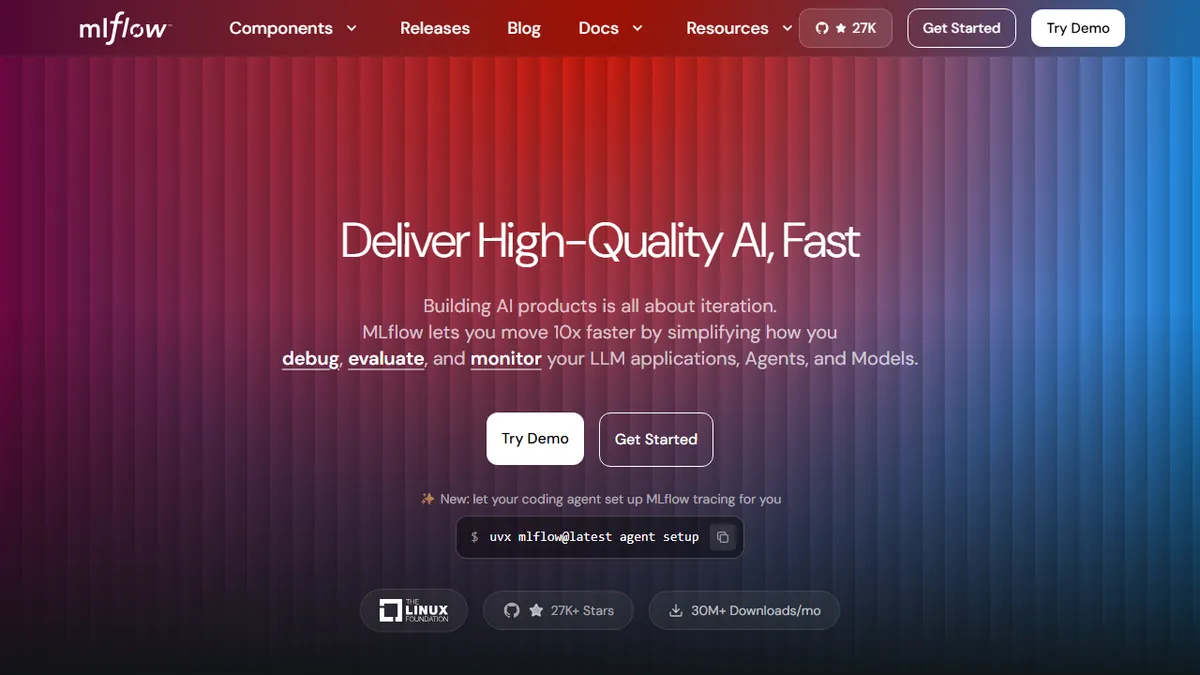
MLflow is an Apache 2.0 licensed AI engineering platform that started as a classical ML experiment tracker and has expanded into one of the most widely adopted open-source stacks for LLM and agent observability. It handles experiment tracking, model registry, prompt versioning, OpenTelemetry-based tracing, and systematic evaluation with 50+ built-in metrics and LLM-as-judge scorers across correctness, relevance, latency, and safety dimensions.
It's aimed at ML and platform engineers who want to run evals and observability on their own infrastructure rather than pay for a SaaS observability vendor. The free, self-hosted nature is the main draw: no per-trace pricing, no enterprise paywall, and SDKs in Python, TypeScript, Java, and R. The ecosystem is huge, with 20,000+ GitHub stars and integrations with LangChain, OpenAI, PyTorch, and ~100 other tools.
The newer additions, an AI Gateway for unified LLM provider access and an Agent Server with FastAPI hosting, push MLflow beyond pure tracking into runtime infrastructure. Hosted versions exist via Databricks if you don't want to operate it yourself, but the open-source server runs fine on a single VM for small teams.
MLflow is the safe, boring, durable choice for ML and LLM tracking, and that's the compliment. The eval and tracing additions are genuinely competitive with the hosted observability vendors, and the price (zero) is hard to beat if you have anyone on staff who can run a Postgres-backed service.
— The AI Tool Bible editorial team
Pros
- ✅ Fully open source under Apache 2.0 with no usage caps
- ✅ Covers eval, tracing, prompts, and registry in one tool
- ✅ Massive ecosystem with 100+ integrations including LangChain and OpenAI
- ✅ Multi-language SDKs (Python, TS, Java, R)
- ✅ Battle-tested at Fortune 500 scale
Cons
- ⚠️ Self-hosting and ops burden unless you pay for Databricks
- ⚠️ UI feels engineering-first rather than polished
- ⚠️ LLM features layered onto a classical-ML core can feel bolted-on
Use cases
Frequently asked
- Is MLflow free to use?
- Yes, MLflow is free and open source under the Apache 2.0 license. A managed offering is available via Databricks, but the core platform has no usage caps or per-trace pricing.
- What languages does MLflow support?
- MLflow provides SDKs in Python, TypeScript, Java, and R, allowing teams to integrate the platform into various development environments.
- Can MLflow evaluate LLM applications?
- Yes, it supports systematic evaluation with over 50 built-in metrics and LLM-as-judge scorers. It assesses dimensions such as correctness, relevance, latency, and safety for LLM and agent observability.
- What are the main drawbacks of using MLflow?
- The primary cons include the self-hosting and operational burden unless using Databricks, an engineering-first UI, and LLM features that may feel layered onto a classical-ML core.
Explore related
Compare with similar tools
All in Evaluation →Braintrust
FeaturedEval, monitor, and improve AI products end-to-end.
LangSmith
LangChain's eval + observability platform.
Weights & Biases
The ML experiment tracker, now with LLM eval features.
Helicone
Open-source LLM observability — one-line proxy install.
Arize AI
Enterprise observability and evaluation platform for LLM agents and generative AI applications.
Giskard
Continuous AI red teaming platform that stress-tests LLM agents for vulnerabilities before they hit production.