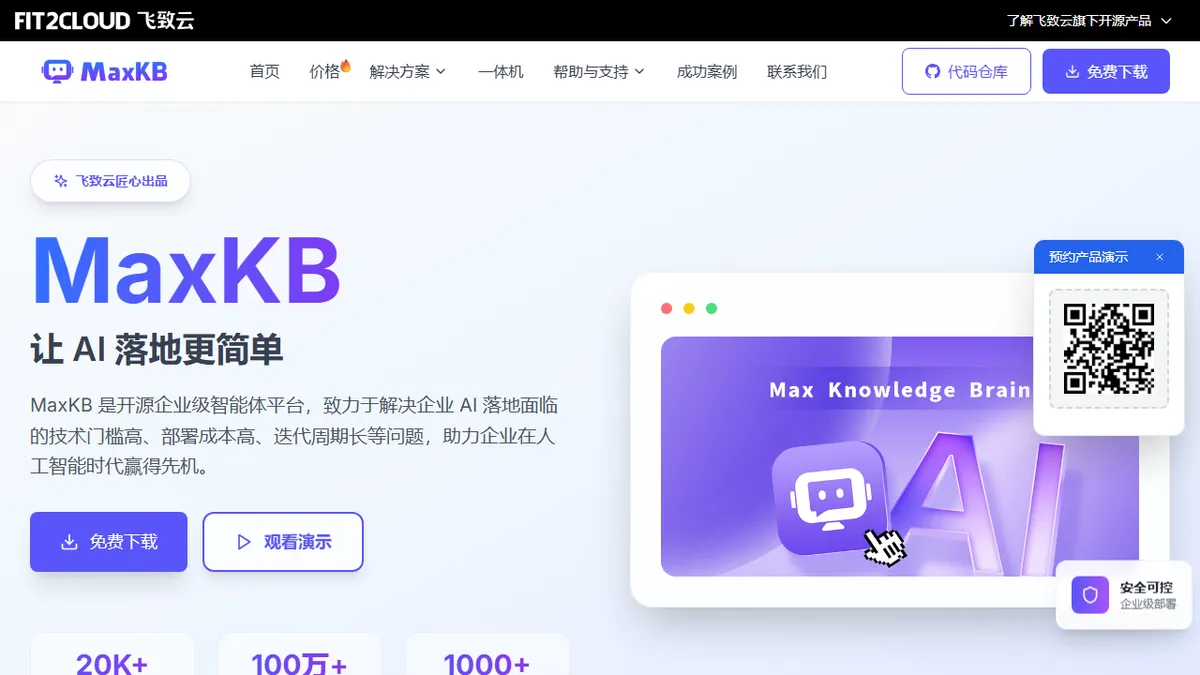

MaxKB
Open-source enterprise RAG and agent platform with built-in workflow engine and multi-LLM support.
In short
MaxKB is a free, self-hosted RAG and agent platform with a visual workflow builder. It supports multiple LLMs and deploys via Docker for enterprise knowledge management.
Pick MaxKB if you want a self-hosted, multi-LLM RAG and agent platform you can deploy in an afternoon and embed into internal tools.
Skip it if you need a fully managed SaaS or a permissively licensed library to bundle into a closed-source product.
MaxKB is a GPLv3-licensed enterprise knowledge base and AI agent platform from 1Panel that combines retrieval-augmented generation with an agentic workflow engine. It handles the full RAG pipeline out of the box: document ingestion (uploads + web crawler), automatic chunking, embedding into a pgvector store, and answer synthesis against a configurable LLM. A visual workflow builder, function library, and MCP tool-use support let teams stitch retrieval into multi-step agents without writing Python.
The big selling point is model flexibility and self-hosting. MaxKB plugs into commercial APIs (OpenAI, Claude, Gemini) and local/open models (DeepSeek, Llama, Qwen) with the same UI, and the whole stack (Vue + Django + PostgreSQL/pgvector) ships as a single Docker container you can stand up in minutes. It's free under GPLv3, with a paid enterprise edition for organizations that need commercial support, SSO, and audit features.
Multimodal inputs (text, image, audio, video), no-code embedding into existing business systems, and a 20k+ star GitHub footprint make it a credible alternative to Dify, FastGPT, or AnythingLLM for internal Q&A, customer support bots, and corporate knowledge management. The Chinese-origin docs and UI are fully translated, but some community resources still skew Mandarin-first.
MaxKB sits in the same lane as Dify and FastGPT but feels more opinionated about the RAG-plus-workflow combo. The GPLv3 license is the catch: fine for internal deployments, awkward if you want to ship it as part of a commercial product. For a self-hosted knowledge bot, it's one of the faster on-ramps we've tested.
— The AI Tool Bible editorial team
Pros
- ✅ Self-hostable via single Docker container with pgvector built in
- ✅ Works with both commercial APIs and local OSS models (DeepSeek, Llama, Qwen)
- ✅ Visual workflow engine and MCP tool-use without writing code
- ✅ Active project with 20k+ GitHub stars and GPLv3 license
Cons
- ⚠️ GPLv3 copyleft can be a non-starter for proprietary embedding
- ⚠️ Some community docs and issues skew Chinese-first
- ⚠️ Enterprise features (SSO, audit) gated behind paid tier
Use cases
Frequently asked
- How much does MaxKB cost?
- The community edition is free under the GPLv3 license. A paid enterprise edition is available for organizations requiring commercial support, SSO, and audit features.
- Can I use MaxKB with different AI models?
- Yes, MaxKB supports multi-model flexibility. It integrates with commercial APIs like OpenAI and Claude, as well as local models like DeepSeek, Llama, and Qwen, through the same user interface.
- Is MaxKB suitable for closed-source products?
- No, you should skip it if you need a permissively licensed library to bundle into a closed-source product. MaxKB is licensed under GPLv3, which may conflict with proprietary distribution requirements.
- How difficult is it to deploy MaxKB?
- Deployment is designed to be quick. The entire stack, including Vue, Django, and PostgreSQL, ships as a single Docker container that can be stood up in minutes for self-hosted use.
- Does MaxKB support non-text data types?
- Yes, MaxKB handles multimodal inputs including text, image, audio, and video. It processes these through its RAG pipeline, which includes document ingestion, chunking, and embedding into a pgvector store.
Explore related
Compare with similar tools
All in RAG →Pinecone
FeaturedManaged vector database for production-scale similarity search.
LlamaIndex
FeaturedData framework for connecting LLMs to your data.
Elasticsearch Vector Search
Hybrid vector + keyword search in the enterprise-grade Elasticsearch engine
Snowflake Cortex
Generative AI and RAG built into the Snowflake data cloud
DataStax Astra DB
Serverless vector and document database for production RAG and AI agents
MongoDB Atlas Vector Search
Vector search built into the operational database you're already using.