MarketMuse
AI-driven content planning and SEO optimization built around topical authority scoring.
In short
MarketMuse uses proprietary NLP to score topical authority and generate structured SEO briefs. It helps content teams identify gaps and plan high-impact topics based on demonstrated site expertise.
Pick MarketMuse if you run a content team that publishes at scale and needs defensible, authority-aware decisions about what to write next.
Skip it if you're a solo creator who just needs a cheap keyword tool or a generative writing assistant.
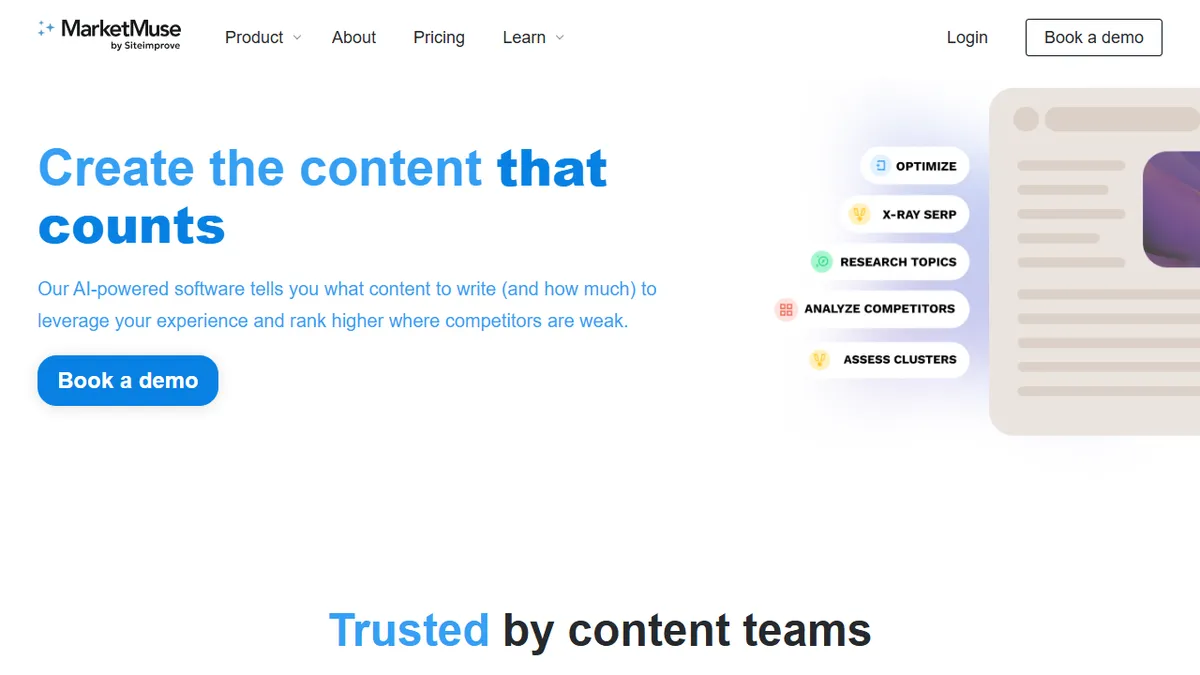
MarketMuse is a long-running content intelligence platform that uses AI to analyze your site's existing content, surface topic gaps versus competitors, and generate optimization briefs for new or updated pages. Its core hook is personalized difficulty scoring and a Topic Authority model: instead of treating keyword volume as gospel, it ranks opportunities against your site's demonstrated expertise, then hands writers a structured brief covering subtopics, questions to answer, internal links, and target depth.
It's aimed squarely at in-house SEO teams, content strategists, and agencies that publish at scale and need to justify what to write next. Pricing is tiered and steep once you leave the free plan (10 queries/month, no briefs): Optimize sits around $149/mo, Research around $499/mo, and the agency-grade Strategy plan around $999/mo with up to 10,000 tracked topics and all nine brief types. A free trial covers the paid features. There is no CMS or publishing layer.
MarketMuse predates the LLM boom by years and leans on proprietary NLP for topic modeling rather than generic generative AI. That gives it a defensible angle versus newer Surfer/Clearscope-style competitors, but it also means the UI and workflow feel more analyst-tool than copilot, and there's no documented public API on the marketing site.
MarketMuse is the grown-up of the SEO content tooling space: more rigorous than Surfer, less keyword-obsessed than Clearscope. The topic authority lens is genuinely useful, but the pricing assumes you're already running a real content operation, not testing the waters.
— The AI Tool Bible editorial team
Pros
- ✅ Personalized topic difficulty scored against your own site's authority, not generic SERPs
- ✅ Detailed content briefs covering structure, subtopics, questions, and linking
- ✅ Strong competitor gap and content inventory analysis
- ✅ Mature platform with a decade of NLP refinement behind it
Cons
- ⚠️ Paid tiers are expensive once you need briefs at any real volume
- ⚠️ No CMS integration; outputs still have to be handed to writers manually
- ⚠️ No documented public API on the marketing site
- ⚠️ UI feels analyst-heavy compared to newer LLM-native SEO copilots
Use cases
Frequently asked
- How much does MarketMuse cost?
- The free plan includes 10 queries per month. Paid tiers are Optimize at $149/mo, Research at $499/mo, and Strategy at $999/mo. A free trial is available for paid features.
- Is MarketMuse suitable for solo creators?
- No. It is best for in-house teams or agencies publishing at scale. Solo creators needing a cheap keyword tool or generative assistant should skip it.
- Does MarketMuse integrate with CMS platforms?
- There is no CMS or publishing layer. Additionally, there is no documented public API on the marketing site, so it functions as an analyst tool rather than a copilot.
- What AI technology does MarketMuse use?
- It uses proprietary NLP for topic modeling rather than generic generative AI. This approach predates the LLM boom and focuses on personalized difficulty scoring and Topic Authority models.
- What features are included in the Strategy plan?
- The Strategy plan costs $999/mo and supports up to 10,000 tracked topics. It includes all nine brief types, making it suitable for agency-grade needs.
Explore related
Compare with similar tools
All in Writing →Claude
FeaturedAnthropic's flagship assistant for long-form writing, analysis, and coding.
GPT-4o
FeaturedOpenAI's multimodal flagship behind ChatGPT.
Gemini Advanced
Google's flagship — strong at math, long context, and Workspace integration.
Llama 3
Meta's open-weights LLM family that put serious frontier-adjacent models in everyone's hands.
Qwen
Alibaba's open-weight foundation model family covering chat, vision, image generation, translation, and safety classification.
Jan
Open-source desktop ChatGPT alternative that runs local LLMs and routes to cloud providers from one app.