
LLaMA Factory
Open-source, no-code WebUI for fine-tuning 100+ open LLMs with LoRA, QLoRA, DPO, and PPO.
In short
LLaMA Factory is an open-source platform that simplifies post-training for open-weight LLMs via a no-code WebUI. It is best for practitioners who want to fine-tune models like LLaMA or Mistral on their own hardware without writing custom scripts.
Pick LLaMA Factory if you want one tool to fine-tune any open-weight LLM on your own hardware without writing custom training scripts.
Skip it if you want a managed, click-to-train cloud service or don't have access to suitable GPUs.
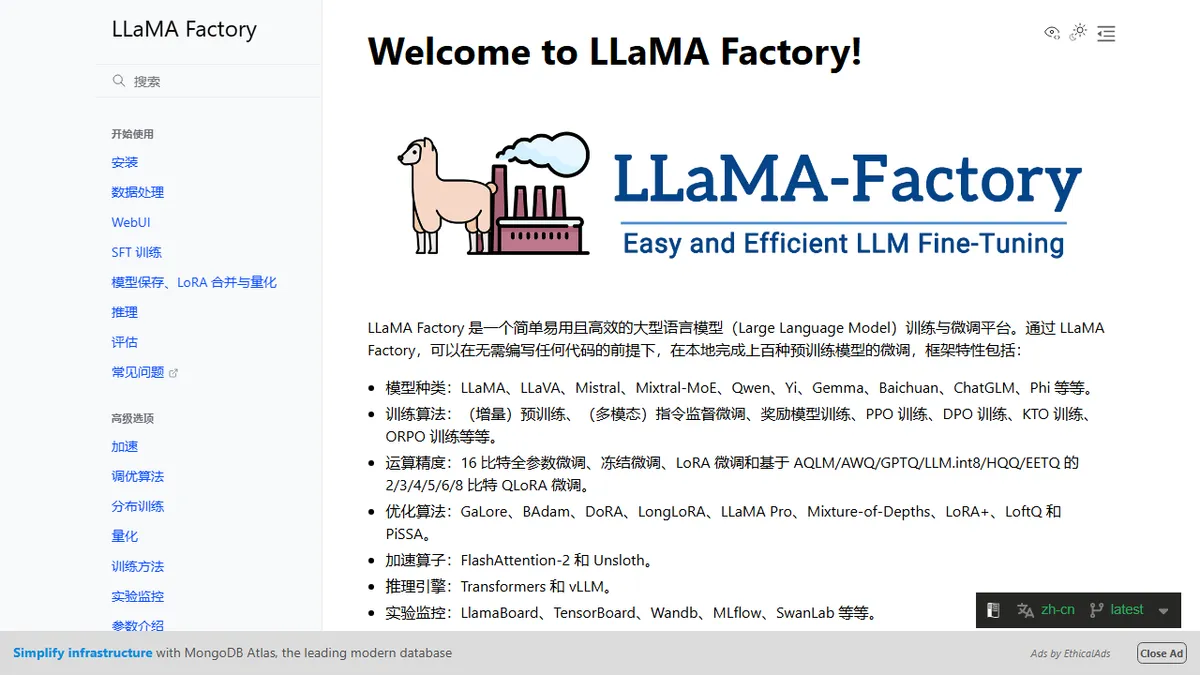
LLaMA Factory is an open-source training and fine-tuning platform that wraps the messy reality of post-training open-weight LLMs behind a clean Python toolkit and a LlamaBoard WebUI. It supports a wide model zoo (LLaMA, Mistral, Qwen, Yi, Gemma, Baichuan, ChatGLM, Phi, LLaVA and other VLMs) and covers the full pipeline: continued pre-training, supervised instruction tuning, reward modeling, and preference alignment via PPO, DPO, KTO, and ORPO.
What sets it apart is the breadth of tuning methods exposed without code: full-parameter, freeze-tuning, LoRA and its variants (LoRA+, DoRA, PiSSA, rsLoRA), plus 2/3/4/5/6/8-bit QLoRA via bitsandbytes, HQQ, or AQLM. Acceleration paths include FlashAttention-2, Unsloth, Liger Kernel, and vLLM for inference. It is aimed at practitioners and small labs who want to iterate on local GPUs (or a single rented H100) instead of stitching together TRL, PEFT, accelerate, and DeepSpeed configs by hand. It is fully free and self-hosted, with no SaaS tier.
Integrations cover Hugging Face Hub for models and datasets, TensorBoard / Weights & Biases / MLflow / SwanLab for experiment tracking, and exports to GGUF and Ollama for downstream serving. Caveats: you still need your own GPU(s), the WebUI hides but does not eliminate VRAM-planning headaches, and the project moves fast enough that pinned versions matter.
This is the de-facto Swiss army knife for open-LLM fine-tuning in 2025-2026 — broader model coverage than Axolotl, friendlier than raw TRL/PEFT, and one of the few projects that keeps pace with new architectures within days. Best paired with Unsloth for single-GPU runs and vLLM for serving.
— The AI Tool Bible editorial team
Pros
- ✅ No-code WebUI (LlamaBoard) covers SFT, DPO, PPO, KTO, and reward modeling
- ✅ Supports 100+ open models including multimodal VLMs out of the box
- ✅ Full QLoRA stack (2-8 bit) plus LoRA+, DoRA, PiSSA variants
- ✅ Acceleration via FlashAttention-2, Unsloth, Liger Kernel, vLLM inference
- ✅ Exports to GGUF / Ollama and integrates with W&B, MLflow, TensorBoard
Cons
- ⚠️ Self-hosted only — you bring the GPUs and the ops
- ⚠️ Rapid release cadence means version pinning is essential
- ⚠️ WebUI abstracts but does not solve VRAM and dataset-formatting pitfalls
Use cases
Frequently asked
- Which models and tuning methods does LLaMA Factory support?
- It supports over 100 open models, including LLaMA, Mistral, Qwen, and multimodal VLMs. Tuning methods include full-parameter, LoRA variants, QLoRA, DPO, PPO, KTO, and ORPO.
- Is LLaMA Factory free to use?
- Yes, it is free and open-source under the Apache-2.0 license. It is self-hosted with no SaaS tier, meaning you must provide your own GPU hardware.
- What acceleration and export options are available?
- The tool offers acceleration via FlashAttention-2, Unsloth, Liger Kernel, and vLLM for inference. It also supports exporting models to GGUF and Ollama for downstream serving.
- Who is LLaMA Factory designed for?
- It is aimed at practitioners and small labs who want to iterate on local GPUs or rented hardware without manually configuring TRL, PEFT, or DeepSpeed.
- What are the main limitations of using LLaMA Factory?
- Users must bring their own GPUs and handle operations. The WebUI abstracts but does not eliminate VRAM-planning challenges, and rapid releases require careful version pinning.
Explore related
Compare with similar tools
All in Fine-tuning →Together AI
FeaturedFine-tune & serve open-weight models (Llama, Mistral, DeepSeek).
Modal
Serverless GPUs and infra for training & serving ML.
Replicate
One-API platform for running and fine-tuning open-source models.
OpenAI Fine-tuning
Fine-tune GPT-4o-mini and friends on your own data.
Llama
Meta's open-weight LLM family covering 1B mobile models up to 405B frontier and natively multimodal 10M-context Llama 4 variants.
RunPod
On-demand GPU cloud and serverless inference platform built specifically for AI workloads.