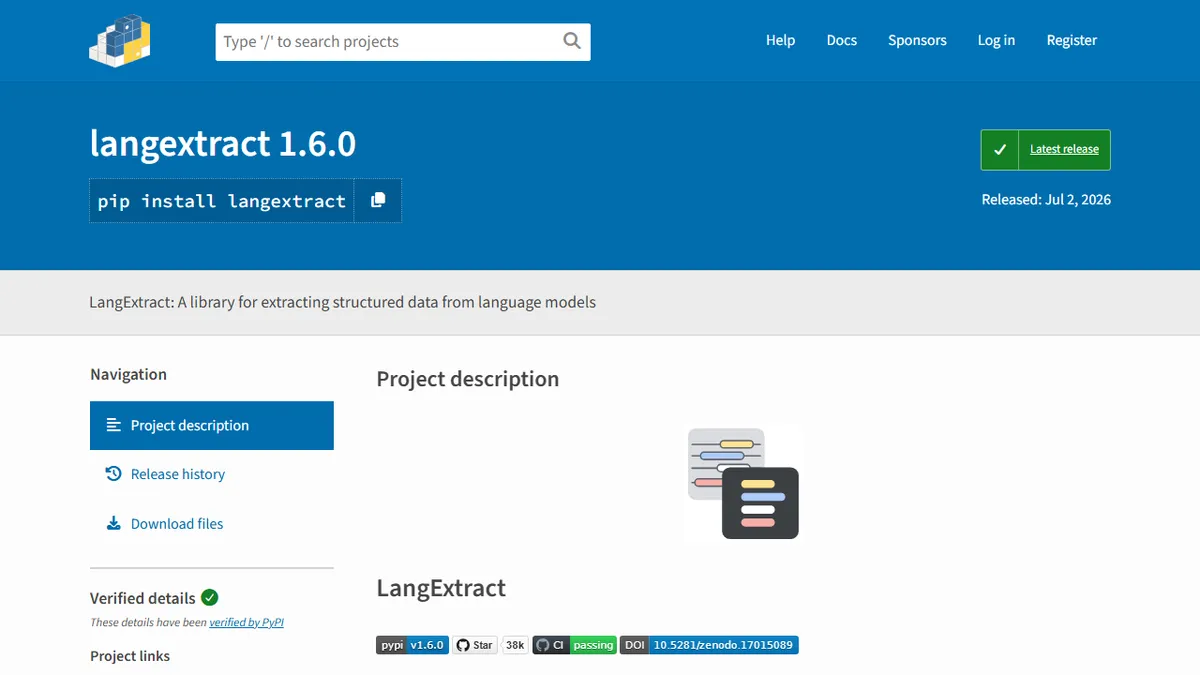
LangExtract
Google's open-source Python library for LLM-driven structured extraction from unstructured text, with source-grounded outputs.
In short
LangExtract uses large language models to extract structured data from long, messy text while mapping every entity to its exact source location. It is best for developers needing auditability and schema consistency in extraction pipelines for clinical, legal, or financial documents.
Pick LangExtract if you're a developer building an extraction pipeline over long documents and need traceable, schema-validated outputs you can audit.
Skip it if you want a hosted, no-code extraction service or a turnkey UI for non-technical analysts.
LangExtract is a Python library released by Google (under Apache-2.0, though not an officially supported Google product) that uses large language models to pull structured information out of long, messy text and map every extracted entity back to its exact location in the source. It supports Gemini, OpenAI, and local models through Ollama, and uses controlled generation to enforce consistent schemas across runs.
What sets LangExtract apart from a raw LLM call is its focus on auditability and long-document handling: it chunks documents, runs multi-pass extraction to mitigate the needle-in-a-haystack problem, and produces an interactive HTML visualization so reviewers can see where each extracted field came from. It's aimed at developers and data teams building extraction pipelines for things like clinical notes, legal documents, financial filings, and research corpora where provenance matters.
The library itself is free; you pay only for whichever LLM backend you wire up, and you can run entirely on local Ollama models for zero marginal cost. It also supports batch APIs (Vertex AI, OpenAI Batch) for large-scale jobs, and a plugin system lets you add custom providers.
This is one of the cleaner open-source takes on LLM extraction: the source-grounding and visualization story is genuinely useful for regulated domains where you can't ship a black-box answer. It's a library, not a product, so budget engineering time, but for teams already wiring up Gemini or GPT-4o it's a sensible default instead of rolling your own prompts.
— The AI Tool Bible editorial team
Pros
- ✅ Source grounding maps every extracted field back to its character span in the original text
- ✅ Handles long documents via chunking and multi-pass extraction
- ✅ Works with Gemini, OpenAI, and local Ollama models behind one API
- ✅ Built-in interactive HTML visualizer for reviewing extractions
- ✅ Apache-2.0 and pip-installable with no vendor lock-in
Cons
- ⚠️ Python-only; no hosted UI or no-code interface
- ⚠️ Quality and cost still hinge entirely on the backing LLM you choose
- ⚠️ Not an officially supported Google product, so SLAs are community-grade
Use cases
Frequently asked
- Is LangExtract free to use?
- The library itself is free under the Apache-2.0 license. You only pay for the LLM API costs associated with the backend you choose, such as Gemini or OpenAI, or can use local models for zero marginal cost.
- Which LLM backends does LangExtract support?
- It supports Gemini, OpenAI, and local models through Ollama. It also supports batch APIs like Vertex AI and OpenAI Batch for large-scale jobs, with a plugin system for custom providers.
- How does LangExtract handle long documents?
- It chunks documents and runs multi-pass extraction to mitigate the needle-in-a-haystack problem. This approach ensures consistent schemas and allows for the mapping of extracted entities back to their specific locations in the source text.
- Who is LangExtract designed for?
- It is aimed at developers and data teams building extraction pipelines for domains where provenance matters, such as clinical notes, legal documents, and financial filings. It is not intended for non-technical analysts seeking a no-code interface.
- Does LangExtract provide visualizations for review?
- Yes, it produces an interactive HTML visualization that allows reviewers to see exactly where each extracted field came from in the original text, enhancing auditability.
Explore related
Compare with similar tools
All in RAG →Pinecone
FeaturedManaged vector database for production-scale similarity search.
LlamaIndex
FeaturedData framework for connecting LLMs to your data.
Elasticsearch Vector Search
Hybrid vector + keyword search in the enterprise-grade Elasticsearch engine
Snowflake Cortex
Generative AI and RAG built into the Snowflake data cloud
DataStax Astra DB
Serverless vector and document database for production RAG and AI agents
MongoDB Atlas Vector Search
Vector search built into the operational database you're already using.