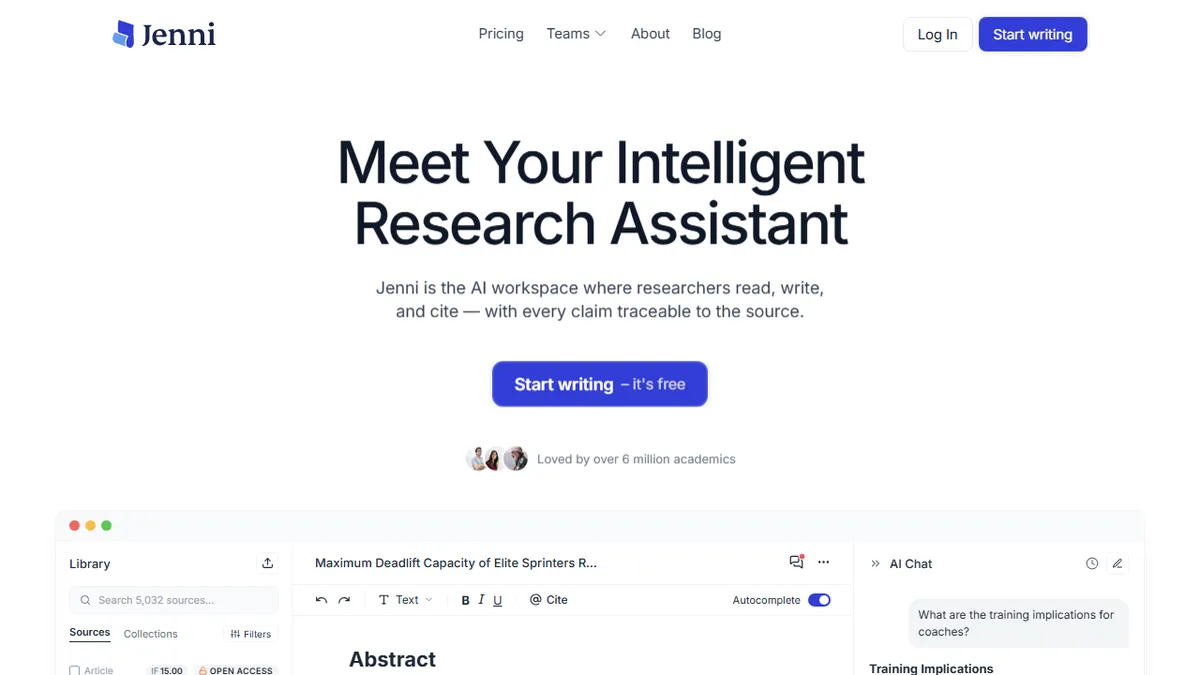

Jenni AI
AI writing workspace built specifically for academic papers, theses, and cited research.
In short
Jenni AI is an AI writing assistant designed specifically for academic papers, theses, and cited research. It grounds suggestions in a 200M-paper index and links claims to specific source locations. It is best for scholars needing traceable citations and long-form scholarly output.
Pick Jenni AI if you're writing a thesis, dissertation, or peer-reviewed paper and need citations that actually trace back to a source.
Skip it if you want a general-purpose writing assistant for blogs, marketing copy, or fiction — its academic guardrails will get in the way.
Jenni is an AI writing assistant aimed squarely at academic users: PhD candidates, grad students, researchers, and anyone whose drafts have to survive a citation check. The core loop is autocomplete and AI edits that are grounded in sources you upload or pull from its 200M-paper semantic index, with claims linked back to the exact spot in the source PDF. It bundles a Zotero/Mendeley import, 2,600+ citation styles, real-time collaboration, and a 'reviewer' pass that flags unsupported claims and contradictions.
What differentiates Jenni from generic chat-based writing tools is the workflow around evidence: every suggestion can be traced to a source, and the editor is structured for long-form scholarly output rather than blog posts or marketing copy. Pricing is reasonable for individuals — a real free tier (10 autocompletes/day, 10 PDF uploads), Plus at $12/month for 5,000 autocompletes and unlimited uploads, and Pro at $29/month for unlimited everything, with up to 60% off annual. There is no public API and the product is closed-source.
It exports to .docx, LaTeX, and HTML, which matters if your advisor demands a specific format. The trade-off is that Jenni is narrow by design — it won't replace a general-purpose writing tool, and the source-grounded autocomplete still requires you to actually read and verify what it cites.
Jenni is one of the few writing tools that takes citations seriously, which is exactly what scholarly users need and what general chatbots refuse to do well. The pricing is fair for individuals and the free tier is enough to test the workflow on a real chapter. The lack of an API and undisclosed model stack are the main reasons it stays a workstation tool rather than a building block.
— The AI Tool Bible editorial team
Pros
- ✅ Source-grounded autocomplete with traceable citations back to PDF locations
- ✅ Semantic search over 200M+ academic papers built in
- ✅ Supports 2,600+ citation styles plus Zotero/Mendeley import
- ✅ Exports to .docx, LaTeX, and HTML for real academic workflows
- ✅ Genuine free tier with no credit card required
Cons
- ⚠️ No public API for programmatic use
- ⚠️ Closed-source with the underlying model undisclosed
- ⚠️ Narrow focus — overkill for non-academic writing
- ⚠️ Unlimited features gated behind the $29/mo Pro tier
Use cases
Frequently asked
- Who is Jenni AI designed for?
- Jenni AI is aimed at academic users such as PhD candidates, grad students, and researchers who need drafts that survive citation checks. It is not intended for general-purpose writing like blogs or marketing copy.
- How does Jenni AI handle citations?
- The tool uses source-grounded autocomplete where claims are linked back to the exact spot in the source PDF. It supports over 2,600 citation styles and allows import from Zotero and Mendeley.
- What file formats can Jenni AI export to?
- Jenni AI exports documents to .docx, LaTeX, and HTML. This supports specific formatting requirements often demanded in academic workflows.
- Does Jenni AI have a free plan?
- Yes, Jenni AI offers a free tier that includes 10 autocompletes per day and 10 PDF uploads. No credit card is required to start using the free plan.
- Is there an API available for Jenni AI?
- No, there is no public API for programmatic use. The product is closed-source, and the underlying model is undisclosed.
Explore related
Compare with similar tools
All in Writing →Claude
FeaturedAnthropic's flagship assistant for long-form writing, analysis, and coding.
GPT-4o
FeaturedOpenAI's multimodal flagship behind ChatGPT.
Gemini Advanced
Google's flagship — strong at math, long context, and Workspace integration.
Llama 3
Meta's open-weights LLM family that put serious frontier-adjacent models in everyone's hands.
Qwen
Alibaba's open-weight foundation model family covering chat, vision, image generation, translation, and safety classification.
Jan
Open-source desktop ChatGPT alternative that runs local LLMs and routes to cloud providers from one app.