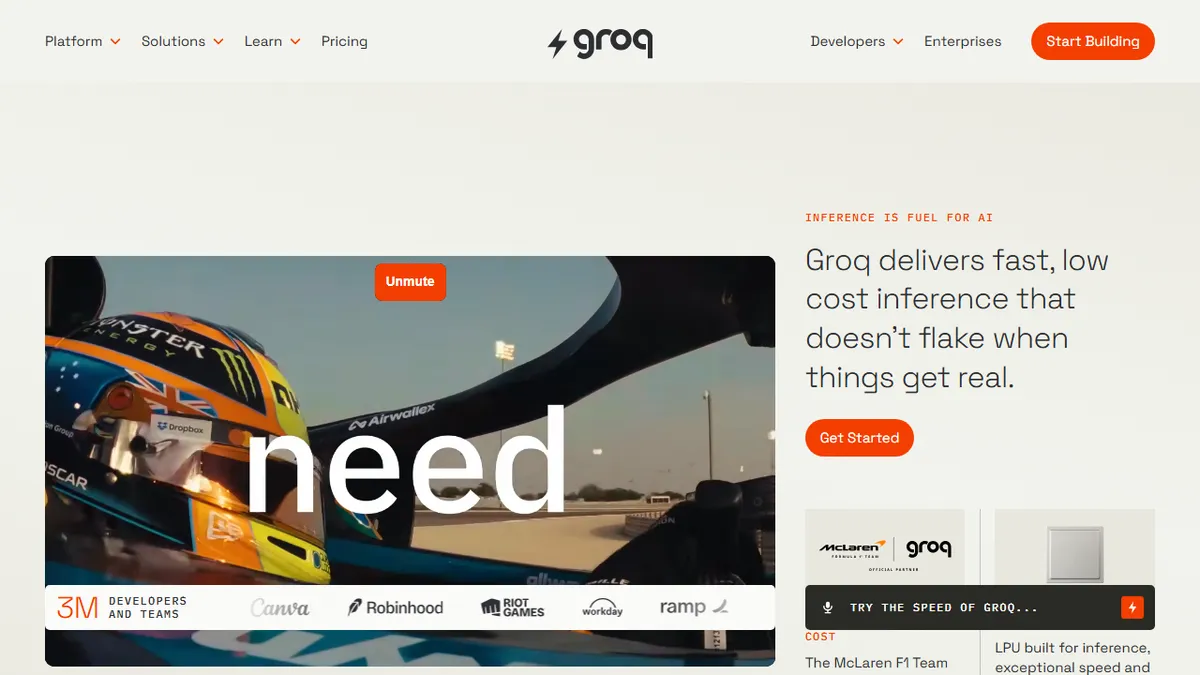

Groq
Custom-silicon LPU inference platform serving open models at GPU-trouncing latency via an OpenAI-compatible API.
In short
Groq provides high-throughput inference for open-weight models using custom LPU hardware. It offers an OpenAI-compatible API for low-latency applications like voice agents and real-time tool calling.
Pick Groq if you need the lowest-latency, highest-throughput inference for open models like Llama or Whisper and want a drop-in replacement for the OpenAI API.
Skip it if you need frontier proprietary models like GPT-5 or Claude, custom fine-tuned checkpoints, or guaranteed access to obscure open-source models.
Groq is an AI inference provider built around the LPU (Language Processing Unit), a custom processor the company designed specifically for sequential token generation rather than the parallel matrix math GPUs were built for. The practical result is that GroqCloud serves popular open-weight models (Llama, Mixtral, Gemma, Whisper, Qwen and others) at throughput numbers that are typically several times what you'd see from GPU-backed providers, often pushing hundreds of tokens per second on chat-scale models.
For developers, the appeal is mechanical: the REST API is OpenAI-compatible, so swapping `OPENAI_BASE_URL` to Groq's endpoint usually gets an existing app running in minutes. There's a free tier with rate-limited access via the console, with paid usage billed per-token on the pricing page; enterprise customers (Dropbox, Vercel, Robinhood, McLaren are cited) get higher throughput tiers and dedicated capacity. Groq doesn't train its own foundation models — it's purely an inference layer for third-party open models.
The main caveats are that model selection is whatever Groq has provisioned on its LPUs (no arbitrary HuggingFace checkpoints), context windows on some hosted models are smaller than the upstream maximums, and you're betting on Groq's roadmap rather than a hyperscaler's. But for latency-sensitive use cases — voice agents, autocomplete, real-time tool-calling loops — almost nothing else in the market matches it.
Groq is the speed play. If your app lives or dies by time-to-first-token — voice, agents, real-time UX — running Llama 3.3 or Qwen on Groq feels like cheating compared to GPU providers. Just don't expect frontier model quality; this is an inference layer, not a model lab.
— The AI Tool Bible editorial team
Pros
- ✅ Industry-leading token-per-second throughput thanks to custom LPU silicon
- ✅ OpenAI-compatible API means near-zero migration cost from existing SDKs
- ✅ Generous free tier for prototyping and a real per-token pricing page
- ✅ Hosts popular open-weight models without you running infrastructure
Cons
- ⚠️ Model catalog limited to what Groq chooses to deploy on LPUs
- ⚠️ Some hosted models ship with reduced context windows vs. upstream
- ⚠️ No proprietary frontier models — purely an inference layer
- ⚠️ Free-tier rate limits are tight for production traffic
Use cases
Frequently asked
- How does Groq's API compare to OpenAI's?
- The REST API is OpenAI-compatible, allowing developers to swap the base URL to run existing apps on Groq with minimal code changes.
- Which models are available on Groq?
- Groq hosts popular open-weight models including Llama, Mixtral, Gemma, Whisper, and Qwen, but does not offer proprietary frontier models or arbitrary HuggingFace checkpoints.
- What is the pricing structure for Groq?
- Groq offers a freemium model with a free API key subject to rate limits, per-token paid tiers, and enterprise contracts for higher throughput.
- Why is Groq faster than GPU-based providers?
- Groq uses a custom Language Processing Unit (LPU) designed for sequential token generation, resulting in throughput that is typically several times higher than GPU-backed providers.
Explore related
Compare with similar tools
All in Coding →Cursor
FeaturedAI-first VS Code fork — chat, edit, and agentic coding in one IDE.
GitHub Copilot
FeaturedThe original AI pair programmer, now with chat and agents.
Replit Agent
FeaturedBuild & deploy a full app from a single prompt.
Warp
The agentic development environment, from the terminal up
Cline
Open-source agentic coding assistant that plans, edits, and runs code inside your IDE
Aider
Terminal-based AI pair programmer that writes commits.