
Graphify
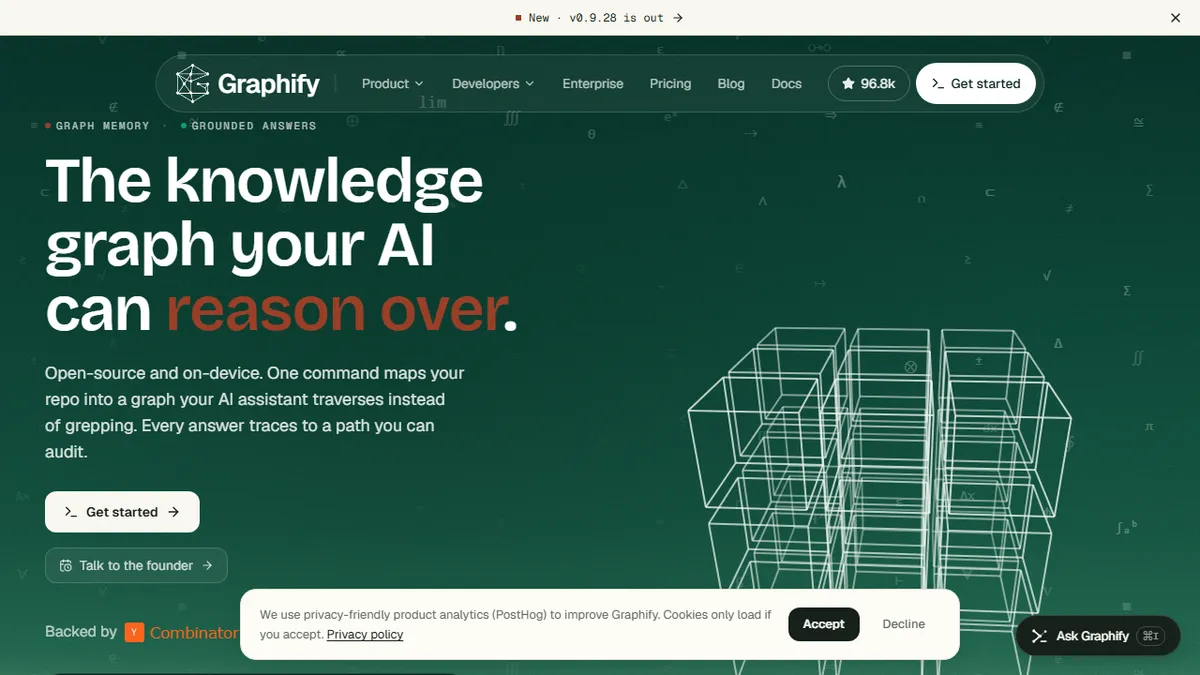
Open-source on-device knowledge graph engine that turns code, docs, papers, meetings and images into a queryable graph.
In short
Graphify is a free, open-source on-device engine that turns code, docs, and meetings into a queryable knowledge graph for complete local recall.
Pick Graphify if you want a local-first, open-source knowledge graph over your own code, docs and meetings instead of yet another cloud RAG service.
Skip it if you need a production-ready product today or a managed hosted RAG API with SLAs.
Graphify is an MIT-licensed knowledge graph engine that ingests heterogeneous inputs — source code (with AST awareness), markdown docs, PDFs and papers, meeting transcripts, browser history, even images and diagrams — and decodes them into a single traversable graph. The pitch is 'any input, one graph, complete recall': instead of throwing everything into a vector store and praying for retrieval, it builds explicit nodes and edges that you can walk to surface relationships like 'this RFC ↔ this commit ↔ this meeting decision'. It runs on-device by default with an optional cloud mode.
The differentiator versus generic RAG stacks is the incremental graph maintenance and the local-first posture: when a file changes, only affected nodes and edges update, so the corpus stays coherent at millions of files without re-embedding everything. That makes it interesting for engineers and researchers who want long-horizon memory over a private corpus rather than a chatbot wrapper. As of this writing the project is in waitlist / early-access; the marketing copy leans heavily on MIT licensing and 'free forever' framing, so expect a community-driven OSS release with cloud add-ons later rather than a polished SaaS today.
Promising positioning — on-device, MIT, graph-native — and exactly the kind of project the RAG space needs more of. But it's still a waitlist landing page with bold claims and thin technical disclosure, so treat it as one to watch rather than one to deploy. Worth bookmarking until the repo and docs land.
— The AI Tool Bible editorial team
Pros
- ✅ MIT-licensed and runs fully on-device — no data leaves your machine
- ✅ Incremental updates: only changed nodes/edges re-process, scales to millions of files
- ✅ Ingests broad input set: code/AST, docs, papers, meetings, browser history, images
- ✅ Explicit graph beats opaque vector retrieval for traceable, multi-hop questions
Cons
- ⚠️ Waitlist / early-access — not generally available yet
- ⚠️ Cloud tier and any paid plan are unpriced and undefined
- ⚠️ Marketing-heavy site with limited technical depth on indexing/query API
- ⚠️ On-device builds at corpus scale will demand serious local compute
Use cases
Frequently asked
- How much does Graphify cost?
- Graphify is free forever under an MIT license. While a cloud tier is hinted at, it is currently unpriced and available only via waitlist. The core engine is open-source and free.
- What types of data can Graphify process?
- It ingests heterogeneous inputs including source code with AST awareness, markdown docs, PDFs, papers, meeting transcripts, browser history, images, and diagrams. All are decoded into a single traversable graph.
- Is Graphify suitable for production use today?
- No, skip it if you need a production-ready product or managed hosted RAG API with SLAs today. The project is currently in waitlist or early-access, focusing on community-driven OSS release rather than polished SaaS.
- How does Graphify handle data updates?
- It uses incremental graph maintenance. When a file changes, only affected nodes and edges update. This keeps the corpus coherent at millions of files without re-embedding everything, unlike generic RAG stacks.
- Does Graphify run locally or in the cloud?
- Graphify runs on-device by default, prioritizing a local-first posture. An optional cloud mode is available, but the primary focus is on private, local knowledge graphs for engineers and researchers.
Explore related
Compare with similar tools
All in RAG →Pinecone
FeaturedManaged vector database for production-scale similarity search.
LlamaIndex
FeaturedData framework for connecting LLMs to your data.
Elasticsearch Vector Search
Hybrid vector + keyword search in the enterprise-grade Elasticsearch engine
Snowflake Cortex
Generative AI and RAG built into the Snowflake data cloud
DataStax Astra DB
Serverless vector and document database for production RAG and AI agents
MongoDB Atlas Vector Search
Vector search built into the operational database you're already using.