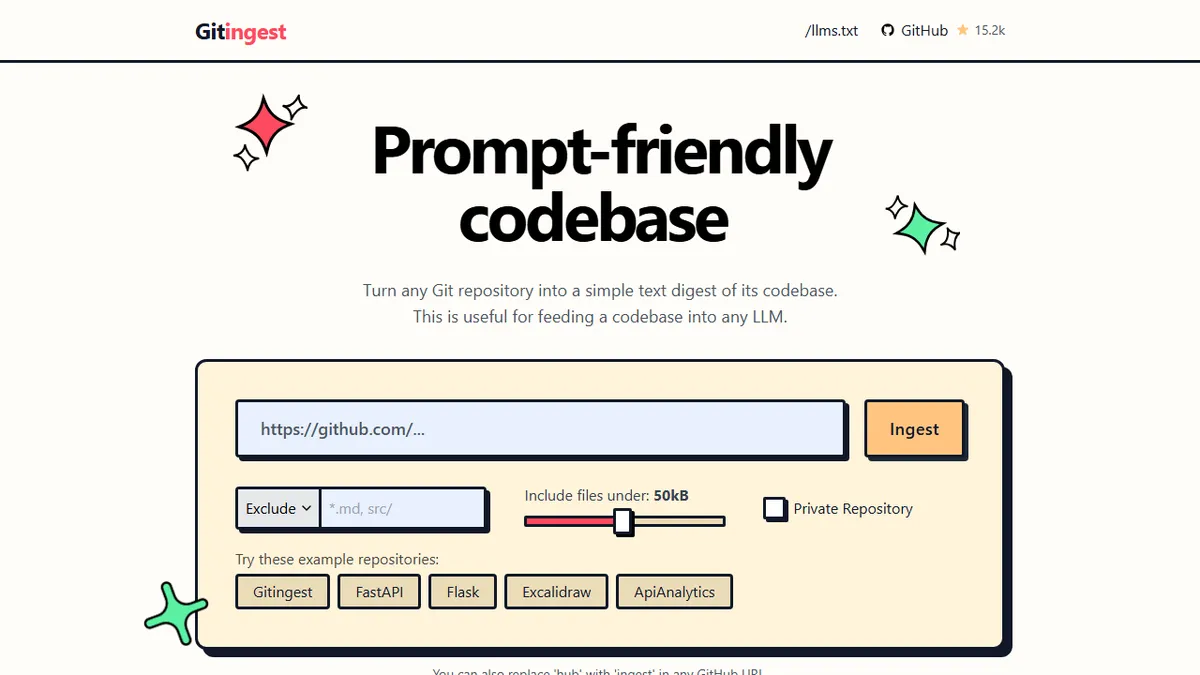

Gitingest
Turns any Git repo into a single LLM-ready text digest by swapping 'hub' for 'ingest' in the URL.
In short
Gitingest flattens any Git repository into a single, prompt-friendly text digest containing the file tree and concatenated source code. It is best for developers who need a zero-setup way to dump a GitHub repo into Claude or ChatGPT for code review, onboarding, or refactor planning.
Pick Gitingest if you want a zero-setup way to dump a GitHub repo into Claude or ChatGPT for review, onboarding, or refactor planning.
Skip it if you need persistent code search, embeddings, or an agent that can navigate a repo on its own.
Gitingest is a small utility that flattens a Git repository into a single prompt-friendly text digest: file tree plus concatenated source, with token counts and basic include/exclude filters. The headline trick is the URL rewrite: replace 'github.com' with 'gitingest.com' on any public repo and you get an instantly shareable, copy-pasteable bundle suitable for dropping into Claude, ChatGPT, Gemini, or any other long-context model.
It is aimed at developers doing code review, onboarding, refactor planning, or one-shot codebase Q&A with an LLM, where setting up a full retrieval pipeline is overkill. The hosted web version is free; the project itself is open source (MIT, coderamp-labs/gitingest on GitHub) and ships as a Python package and CLI for local use, plus a Chrome extension that adds an 'Ingest' button to GitHub. Private repos are supported via a personal access token which the site says is not persisted, and cloned repos are deleted after processing.
It is not a RAG system, agent, or hosted chat - it is a preprocessor. For very large monorepos you will still blow past context windows and need to scope with the include/exclude patterns, but as a glue tool between GitHub and a frontier LLM it is hard to beat.
Gitingest is the kind of two-feature tool that quietly becomes part of your daily workflow: change one word in a URL, get a clean codebase digest. The fact that it is MIT-licensed and self-hostable means you are not betting on the hosted service sticking around, which is exactly the right posture for a utility this small.
— The AI Tool Bible editorial team
Pros
- ✅ URL-swap trick (hub -> ingest) makes any public repo instantly LLM-ready
- ✅ Open source (MIT) with Python package, CLI, and Chrome extension
- ✅ Shows token counts and supports include/exclude filters out of the box
- ✅ Works with private repos via PAT that the service says it does not store
Cons
- ⚠️ Not a RAG or chat layer - you still paste output into an LLM yourself
- ⚠️ Large monorepos will exceed context windows without aggressive filtering
- ⚠️ Hosted instance has no formal SLA or paid tier for heavy use
Use cases
Frequently asked
- How does Gitingest work?
- It flattens a Git repository into a single text digest including the file tree and source code. Users can instantly generate this by swapping 'github.com' with 'gitingest.com' in any public repo URL.
- Is Gitingest free to use?
- Yes, it is a free hosted service and open-source under the MIT license. It is available as a Python package, CLI, and Chrome extension for local or self-hosted use.
- Can I use Gitingest with private repositories?
- Yes, private repos are supported via a personal access token. The service states that this token is not persisted and cloned repos are deleted after processing.
- What are the limitations of Gitingest?
- It is a preprocessor, not a RAG system or chat layer, so you must paste the output into an LLM yourself. Large monorepos may exceed context windows and require aggressive filtering.
Explore related
Compare with similar tools
All in Coding →Cursor
FeaturedAI-first VS Code fork — chat, edit, and agentic coding in one IDE.
GitHub Copilot
FeaturedThe original AI pair programmer, now with chat and agents.
Replit Agent
FeaturedBuild & deploy a full app from a single prompt.
Warp
The agentic development environment, from the terminal up
Cline
Open-source agentic coding assistant that plans, edits, and runs code inside your IDE
Aider
Terminal-based AI pair programmer that writes commits.