
Genei
AI research assistant that summarizes PDFs and web pages and answers questions across your document library.
In short
Genei is an AI tool that summarizes PDFs and web pages while managing citations for academic researchers and students. It functions as a structured research workspace with project folders and semantic question-answering capabilities. It is best for users needing a cheap, organized environment for literature reviews and document queries.
Pick Genei if you want a cheap, structured research workspace for summarizing and querying PDFs and web articles with citations included.
Skip it if you need state-of-the-art reasoning, API access, or you already drive your literature review through ChatGPT or Claude Projects.
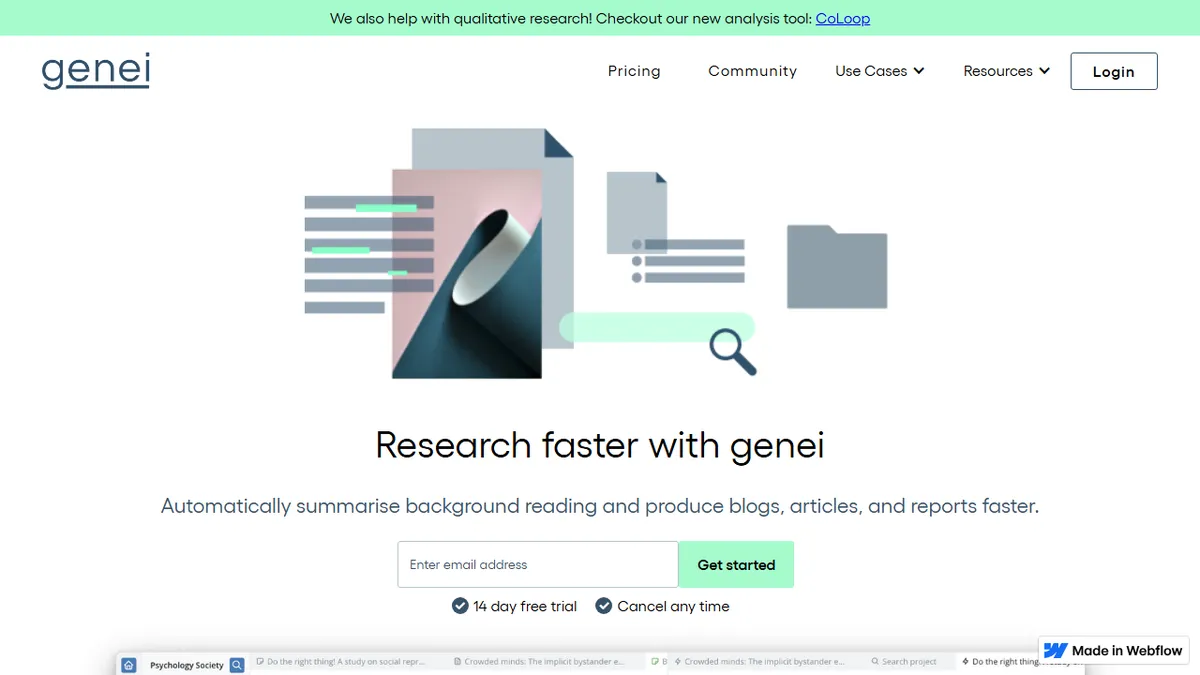
Genei is an AI-powered research and writing tool built around document summarization, semantic question-answering, and citation management. Upload PDFs or clip web pages through the Chrome extension and Genei produces structured summaries, extracts keywords, paraphrases passages, and lets you query across multiple documents in a project. It is pitched primarily at academic researchers, students, editors, and content producers who deal with long-form reading lists.
What differentiates it is the workflow wrapper around the AI rather than the model itself: projects and folders, inline annotations, and reference/citation generation make it more of a research workspace than a one-shot summarizer. Pricing is modest by 2026 standards — Basic at £3.99/mo and Pro at £15.99/mo, with the Pro tier surfacing a higher-quality model (historically GPT-3) and a 14-day free trial on both. It is a Y Combinator S21 company and was featured in TechCrunch's startup roundup.
The model lineup is dated on the public site (GPT-3 era language), so anyone evaluating it today should confirm what is actually powering Pro summaries before committing. There is no obvious public API, and the moat is the research workflow, not raw model quality — which matters now that ChatGPT, Claude, and dedicated PDF chat tools cover much of the same ground.
Genei was a smart YC-era take on the 'AI for researchers' niche and the workspace-around-summaries idea still holds up. But the public model claims look dated in 2026 and general-purpose chatbots have closed most of the gap. Worth the trial if the cited workflow appeals; verify the current model before subscribing.
— The AI Tool Bible editorial team
Pros
- ✅ Project/folder structure built for real research workflows, not one-off chats
- ✅ Chrome extension summarizes web pages as you browse
- ✅ Built-in citation and reference management
- ✅ Cheap relative to general-purpose AI writing tools
Cons
- ⚠️ Public site still references GPT-3, suggesting the model stack may be behind newer alternatives
- ⚠️ No prominent public API for integration
- ⚠️ Overlaps heavily with ChatGPT, Claude, and dedicated PDF-chat tools
Use cases
Frequently asked
- Who is Genei designed for?
- Genei is pitched primarily at academic researchers, students, editors, and content producers who deal with long-form reading lists and need to manage multiple documents.
- What are the main features of Genei?
- The tool offers document summarization, semantic question-answering, citation management, and a Chrome extension for clipping web pages. It organizes work into projects and folders with inline annotations.
- How much does Genei cost?
- Genei operates on a freemium model with pricing details listed as Basic at £9.99 or £4.99 and PRO at £29.99 or £19.99. The description also mentions Basic at £3.99/mo and Pro at £15.99/mo with a 14-day free trial.
- Does Genei have a public API?
- No, there is no obvious public API available for integration. The tool is a closed-source product focused on its research workflow rather than raw model access.
- What AI model does Genei use?
- The public site references GPT-3 era language, suggesting the model stack may be dated. Users are advised to confirm what is actually powering Pro summaries before committing.
Explore related
Compare with similar tools
All in RAG →Pinecone
FeaturedManaged vector database for production-scale similarity search.
LlamaIndex
FeaturedData framework for connecting LLMs to your data.
Elasticsearch Vector Search
Hybrid vector + keyword search in the enterprise-grade Elasticsearch engine
Snowflake Cortex
Generative AI and RAG built into the Snowflake data cloud
DataStax Astra DB
Serverless vector and document database for production RAG and AI agents
MongoDB Atlas Vector Search
Vector search built into the operational database you're already using.