Elicit
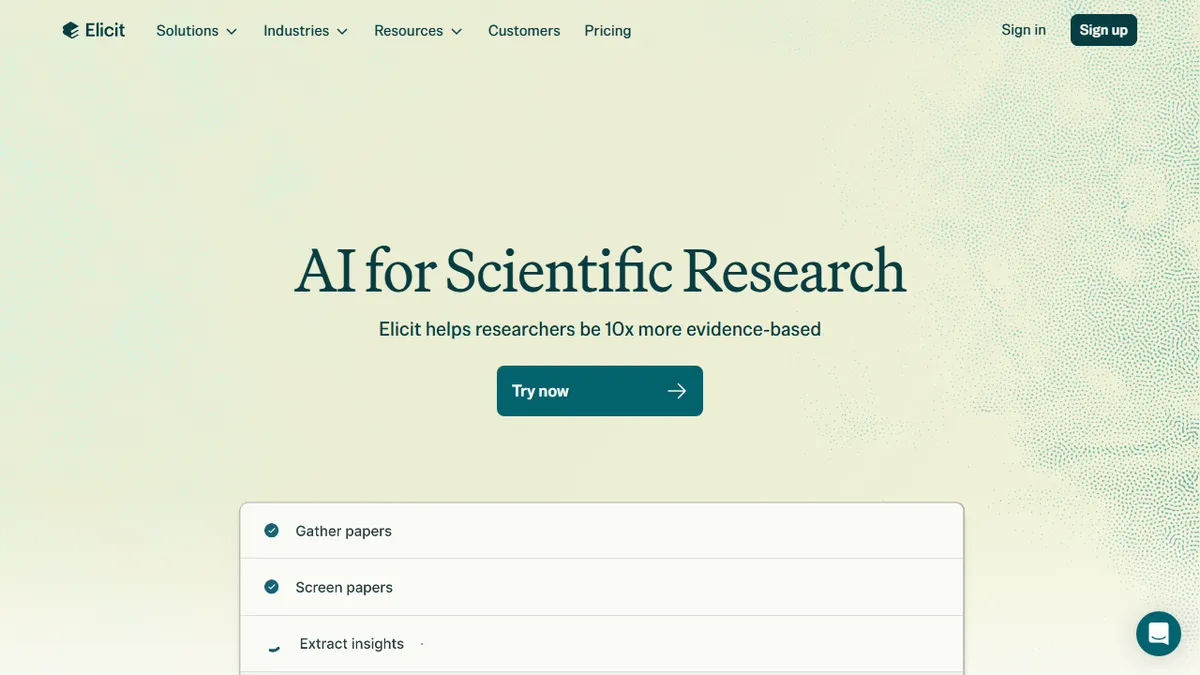
AI research assistant that searches, screens, and extracts data from 138M+ academic papers at scale.
In short
Elicit automates systematic reviews by screening and extracting data from 138M+ papers. It saves up to 80% of researcher time with high-accuracy, cited reports.
Pick Elicit if you're running systematic reviews, meta-analyses, or evidence syntheses and need to screen and extract from hundreds of papers without hiring a team of RAs.
Skip it if your research is non-academic, you mostly write blog-style summaries, or you need a general-purpose chatbot rather than a literature-grounded extraction tool.
Elicit is a purpose-built AI research platform for systematic literature reviews and evidence-based scientific work. It searches across 138+ million academic papers, generates structured research reports with sentence-level citations from up to 80 sources at a time, and automates the screening and data extraction steps that typically eat weeks of a researcher's calendar. The team claims accuracy rates of 95-99% on systematic review tasks and reports user time savings of up to 80% on lit reviews.
It's aimed squarely at academics, pharma, medical-device, policy, and consumer-goods research teams rather than casual users looking for a 'ChatGPT for papers.' The differentiator is the workflow: custom extraction columns across thousands of papers, reusable libraries, ongoing research alerts, and an API for programmatic access. Currently powered by Claude Opus 4.5 for extraction and report writing, with tiered pricing including a free entry tier.
Elicit is one of the few research tools serious enough to be cited in actual systematic review methodology discussions, but it's narrow by design. If your work isn't grounded in peer-reviewed literature, most of the product is wasted on you.
Elicit is the most credible AI tool we've seen for serious academic literature work — it solves a real, painful workflow rather than dressing up a chat UI. The Claude Opus 4.5 backend and verifiable citations make it usable for actual review protocols. Still, treat extracted data as a strong first pass, not a final answer.
— The AI Tool Bible editorial team
Pros
- ✅ Indexes 138M+ academic papers with sentence-level citations
- ✅ Automates systematic review screening and extraction at scale
- ✅ Reported 95-99% accuracy on review tasks, used by 2M+ researchers
- ✅ API access for programmatic search and report generation
- ✅ Free tier available for evaluation
Cons
- ⚠️ Narrow to academic/scientific literature workflows
- ⚠️ Pro pricing required to unlock full extraction throughput
- ⚠️ Closed-source; you depend on their pipeline and chosen model
- ⚠️ Citations still need human verification for high-stakes work
Use cases
Frequently asked
- How much does Elicit cost?
- Elicit offers a freemium model. The Basic tier is free. Paid plans include Plus at $11, Pro at $39, and Scale at $89. Enterprise pricing is available upon custom request.
- What AI model powers Elicit?
- Elicit is currently powered by Claude Opus 4.5. This model handles the extraction of data and the writing of structured research reports within the platform.
- Is Elicit suitable for non-academic research?
- No. Elicit is designed for systematic reviews and evidence-based scientific work. If your research is non-academic, involves blog-style summaries, or requires a general-purpose chatbot, Elicit is not the right fit.
- Can I access Elicit via API?
- Yes. Elicit provides an API for programmatic access. This allows users to integrate its literature screening and data extraction capabilities into their own workflows or systems.
- How accurate is Elicit for systematic reviews?
- The team claims accuracy rates of 95-99% on systematic review tasks. Users report time savings of up to 80% on literature reviews compared to manual processes.
Explore related
Compare with similar tools
All in RAG →Pinecone
FeaturedManaged vector database for production-scale similarity search.
LlamaIndex
FeaturedData framework for connecting LLMs to your data.
Elasticsearch Vector Search
Hybrid vector + keyword search in the enterprise-grade Elasticsearch engine
Snowflake Cortex
Generative AI and RAG built into the Snowflake data cloud
DataStax Astra DB
Serverless vector and document database for production RAG and AI agents
MongoDB Atlas Vector Search
Vector search built into the operational database you're already using.