Cognee
Open-source graph-memory layer that gives AI agents persistent, queryable context across sessions.
In short
Cognee is an open-source graph-memory layer that gives AI agents persistent, queryable context across sessions using structured knowledge graphs.
Pick Cognee if you're building agents that need durable, structured memory across sessions and a flat vector store is failing you on entity-rich data.
Skip it if you just need basic document retrieval for a single chatbot — a standard vector DB will be simpler and cheaper.
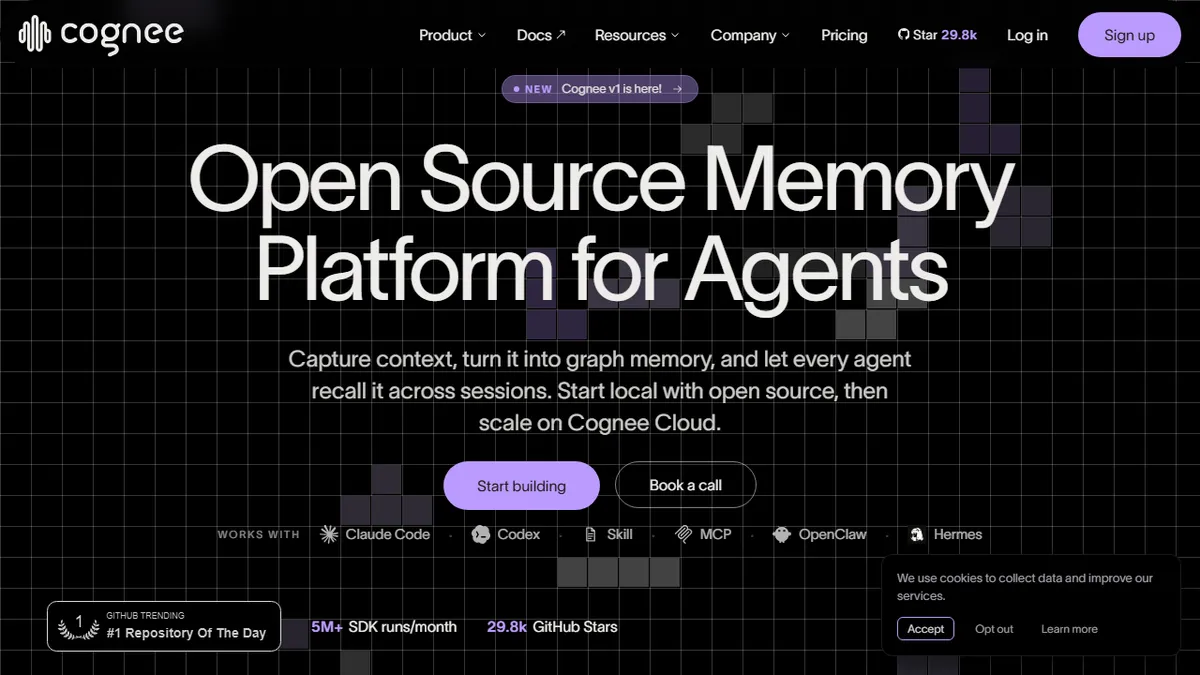
Cognee is an open-source memory platform for AI agents that converts raw context (documents, chats, APIs, warehouses) into a structured knowledge graph the agent can recall across sessions. Instead of bolting a vector store onto an LLM and hoping retrieval works, Cognee builds an ontology-aware graph with adapters for common data sources and exposes it through an SDK and an MCP server so multiple agents can share one memory layer.
It is aimed at developers building agentic systems who have outgrown naive RAG: solo builders, AI researchers, and product teams shipping customer-facing agents that need to remember users, projects, or domain entities. The Hobby tier is free with 1M tokens/month, Growth is $5/workspace/month plus token usage, and Enterprise is custom. The repo (17.5k+ stars) means you can self-host the whole thing if you don't want to touch their cloud.
Cognee is model-agnostic and works with Claude, OpenAI, and other LLM providers for the extraction and embedding steps, and it ships custom ontologies, permissioning, and governance controls for teams that care about who can read what. The trade-off versus a plain vector DB is real complexity — you're maintaining a graph, not a flat index — and the product is still maturing, so expect rough edges.
Cognee is one of the more thoughtful entries in the agent-memory space, treating context as a graph rather than a bag of embeddings. The open-source core plus MCP support make it a serious option for teams who want to own their memory layer, though you'll pay for that power with extra moving parts.
— The AI Tool Bible editorial team
Pros
- ✅ Open source and self-hostable with a sizable GitHub community
- ✅ Graph-based memory beats flat vector RAG for entity-heavy domains
- ✅ MCP server makes it easy to plug into Claude Desktop and agent frameworks
- ✅ Generous free tier (1M tokens/month) for experimentation
- ✅ Adapters for warehouses, docs, chats, and APIs out of the box
Cons
- ⚠️ Graph memory adds operational complexity vs. a plain vector store
- ⚠️ Still a young product; ontologies and governance features are evolving
- ⚠️ Token-based pricing on top of LLM costs can compound at scale
Use cases
Frequently asked
- How much does Cognee cost?
- Cognee offers a free Hobby tier with 1M tokens per month. The Growth plan costs $5 per workspace per month plus token usage. Enterprise pricing is custom. You can also self-host the open-source repository to avoid cloud costs.
- Which AI models does Cognee support?
- Cognee is model-agnostic and works with multiple LLM providers, including Claude and OpenAI. It uses these models for the extraction and embedding steps required to build and query the knowledge graph.
- Is Cognee better than a standard vector database?
- Cognee is best for entity-rich data where flat vector stores fail. It builds an ontology-aware graph rather than a flat index. However, it introduces more complexity than a standard vector DB, which is simpler and cheaper for basic document retrieval.
- Can I self-host Cognee?
- Yes, Cognee is open-source with over 17.5k stars on its repository. You can self-host the entire platform if you prefer not to use their cloud services, giving you full control over your data and infrastructure.
- What data sources can Cognee integrate with?
- Cognee converts raw context from documents, chats, APIs, and warehouses into a structured knowledge graph. It includes adapters for common data sources and exposes the memory layer through an SDK and an MCP server for multi-agent systems.
Explore related
Compare with similar tools
All in RAG →Pinecone
FeaturedManaged vector database for production-scale similarity search.
LlamaIndex
FeaturedData framework for connecting LLMs to your data.
Elasticsearch Vector Search
Hybrid vector + keyword search in the enterprise-grade Elasticsearch engine
Snowflake Cortex
Generative AI and RAG built into the Snowflake data cloud
DataStax Astra DB
Serverless vector and document database for production RAG and AI agents
MongoDB Atlas Vector Search
Vector search built into the operational database you're already using.