
Codeflash
Autonomous AI performance engineer that finds and PRs code optimizations with benchmarks attached.
In short
Codeflash acts as an autonomous performance engineer, analyzing entire repositories to find and submit code optimizations with attached benchmark data. It is best for ML shops and enterprises seeking to reduce infrastructure costs through automated, reviewable performance improvements.
Pick Codeflash if you run ML inference or data pipelines at scale and want an AI agent that ships optimization PRs with benchmarks instead of vague suggestions.
Skip it if you're a small app team without meaningful infra spend or GPU workloads, where hand-tuning would be cheaper than an engagement.
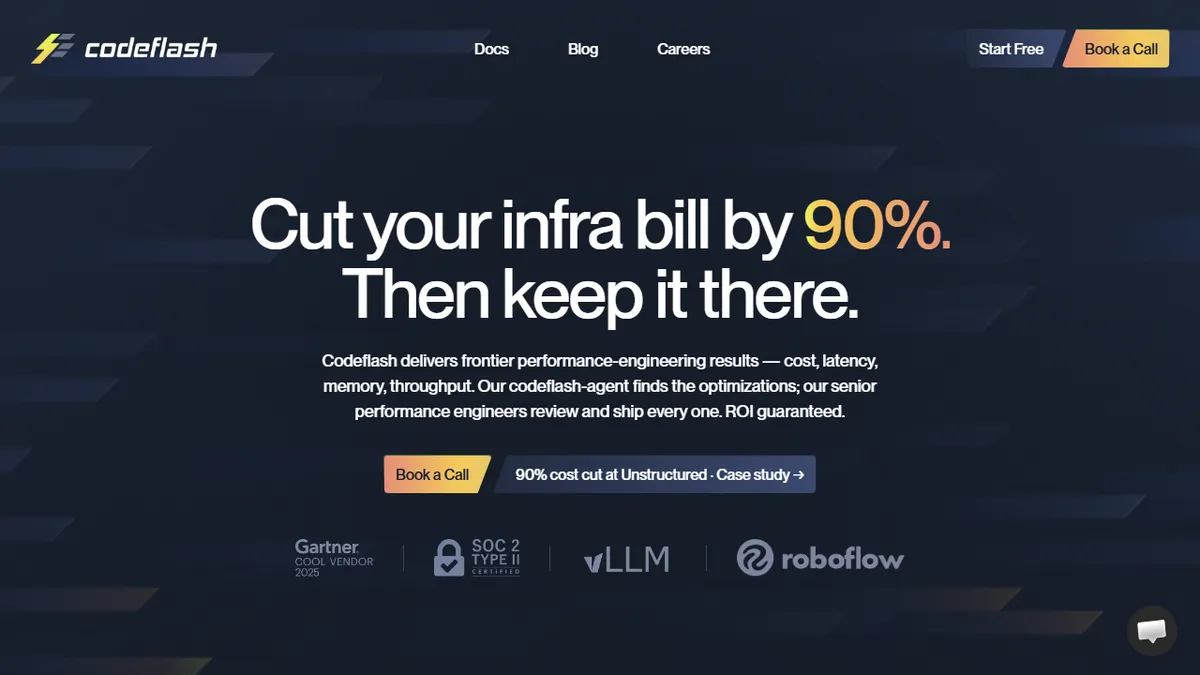
Codeflash is an AI agent that hunts for performance wins across a codebase and ships them as reviewable pull requests. Instead of doing point fixes, it analyzes entire repos, rewrites multi-step abstractions, and produces optimizations with attached benchmark data, regression tests, and a technical rationale for the change. It then keeps watching new commits to catch performance regressions before they ship.
The pitch is aimed at teams burning real money on infrastructure, especially ML shops running inference, training, or data pipelines at scale. Codeflash leans heavily on GPU and CUDA-kernel work and has visible contributions to vLLM, Hugging Face Diffusers, and Pydantic, plus a case-study claim of a 90 percent infra cut at Unstructured. It integrates with Claude Code, Cursor, and GitHub, runs customer code in a sandbox (and doesn't train on it), and is SOC 2 Type 2 certified.
Pricing is engagement-based with an ROI guarantee, alongside SaaS, cloud, and on-prem options for enterprise. There's a free entry tier to get started, but this is fundamentally a serious tool for companies whose performance problems are expensive enough to justify a dedicated optimization vendor.
This is one of the more credible performance-engineering agents we've seen, mostly because every change ships as a reviewable PR with numbers attached and named upstream contributions to back it up. The freemium tier is a try-before-you-buy, but the real product is clearly an enterprise engagement for ML shops.
— The AI Tool Bible editorial team
Pros
- ✅ PRs come with real benchmarks and auto-generated regression tests, not vibes
- ✅ Targets whole-codebase abstractions, not just micro-optimizations
- ✅ Strong GPU/CUDA and ML-framework track record (vLLM, HF, Pydantic)
- ✅ Sandboxed execution and SOC 2 Type 2; customer code isn't used for training
- ✅ Plugs into Claude Code, Cursor, and GitHub review flow
Cons
- ⚠️ Engagement-based pricing is opaque without a sales conversation
- ⚠️ Value tilts heavily toward expensive ML/infra workloads
- ⚠️ Closed-source proprietary agent
- ⚠️ Real ROI depends on having a hot enough codebase to optimize
Use cases
Frequently asked
- How does Codeflash deliver its code optimizations?
- It ships optimizations as reviewable pull requests that include attached benchmark data, regression tests, and a technical rationale for the changes.
- What types of workloads is Codeflash best suited for?
- It is designed for teams running ML inference, training, or data pipelines at scale, with a strong focus on GPU and CUDA-kernel work.
- Does Codeflash monitor code after initial optimization?
- Yes, it continues to watch new commits to catch performance regressions before they are shipped to production.
- What security and privacy measures does Codeflash implement?
- The tool runs customer code in a sandbox, does not use it for training, and is SOC 2 Type 2 certified.
- Which development tools does Codeflash integrate with?
- Codeflash integrates with Claude Code, Cursor, and GitHub to fit into existing review workflows.
Explore related
Compare with similar tools
All in Coding →Cursor
FeaturedAI-first VS Code fork — chat, edit, and agentic coding in one IDE.
GitHub Copilot
FeaturedThe original AI pair programmer, now with chat and agents.
Replit Agent
FeaturedBuild & deploy a full app from a single prompt.
Warp
The agentic development environment, from the terminal up
Cline
Open-source agentic coding assistant that plans, edits, and runs code inside your IDE
Aider
Terminal-based AI pair programmer that writes commits.