
AlpacaEval
Automatic LLM evaluator and leaderboard that benchmarks instruction-following with length-controlled win rates.
In short
AlpacaEval provides a cheap, fast proxy for human preference evaluation of fine-tuned LLMs. It uses GPT-4 as an annotator to compute length-controlled win rates, correcting for bias toward longer responses. It is best for researchers iterating on post-trained models before committing to human eval.
Pick AlpacaEval if you are iterating on a fine-tuned or post-trained LLM and want a cheap, reproducible win-rate signal before committing to human eval.
Skip it if you need safety, factuality, code, or hard-reasoning benchmarks, or if you cannot afford the OpenAI annotator API costs.
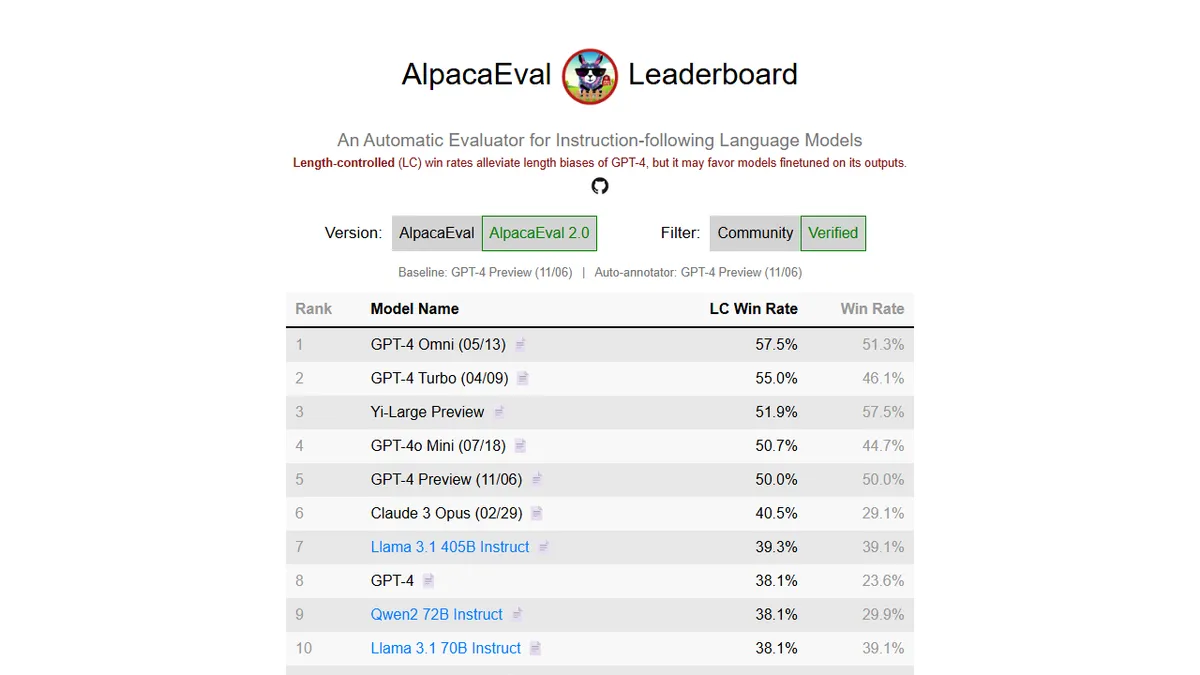
AlpacaEval is an open-source automatic evaluator for instruction-following language models, built by Stanford's Tatsu Lab as a follow-on to AlpacaFarm. It runs roughly 800 diverse instruction prompts through a candidate model, then uses GPT-4 (currently the November 2024 Preview) as an auto-annotator to compute the win rate against a fixed baseline. The headline metric is the length-controlled (LC) win rate, which corrects for the well-documented bias where GPT-4 judges tend to prefer longer responses.
It's free, fully open-source on GitHub, and aimed squarely at researchers and engineers shipping fine-tuned or post-trained LLMs who want a cheap, fast proxy for human preference before paying for human eval or running full Chatbot Arena cycles. The public leaderboard accepts community submissions, so you can also use it for sanity-checking how your model stacks up against frontier and open-weight peers. Cost in practice comes from the OpenAI API calls you pay for to run the annotator, not from AlpacaEval itself.
Integration is via the Python package (pip install alpaca-eval) and a CLI; it supports custom evaluators, custom baselines, and pluggable annotators beyond GPT-4. Caveats are real: the team itself warns it doesn't measure safety, leans on relatively simple prompts, and even with LC adjustments still inherits the quirks of an LLM-as-judge pipeline.
AlpacaEval has become a default first-pass eval for open-weight model teams for a reason: it's cheap, scriptable, and the length-controlled metric is a genuine improvement over vanilla LLM-as-judge. Just don't mistake a high LC win rate for a well-rounded model; pair it with MT-Bench, Arena-Hard, or actual humans.
— The AI Tool Bible editorial team
Pros
- ✅ Cheap, fast proxy for human preference evaluation of instruction-tuned LLMs
- ✅ Length-controlled win rate corrects a known GPT-4 judge bias
- ✅ Fully open source with an active public leaderboard
- ✅ Pluggable: bring your own annotator, baseline, or eval set
Cons
- ⚠️ Does not evaluate safety, harmlessness, or reasoning depth
- ⚠️ Inherits LLM-as-judge biases even with LC adjustment
- ⚠️ Prompt set skews toward relatively simple instructions
- ⚠️ Requires a paid OpenAI key to run the default annotator
Use cases
Frequently asked
- What is the primary metric used by AlpacaEval?
- The headline metric is the length-controlled (LC) win rate. This metric corrects for the documented bias where GPT-4 judges tend to prefer longer responses over shorter ones.
- Is AlpacaEval free to use?
- Yes, AlpacaEval is free and fully open-source. However, users must pay for the underlying OpenAI API calls required to run the GPT-4 annotator.
- Who is AlpacaEval designed for?
- It is aimed at researchers and engineers shipping fine-tuned or post-trained LLMs who need a cheap, fast proxy for human preference evaluation before running full human evals.
- Does AlpacaEval evaluate model safety or reasoning?
- No, the team warns that AlpacaEval does not measure safety, harmlessness, or reasoning depth. It focuses specifically on instruction-following capabilities.
- Can I customize the evaluation process?
- Yes, the tool supports custom evaluators, custom baselines, and pluggable annotators beyond the default GPT-4 model. It is available via a Python package and CLI.
Explore related
Compare with similar tools
All in Evaluation →Braintrust
FeaturedEval, monitor, and improve AI products end-to-end.
LangSmith
LangChain's eval + observability platform.
Weights & Biases
The ML experiment tracker, now with LLM eval features.
Helicone
Open-source LLM observability — one-line proxy install.
Arize AI
Enterprise observability and evaluation platform for LLM agents and generative AI applications.
Giskard
Continuous AI red teaming platform that stress-tests LLM agents for vulnerabilities before they hit production.