
aiPDF
Chat-with-your-documents app that ingests PDFs, EPUBs, web pages and YouTube videos with cited answers.
In short
aiPDF allows users to upload documents, books, or video links to ask questions and get summaries with source citations. It is best for individuals seeking a simple, free-to-start interface for document analysis without developer setup.
Pick aiPDF if you want a friendly, free-to-start chat-with-documents app that also handles EPUBs and YouTube videos, not just PDFs.
Skip it if you need an API, on-prem deployment, transparent model choice, or enterprise-grade document governance.
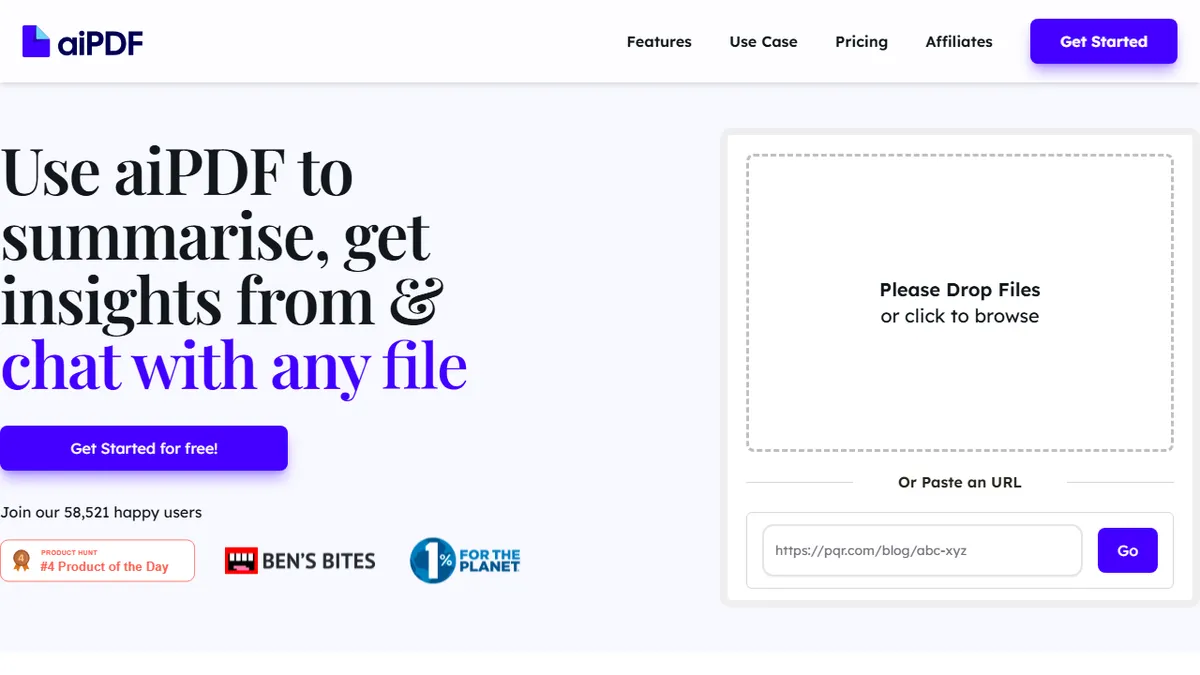
aiPDF is a document-chat web app that lets you upload PDFs, EPUB books, paste website URLs, or drop in YouTube links and then ask questions, request summaries, and pull structured insights with citations back to the source. It positions itself as a friendlier alternative to the wave of ChatPDF clones, with preprocessing for faster turnaround and a Q&A pipeline the team benchmarks against Google and Stanford evaluation sets.
The target user is a student, researcher, or knowledge worker who wants a low-friction reader-plus-chat interface rather than a developer building RAG into their own product. Pricing follows the standard freemium ladder (free tier plus Playful, Dynamic and Flagship paid plans) with file size and storage retention scaling by tier. There is no public API, no self-hosting, and the underlying model is not disclosed, so it's strictly an end-user tool.
Multi-language support and response export are the more useful extras over the basic ChatPDF feature set, but the user base is small and the product is clearly an indie effort rather than an enterprise platform.
aiPDF is a competent entry in the crowded chat-with-PDF space, with the nice twist of accepting EPUBs and YouTube links alongside documents. It's an end-user app, not a platform, and the lack of a disclosed model or API ceilings how seriously a team can adopt it, but the free tier makes it a reasonable everyday reader.
— The AI Tool Bible editorial team
Pros
- ✅ Handles PDFs, EPUBs, web URLs and YouTube transcripts in one chat UI
- ✅ Cites sources in answers rather than hallucinating freely
- ✅ Free tier is genuinely usable, not just a teaser
- ✅ Multi-language Q&A and exportable responses
Cons
- ⚠️ Underlying model is undisclosed
- ⚠️ No public API or developer hooks
- ⚠️ Small user base suggests limited long-term roadmap
- ⚠️ File size and retention caps on lower tiers
Use cases
Frequently asked
- What types of files can I upload to aiPDF?
- You can upload PDFs and EPUB books, paste website URLs, or drop in YouTube links to generate chat-based answers and summaries.
- Does aiPDF offer a free plan?
- Yes, aiPDF uses a freemium model with a free tier that is described as genuinely usable, alongside paid plans starting at $9 per month.
- Is there an API available for developers?
- No, aiPDF does not have a public API or developer hooks, making it strictly an end-user tool rather than a platform for integration.
- How does aiPDF handle source attribution?
- The tool provides cited answers that reference the source material, aiming to reduce hallucinations by grounding responses in the uploaded content.
- Can I self-host aiPDF or choose the underlying model?
- No, the product does not support self-hosting, and the underlying model is not disclosed to users.
Explore related
Compare with similar tools
All in RAG →Pinecone
FeaturedManaged vector database for production-scale similarity search.
LlamaIndex
FeaturedData framework for connecting LLMs to your data.
Elasticsearch Vector Search
Hybrid vector + keyword search in the enterprise-grade Elasticsearch engine
Snowflake Cortex
Generative AI and RAG built into the Snowflake data cloud
DataStax Astra DB
Serverless vector and document database for production RAG and AI agents
MongoDB Atlas Vector Search
Vector search built into the operational database you're already using.