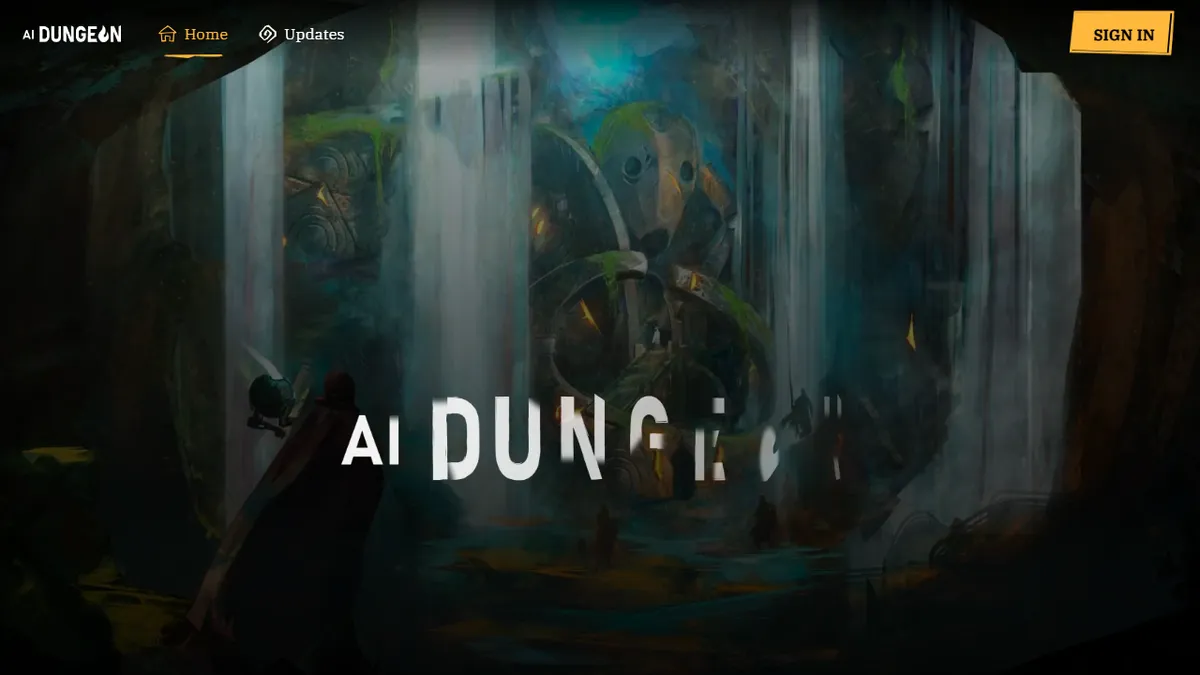
AI Dungeon
AI-powered text adventure platform where the story is generated turn-by-turn by an LLM.
In short
AI Dungeon is a purpose-built sandbox for AI-driven interactive fiction and roleplay. It uses a rotating stable of open-weights LLMs to generate turn-by-turn stories based on user actions. It is best for users seeking a frictionless entry into LLM-driven narrative games rather than serious productivity tools.
Pick AI Dungeon if you want a polished, purpose-built sandbox for AI-driven interactive fiction and roleplay rather than wrestling ChatGPT into staying in character.
Skip it if you need a serious authoring tool, API access, or frontier-grade reasoning — a direct Claude or GPT subscription will outwrite it.
AI Dungeon is the pioneering AI text-adventure game from Latitude, originally built on GPT-2 in 2019 and now running on a rotating stable of large language models. Players type freeform actions, dialogue, or narration in Do/Say/Story modes, and the model continues the scene, remembers world details via a 'Memory' and 'Story Cards' system, and lets you spin off scenarios, characters, and full multiplayer adventures.
It sits closer to a creative-writing toy than a serious productivity tool, but it's the canonical example of LLM-driven interactive fiction and remains a useful sandbox for prompt-engineering experiments around persona, world-state, and long-context coherence. Pricing is freemium: a limited free tier with a weaker model and short context, then paid tiers (historically branded Adventurer, Champion, Mythic / Legend) in the roughly $10-$30/month range that unlock larger models, longer context windows, image generation, and faster turns.
The platform has cycled through controversies (filter changes, privacy incidents around stored adventures) and the 'best' underlying model varies as Latitude swaps in Mixtral, Llama, Hermes, and other open-weights backends. There is a community 'Scenarios' marketplace, image generation for scene art, and Discord-style multiplayer. No public API to speak of — this is an end-user product, not infrastructure.
AI Dungeon is more historically important than technically impressive in 2026 — frontier chat models will out-write its backend on a good day. But the Memory/Story Cards UX and scenario ecosystem still make it the most frictionless on-ramp to LLM-driven interactive fiction, and the free tier is genuinely worth a session.
— The AI Tool Bible editorial team
Pros
- ✅ Genre-defining AI text adventure with a mature Do/Say/Story interaction model
- ✅ Memory and Story Cards give surprisingly coherent long-running narratives
- ✅ Generous free tier to test the experience before paying
- ✅ Active scenario marketplace and multiplayer adventures
Cons
- ⚠️ Underlying model quality varies and trails frontier chat models
- ⚠️ History of content-filter and privacy controversies
- ⚠️ Not really useful as a serious writing or productivity tool
- ⚠️ No public API; closed end-user product only
Use cases
Frequently asked
- How does AI Dungeon generate story content?
- The platform uses a rotating stable of large language models, including Mixtral, Llama, and Hermes variants. Players type actions or dialogue in Do/Say/Story modes, and the model continues the scene while remembering details via Memory and Story Cards.
- What are the pricing options for AI Dungeon?
- AI Dungeon operates on a freemium model with a limited free tier. Paid tiers are available at $10, $20, and $50, unlocking larger models, longer context windows, image generation, and faster turns.
- Is AI Dungeon suitable for professional writing or API integration?
- No, it is not designed as a serious authoring tool or infrastructure. It is a closed end-user product with no public API, and frontier chat models generally outperform its backend for serious writing tasks.
- What features distinguish AI Dungeon from standard chatbots?
- It offers a mature Do/Say/Story interaction model, a Memory and Story Cards system for narrative coherence, a community scenario marketplace, and multiplayer adventures. These features make it a specialized sandbox for interactive fiction rather than a general-purpose chat tool.
Explore related
Compare with similar tools
All in Writing →Claude
FeaturedAnthropic's flagship assistant for long-form writing, analysis, and coding.
GPT-4o
FeaturedOpenAI's multimodal flagship behind ChatGPT.
Gemini Advanced
Google's flagship — strong at math, long context, and Workspace integration.
Llama 3
Meta's open-weights LLM family that put serious frontier-adjacent models in everyone's hands.
Qwen
Alibaba's open-weight foundation model family covering chat, vision, image generation, translation, and safety classification.
Jan
Open-source desktop ChatGPT alternative that runs local LLMs and routes to cloud providers from one app.